Language › Part 2 › Unit 2 › Lesson 3
Unit 2 · Lesson 3 / 8
Prepositions of place — staðarforsetningar
Describe where objects are with nine core location phrases and notice which case each phrase requires.
Markmið What you will learn
- Recognise nine core location expressions
- Answer Hvar er…? in a complete sentence
- Use the dative for static location with á/í and learn the form required by each longer phrase
Sjáðu og segðu Learn from the visual
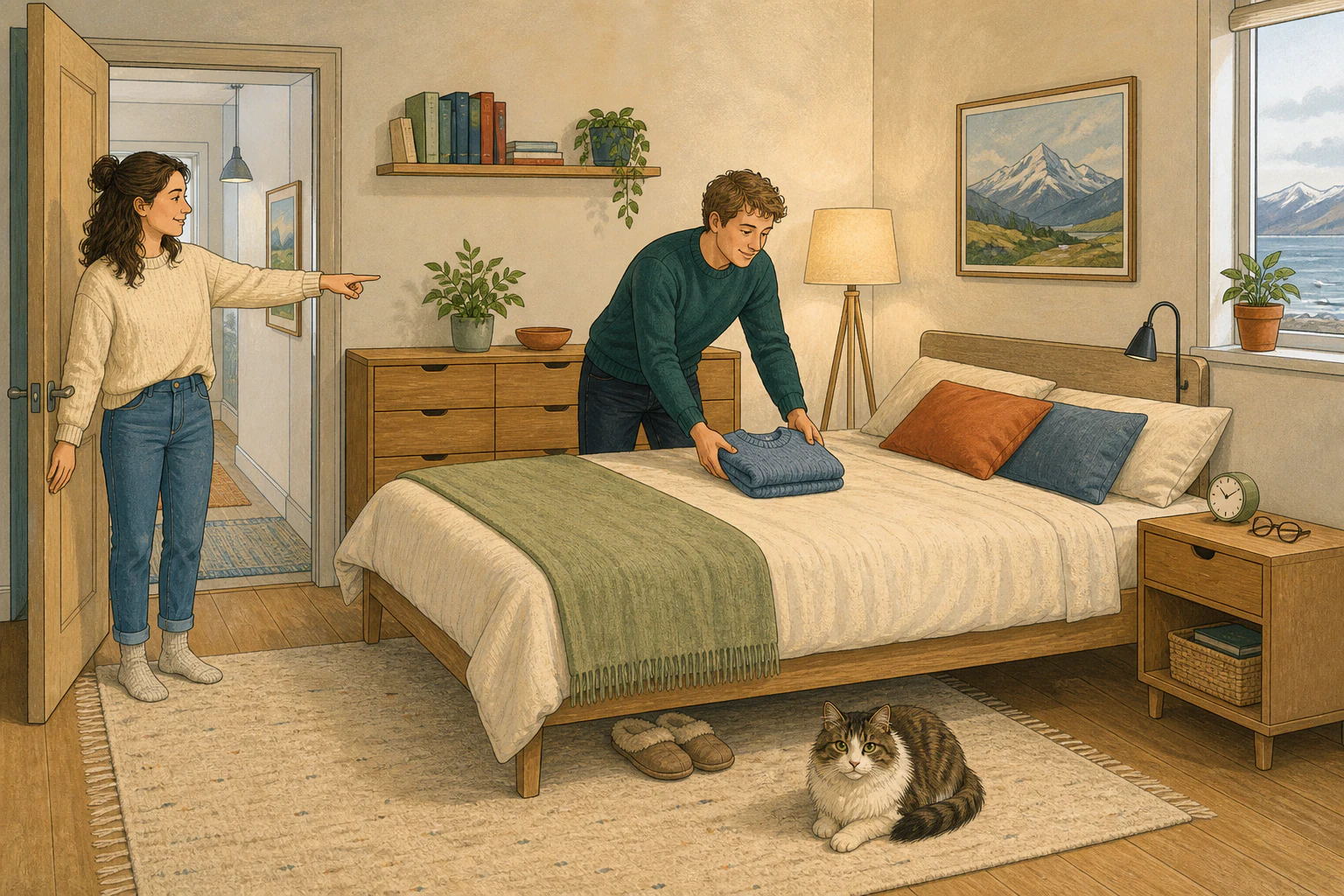
What is where in the bedroom?
Describe every object in relation to another object in the scene.
Málfræði Grammar and usage
| Phrase | Example | Pattern |
|---|---|---|
| á / í / undir / yfir | á borðinu, í skápnum, undir rúminu, yfir sófanum | Dative for static location |
| fyrir framan / fyrir aftan | fyrir framan gluggann | Accusative |
| við hliðina á | við hliðina á lampanum | á + dative |
| á milli | á milli borðsins og stólsins | Genitive |
| á móti | á móti glugganum | Dative |
Learn the phrase and its noun form as one chunk: not only á milli, but á milli borðsins og stólsins.
Orð og setningar Words and sentences
- áon
- íin
- undirunder
- yfirabove
- fyrir framanin front of
- fyrir aftanbehind
- við hliðina ánext to
- á millibetween
- á mótiopposite
- hægra megin viðto the right of
- vinstra megin viðto the left of
Samtal Dialogue — Looking for the keys
- Hvar eru lyklarnir?Where are the keys?
- Þeir eru á borðinu.They are on the table.
- Ég sé þá ekki.I cannot see them.
- Þeir eru við hliðina á lampanum.They are next to the lamp.
- Er síminn líka þar?Is the phone there too?
- Nei, hann er undir sófanum.No, it is under the sofa.
Culture and usage
Practising location phrases with real objects at home is highly effective. Choose three objects each day and answer Hvar er…?; complete chunks become more memorable than isolated case endings.
Everyday use · A2
Understand the pattern and build your sentence
What am I learning?
Describe an object's position relative to another object. Find relationships such as in front, behind, under and beside in the scene.
Why this structure?
A preposition expresses a relationship and may affect the following noun's form. Learn chunks such as á borðinu or undir sófanum together.
When do I use it?
Use this when looking for keys, a phone or a book. Identify the missing object, then use another item as a location reference.
How do I build it?
Build object + er/eru + location. Keys are plural, so use þeir eru; a phone is masculine singular, so use hann er.
Which difference matters?
Á can describe being on a surface; yfir can describe being above it. Beside and opposite are different positions too; select the one shown in the scene.
Which mistake do I avoid?
Think about whether changing a preposition changes the object's location. Do not copy one ending after every preposition; check the complete new phrase.
Three recorded examples
Reference resources: BÍN · Árnastofnun · Icelandic Online
Everyday use · A2
Recorded role practice
Listen and follow first. Then choose a role: your replies close, so you can answer aloud after listening to the other speaker. Reveal your reply to compare when needed.
The whole conversation is visible. Listen and follow the turns.
Say your reply; reveal the model
Say your reply; reveal the model
Say your reply; reveal the model
Say your reply; reveal the model
Say your reply; reveal the model
Say your reply; reveal the model
Everyday use · A2
Apply it without looking
Your partner looks for lost keys. Locate them using two references such as a table and lamp, then say whether the phone is in the same place.
Reveal a starting model
AThis personal checklist does not change your score or course completion. Additional practice:
Lokapróf — Lesson check
Exercise 1What does Mottan er undir rúminu mean?
Exercise 2Which phrase takes the genitive?
Exercise 3Write “The phone is under the sofa” in Icelandic.
Exercise 4Write “Where are the keys?” in Icelandic.
Exercise 5Match each location with its meaning.
This lesson is part of Learning Icelandic 2. Completion is stored in this browser.