Language › Part 2 › Unit 2 › Lesson 2
Unit 2 · Lesson 2 / 8
Furniture and household items — húsgögn og húsmunir
Name the main pieces of furniture in a room and choose er or eru for singular and plural items.
Markmið What you will learn
- Recognise twelve common furniture and household words
- Use Í stofunni er… for one item
- Use Í stofunni eru… for more than one item
Sjáðu og segðu Learn from the visual
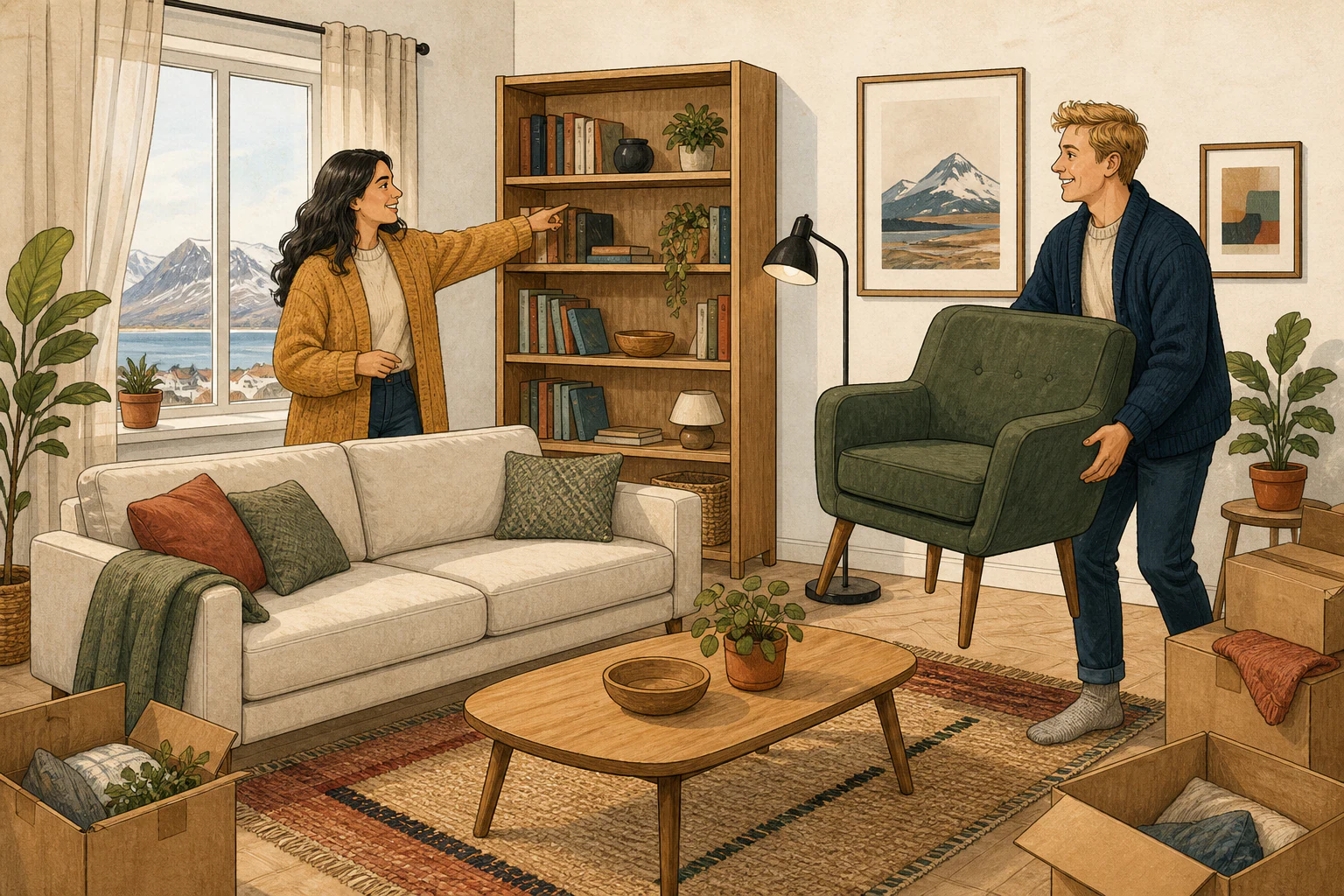
Find the objects in the living room
The moving boxes are open; Elif tells Ari where each object should go.
Málfræði Grammar and usage
Use er when one thing is in a place and eru when there is more than one:
| Í stofunni er sófi. | There is a sofa in the living room. |
| Í stofunni eru sófi, borð og tveir stólar. | There are a sofa, a table and two chairs in the living room. |
After a number the noun is plural: einn stóll, tveir stólar. A neuter noun such as borð can look the same in singular and plural: eitt borð, tvö borð.
Orð og setningar Words and sentences
- sófisofa
- borðtable
- stóllchair
- rúmbed
- skápurcupboard
- hillashelf
- kommóðachest of drawers
- náttborðbedside table
- lampilamp
- mottarug
- ísskápurrefrigerator
- eldavélcooker
Samtal Dialogue — Opening the boxes
- Hvar á sófinn að vera?Where should the sofa go?
- Hann á að vera við vegginn.It should be by the wall.
- Og hvar setjum við borðið?And where do we put the table?
- Setjum það fyrir framan gluggann.Let's put it in front of the window.
- Mig vantar enn lampa.I still need a lamp.
- Við kaupum lampa á morgun.We will buy a lamp tomorrow.
Culture and usage
In Icelandic compounds, the final element usually carries the main meaning: nátt|borð is a type of table, and íss|kápur is a type of cupboard. Start from the end when unpacking a long word.
Everyday use · A2
Understand the pattern and build your sentence
What am I learning?
Combine an item's name with where it stands. Choose a sofa, table or chair, then indicate its position in the room.
Why this structure?
Nouns are masculine, feminine or neuter; this helps with pronouns and numbers. Learn the word inside an example sentence.
When do I use it?
Use this when moving or planning furniture positions. Taking turns to ask and choose places is a conversation task, not just a vocabulary list.
How do I build it?
Item + er + place gives a location. Multiple items take eru; in tveir stólar, the number agrees with masculine plural stólar.
Which difference matters?
Hvar er…? asks about the current location; hvar á…að vera? asks about an intended position. Answering one does not automatically answer the other.
Which mistake do I avoid?
Choose er for one sofa and eru for two chairs. Keep the verb when a place starts the sentence: í stofunni → er → sófi.
Three recorded examples
Reference resources: BÍN · Árnastofnun · Icelandic Online
Everyday use · A2
Recorded role practice
Listen and follow first. Then choose a role: your replies close, so you can answer aloud after listening to the other speaker. Reveal your reply to compare when needed.
The whole conversation is visible. Listen and follow the turns.
Say your reply; reveal the model
Say your reply; reveal the model
Say your reply; reveal the model
Say your reply; reveal the model
Say your reply; reveal the model
Say your reply; reveal the model
Everyday use · A2
Apply it without looking
Have a moving-in conversation: your partner asks where to put the sofa and table. Give two positions, then name one missing item.
Reveal a starting model
AThis personal checklist does not change your score or course completion. Additional practice:
Lokapróf — Lesson check
Exercise 1What does hilla mean?
Exercise 2Choose the right verb for several objects: Í stofunni ___ sófi og tveir stólar.
Exercise 3Write “There is a sofa in the living room” in Icelandic.
Exercise 4Write “two chairs” in Icelandic.
Exercise 5Match the objects with their rooms.
This lesson is part of Learning Icelandic 2. Completion is stored in this browser.