Language › Part 2 › Unit 2 › Lesson 1
Unit 2 · Lesson 1 / 8
Rooms in the home — herbergin í íbúðinni
Name the rooms in a home, ask how many rooms there are, and describe their positions from the entrance.
Markmið What you will learn
- Recognise nine common room and area names
- Ask the number of rooms with Hvað eru mörg herbergi?
- Build location sentences such as Eldhúsið er við hliðina á stofunni
Sjáðu og segðu Learn from the visual
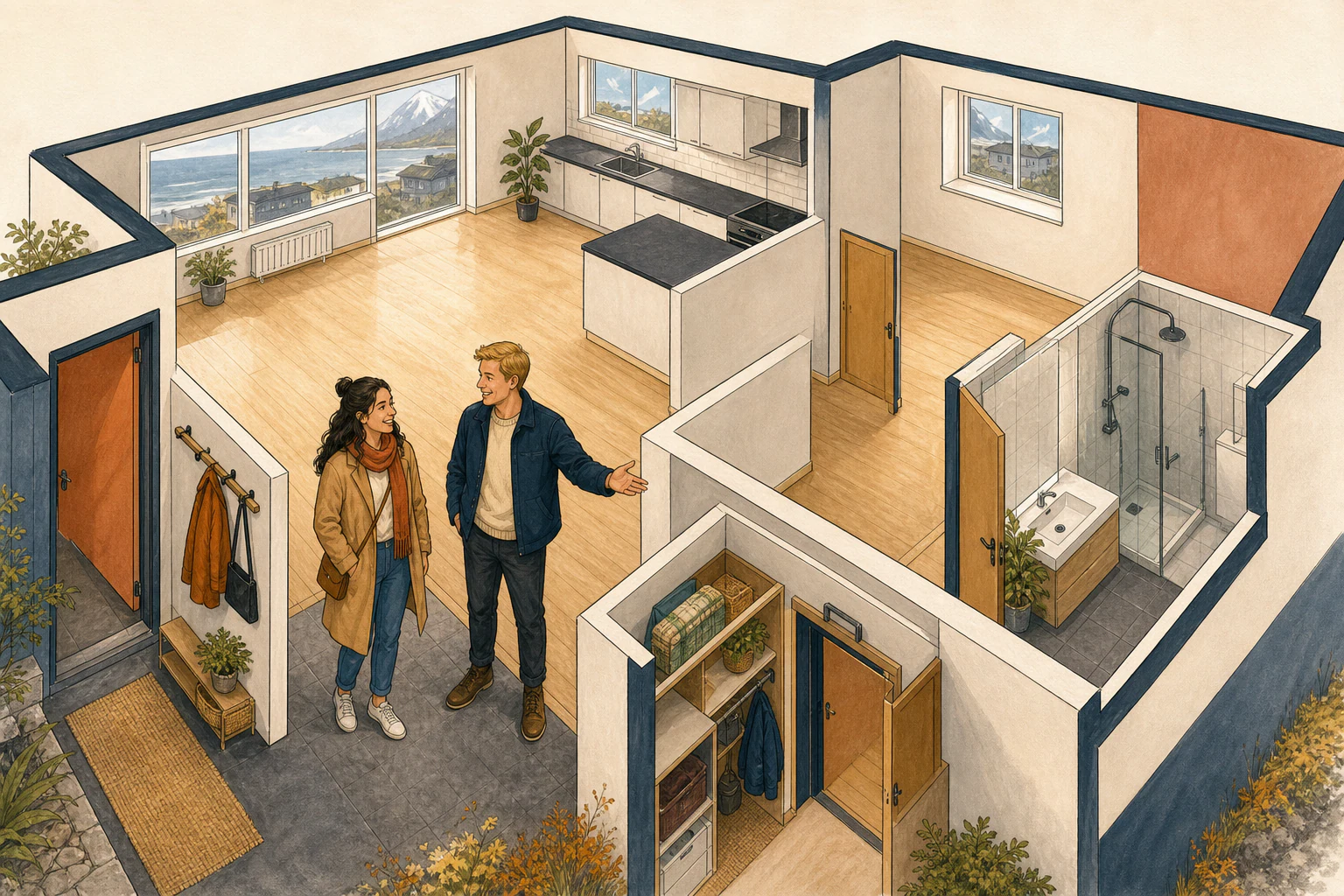
Read the plan of a new apartment
Elif and Ari are viewing an empty apartment. Start at the door and name every room in Icelandic.
Málfræði Grammar and usage
Two question patterns are enough: Hvað er þetta? asks what a place is; Hvar er …? asks where it is.
| Question | Answer | Meaning |
|---|---|---|
| Hvað er þetta? | Þetta er eldhús. | What is this? — This is a kitchen. |
| Hvar er eldhúsið? | Það er við hliðina á stofunni. | Where is the kitchen? — Next to the living room. |
| Hvað eru mörg herbergi? | Það eru þrjú herbergi. | How many rooms are there? — Three. |
When something is inside a room, í is normally followed by the dative: í stofu → í stofunni, í eldhúsi → í eldhúsinu. Learn these as complete chunks for now.
Orð og setningar Words and sentences
- forstofaentrance hall
- stofaliving room
- eldhúskitchen
- svefnherbergibedroom
- baðherbergibathroom
- vinnuherbergistudy
- gangurcorridor
- geymslastorage room
- þvottahúslaundry room
- svalirbalcony
Samtal Dialogue — First look around the apartment
- Hvernig er íbúðin?What is the apartment like?
- Hún er lítil en mjög björt.It is small but very bright.
- Hvað eru mörg herbergi?How many rooms are there?
- Það eru þrjú herbergi.There are three rooms.
- Hvar er eldhúsið?Where is the kitchen?
- Það er við hliðina á stofunni.It is next to the living room.
Culture and usage
In Icelandic listings, herbergi may count more than bedrooms alone; the living room can be included in the room count. Check the named rooms and the floor plan together.
Everyday use · A2
Understand the pattern and build your sentence
What am I learning?
Describe room names, numbers and positions relative to one another. Introduce a flat as a short tour rather than one long sentence.
Why this structure?
A room name and its location give different information. Herbergi means a room; herbergið points to a particular room, and a location phrase explains where it is.
When do I use it?
Use this to guide a visitor or describe an imaginary flat. There is no need to share a real address or private home details.
How do I build it?
Ask Hvar er + room? Answer with the room name or a suitable pronoun + er + location; use það eru + number + herbergi for a room count.
Which difference matters?
Hvernig er íbúðin? asks what the flat is like. Hvar er eldhúsið? asks where the kitchen is; saying bright does not answer the location question.
Which mistake do I avoid?
Do not use the same pronoun for every room: eldhús is neuter and takes það. Learn location endings together with the recorded phrase.
Three recorded examples
Reference resources: BÍN · Árnastofnun · Icelandic Online
Everyday use · A2
Recorded role practice
Listen and follow first. Then choose a role: your replies close, so you can answer aloud after listening to the other speaker. Reveal your reply to compare when needed.
The whole conversation is visible. Listen and follow the turns.
Say your reply; reveal the model
Say your reply; reveal the model
Say your reply; reveal the model
Say your reply; reveal the model
Say your reply; reveal the model
Say your reply; reveal the model
Everyday use · A2
Apply it without looking
Give a tour of an imaginary flat from the entrance: state the room count and two room locations. Your partner asks where the kitchen is.
Reveal a starting model
AThis personal checklist does not change your score or course completion. Additional practice:
Lokapróf — Lesson check
Exercise 1Which room is eldhús?
Exercise 2Which sentence means “The bedroom is opposite the bathroom”?
Exercise 3Write “This is a living room” in Icelandic.
Exercise 4Write “Where is the kitchen?” in Icelandic.
Exercise 5Match the rooms with their meanings.
This lesson is part of Learning Icelandic 2. Completion is stored in this browser.