Where?
An island in the North Atlantic, between Greenland and northern Europe, with no land borders.

İzlandapedia / Start planning
Last updated:
Start with the essentials: Iceland is an independent island country, Reykjavík is its capital, Icelandic is its language and the króna is its currency. Then follow the guide that matches a visit, job search or move.
An island in the North Atlantic, between Greenland and northern Europe, with no land borders.
Reykjavík; an independent republic. Iceland is not part of Denmark or Greenland.
Icelandic and the Icelandic króna (ISK). Understand payments and exchange →
UTC+0 / GMT all year. Do not assume your flight’s local departure and arrival clocks use the same zone.
Source: Nordic Council of Ministers — country, government and language · Checked 5 November 2026
Source: Visit Iceland — practical information · Checked 5 November 2026
In the check dated 5 November 2026, Iceland was three hours behind Turkey: 12:00 in Iceland was 15:00 in Turkey. Iceland uses UTC+0 throughout the year.
Iceland is in the North Atlantic and is generally grouped with Europe. On a map, look east of Greenland, northwest of the United Kingdom and west of Norway. Reykjavík is in the southwest of the island; the name of the capital and the name of the country are not interchangeable.
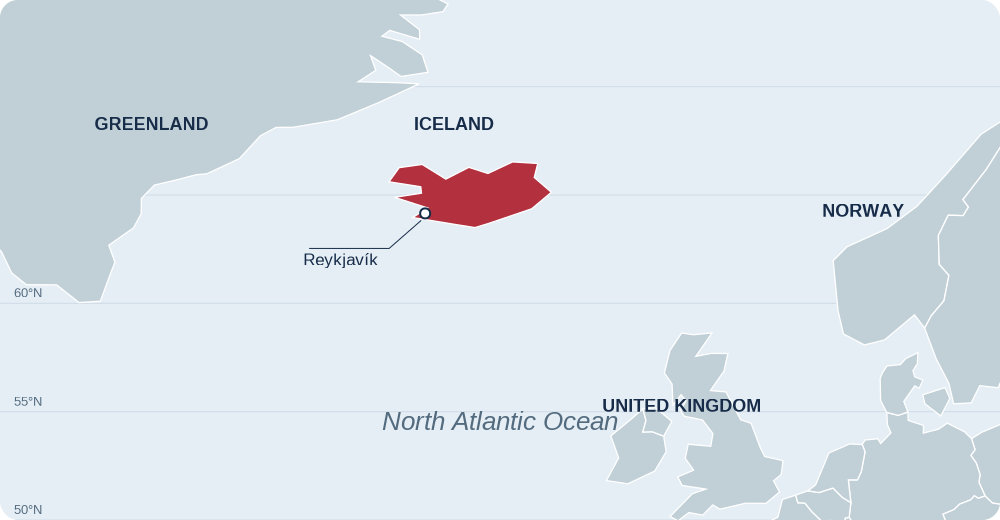
The familiar description “between two continents” refers to the North American and Eurasian tectonic plates. It does not mean different halves of the island have different entry rules. Geography, EU membership and Schengen participation answer different questions.
Source: Visit Iceland — geography · Checked 5 November 2026
Iceland is independent and is not a member of the European Union. The present republic was established on 17 June 1944. Iceland participates in the European Economic Area and in Schengen; neither of those makes it an EU member.
For a visitor, the practical point is that “not in the EU” does not mean “outside Schengen”. For someone considering a move, visa-free tourism is not unrestricted permission to work. Follow the entry and residence guide for the passport and purpose that apply to you.
Source: Nordic Council of Ministers — political structure and EEA · Checked 5 November 2026
Source: US Office of the Historian — 17 June 1944 · Checked 5 November 2026
Population at the end of the second quarter of 2026.
Statistics Iceland · Release published 31 July 2026.
The same release records 253,230 people in the Capital region and 143,270 in other regions. The Capital region is larger than the municipality of Reykjavík; do not use its total as the city’s population. Foreign citizens number 71,130, or 17.9% of the population.
This is the official quarter-end release verified for this guide, not a real-time estimate or a claim to be the latest available release. Annual averages, year-start counts and quarter-end figures measure different points or periods. When comparing two numbers, match the date and definition first.
Source: Statistics Iceland — population in Q2 2026 · Checked 5 November 2026
The country’s Icelandic name is Ísland; the language is íslenska. Recognising place names helps with travel planning. For a move or a job search, check the language actually required by the employer rather than assuming a tourist conversation is enough for every role. Explore the Icelandic learning programme →
The national currency is the Icelandic króna (ISK). An advertised conversion into euros or dollars is not a promise that the shop accepts that currency. Compare exchange rates and your card issuer’s charges in the currency and payments guide. Use the living-cost guide for monthly costs, rather than treating a holiday budget as a relocation budget.
Your home country may change its clocks while Iceland does not. Check the date of travel, especially around daylight-saving changes. Flight tickets show local times: subtracting the two clock readings may not give the elapsed journey time.
Source: Visit Iceland — language, money and year-round GMT · Checked 5 November 2026
Compare 1–10-day itineraries and monthly travel conditions. Leave room to change the plan for roads and weather.
Plan flights, connections and the KEF transfer together. Check entry requirements before making non-refundable bookings.
Start with finding work and the gross-to-net calculator. The applicable collective agreement determines the pay floor for your job.
The first-30-days guide brings together registration, housing and practical setup. Work and residence permissions come before assuming you can start a job.
Iceland is an island country in the North Atlantic, east of Greenland and northwest of the United Kingdom. It is generally grouped with Europe. Its location on two tectonic plates is a geological fact, not a rule about visas or political membership.
Iceland is an independent republic, not a territory of Denmark. The present republic was established on 17 June 1944.
Iceland is not an EU member. It participates in the European Economic Area and the Schengen area. These are different arrangements, with different consequences for visitors and people moving to Iceland.
The Statistics Iceland release checked here reports 396,500 at the end of the second quarter of 2026. Published on 31 July 2026, it is a dated quarter-end figure, not a live count.
The capital is Reykjavík, the official language is Icelandic and the currency is the Icelandic króna (ISK). Iceland does not use the euro as its national currency.
Iceland uses UTC+0 / GMT throughout the year and does not change clocks for daylight saving. The difference from your home may change when your home country moves its clocks.