
Iceland · Language and migration
Are Iceland's Icelandic courses good enough? Official reports: old curriculum, no tests, no teacher requirements
Iceland expects immigrants to learn Icelandic. Yet official reviews since 2015 have pointed to the same problems: a curriculum from 2008, almost no end-of-course testing, no qualification requirement for teachers and outdated materials. The government's new plan aims to fix some of this by 2029.
Based on: official reports and parliamentary documents, 2015–2026
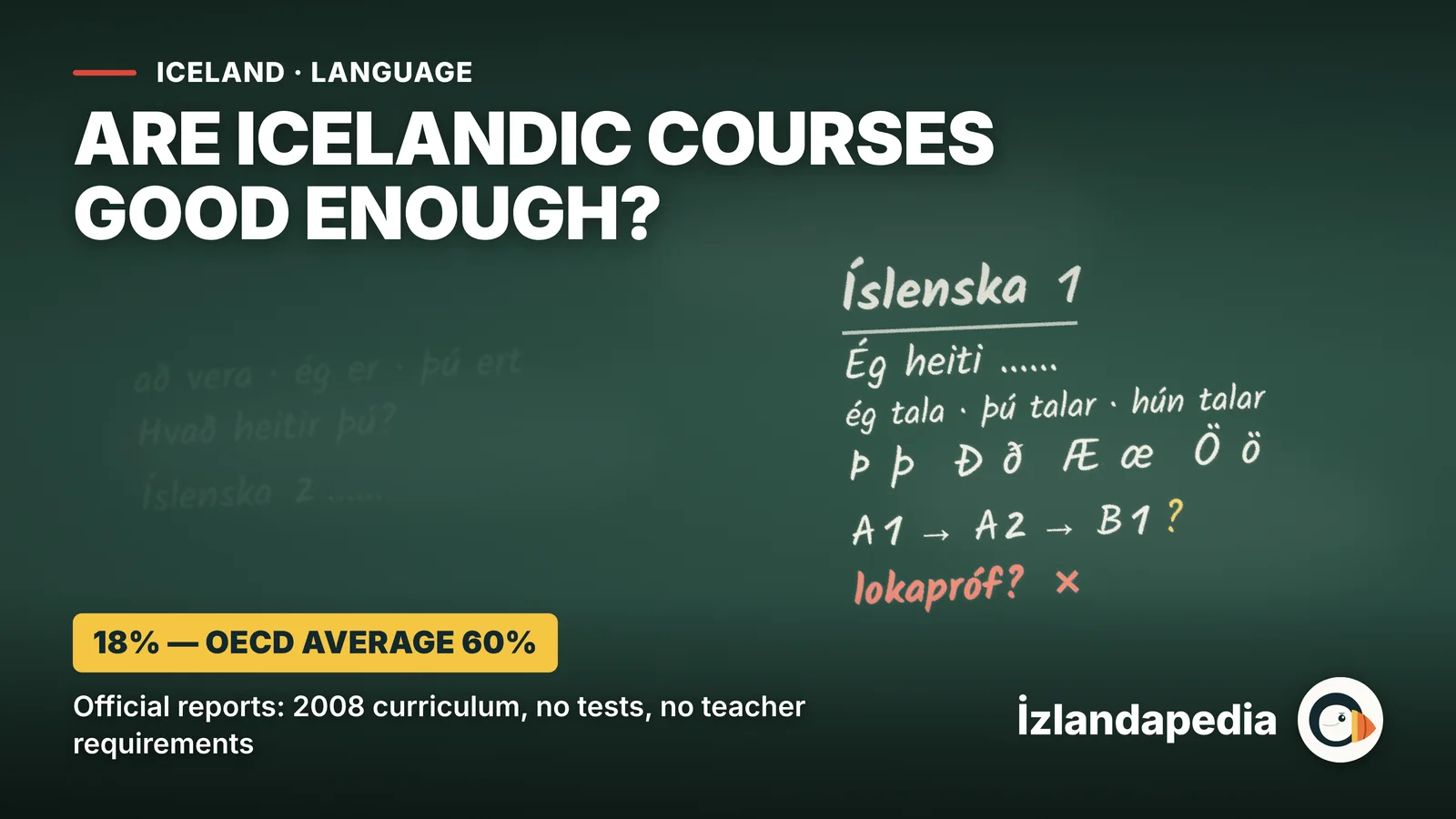
Only 18% of immigrants in Iceland say their Icelandic is good enough. The OECD average is 60%. In the other Nordic countries the share is 45% in Finland, 50% in Denmark, 58% in Norway and 60% in Sweden. The government quotes these figures in its new immigration action plan. [8][9]
Last week former Reykjavík mayor Jón Gnarr said learning Icelandic should not be “deadly boring and extremely expensive” (details). [13] But do the courses themselves work? The state's own reviews give no clear yes.
What the state's own review found
In 2023 the Ministry of Social Affairs commissioned the University of Iceland's Social Science Research Institute to review adult Icelandic teaching. The researchers held 17 interviews with 50 people at course providers and ran two focus groups with 14 former students. [1]
Their findings:
- An outdated curriculum: Most providers follow the 2008 curriculum “Íslenska fyrir útlendinga – grunnnám”, which interviewees called outdated. [1]
- CEFR on paper: Courses are labelled Icelandic 1, 2 and 3 rather than A1 or A2. Providers want a shared definition of what each level should cover. [1] Yet state grants already require courses to be linked to CEFR levels. [10]
- No tests: End-of-course testing is rare. The teacher decides whether a student moves up, and many students repeat Icelandic 1. [1]
- Fixed hours: The curriculum sets fixed lesson hours per level, which providers and learners say does not fit people's different starting points. [1]
The report recommends updating the curriculum and materials, a shared quality framework and clearer requirements for providers. [1][2]
Materials: old books and home-made worksheets
The two most used books are “Íslenska fyrir alla” and “Íslenska á allra vörum”. The 2023 review found both were seen as dull and unsuitable for learners who cannot read Latin script. The Tungumálatorg teachers' website is outdated. Many providers make their own worksheets and games and want state support. [1]
This is not new. A 2015 ministry review already said “Íslenska fyrir alla” was too long to finish and that online resources were needed. [5]
Teachers: no requirements, no permanent jobs
There are no formal requirements for teachers of Icelandic to adults. Teachers are paid per course and almost none work full time. In Denmark and Norway a teaching qualification is required by law. [3]
The government's November 2024 progress report says the same: the 2010 adult education act requires neither a teaching licence nor training in Icelandic as a second language. Denmark, Norway and Sweden require 30 ECTS in the national language as a second language. [6]
The 2023 review found that most teachers are contractors and qualified teachers are scarce, especially outside the capital. Grants cover teaching only, not teacher training. Providers said there is no university-level programme in teaching Icelandic to adults. [1]
Are the methods evidence-based?
We found no binding national standard for teaching methods. Methods vary by provider; the 2023 review lists games, singing, cooking together and museum visits. Some courses focus on grammar, others on speaking, and learners want the choice. [1]
Researchers at the University of Akureyri found no clear link between the number of courses people had taken and their self-reported Icelandic. They point to course structure, weak government oversight and teachers' lack of pedagogical training. [4]
The government's new plan acknowledges the gap. It says the state still needs to define what individualised adult learning means and what teaching knowledge different groups require. [8]
What happened to the promises?
In May 2024 the Althing adopted the 2024–2026 action plan on the Icelandic language. It included better teaching quality, putting the CEFR into practice and professional development for teachers. The November 2024 progress report planned clearer teacher requirements and CEFR alignment of the 2008 and 2011 curricula for 2025–2026. [6] We found no announcement that the 2008 curriculum has been replaced.
In January 2024 the Ministry of Education signed an agreement with the University of Iceland on an electronic CEFR placement test. [7] The 2026–2029 immigration action plan still lists such tests as something to be introduced; the CEFR action was carried over from the 2022–2025 plan. [8]
The new plan's Icelandic measures: [8]
- ISK 180 million a year for varied Icelandic teaching where cost is not a barrier, CEFR tests and digital materials;
- a learner survey of teaching quality in 2027, costing ISK 16 million;
- courses for shift workers and parents without childcare, and open digital tools (ISK 75 million a year).
The new plan has no separate measure on teacher qualifications; the closest item is defining the teaching knowledge needed. [8]
In the last parliamentary session, Progressive Party (Framsókn) MP Halla Hrund Logadóttir and colleagues proposed tax incentives for pensioners who practise Icelandic conversation with immigrants. Their proposal says current approaches have not delivered acceptable results. [12]
What comes next
What to ask before you sign up
- Level: Which CEFR level (A1, A2, B1) does the course match?
- Assessment: Is there an end-of-course assessment or certificate?
- Teacher: Is the teacher trained in Icelandic or language teaching?
- Focus: Does the course focus on grammar or speaking?
- Free help: The University of Iceland's Icelandic Online, the Árni Magnússon Institute's m.is dictionary portal [6] and İzlandapedia's Icelandic section are free.
Sources
- Félagsvísindastofnun Háskóla Íslands (2023) — Úttekt á gæðamálum íslenskukennslu fyrir fullorðið fólk með annað móðurmál en íslensku
- Stjórnarráðið · 13.11.2023 — Rannsóknir og úttektir vegna stefnumótunar um framhaldsfræðslu
- Hoffmann, Höller & Meckl — Milli mála 15/2023, s. 111
- Hoffmann, Höller & Meckl — Milli mála 15/2023, s. 131
- Capacent fyrir mennta- og menningarmálaráðuneytið (2015) — Úttekt á íslenskukennslu fyrir útlendinga
- Menningar- og viðskiptaráðuneytið (nóv. 2024) — Mál með vexti: aðgerðir og verkefni í þágu íslenskrar tungu
- Stjórnarráðið · 19.1.2024 — Þróað verður stöðumat í íslensku fyrir innflytjendur
- Alþingi · þskj. 102, 158. löggjafarþing — framkvæmdaáætlun í málefnum innflytjenda 2026–2029
- OECD (2024) — Skills and Labour Market Integration of Immigrants and their Children in Iceland, ch. 3
- Rannís · 16.10.2026 — Íslenskukennsla fyrir útlendinga (umsóknarfrestur 7.12.2026)
- Ísland.is · 5.2.2026 — Úthlutun styrkja til íslenskukennslu fyrir útlendinga 2026
- Alþingi · þskj. 192, 157. löggjafarþing — tillaga til þingsályktunar um aukna færni innflytjenda í íslensku
- mbl.is · 15.11.2026 — „Helst án þess að vera drepleiðinlegt og rándýrt“