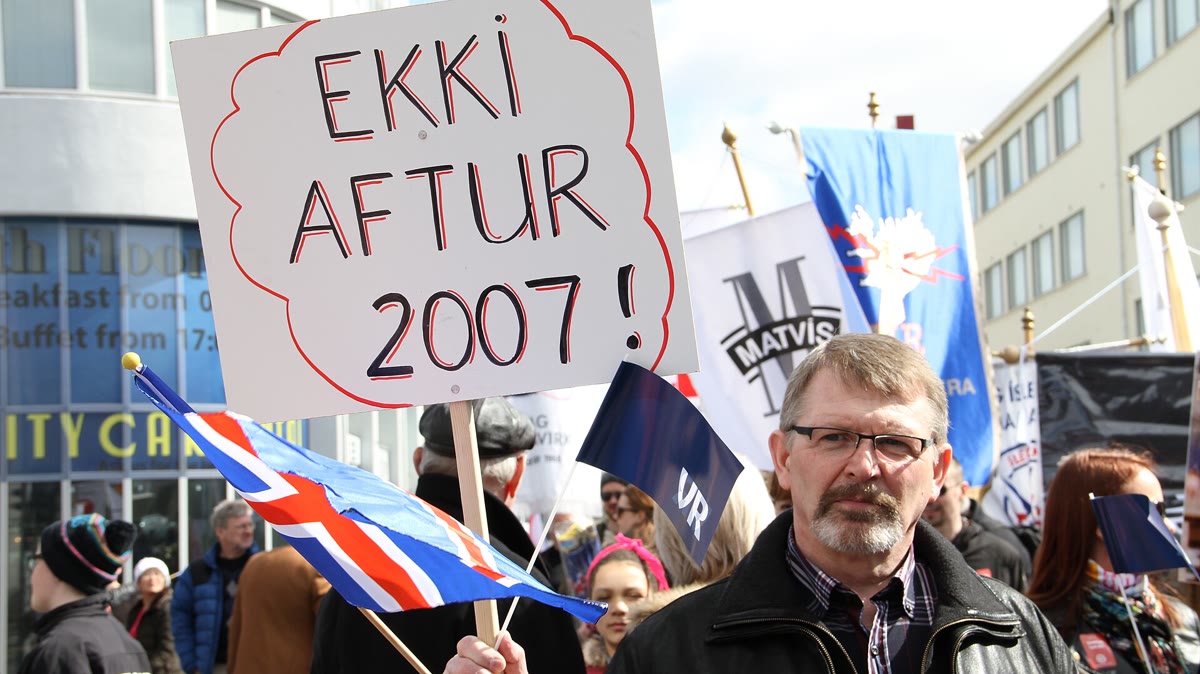
Three days at the Hilton: anatomy of a rupture
ASÍ, the umbrella body of Iceland's private-sector unions, held its 47th congress at the Hilton Reykjavík on 14–16 October. About 300 delegates voted on what looked like a technical question: should there be one vice-president instead of three? The proposal won 174 votes to 111 but fell short of the two-thirds needed to change the rules.
For Sólveig Anna, nothing about it was technical. She called it an attempt by Halla Gunnarsdóttir, chair of the large retail and office workers' union VR, to "seize" ASÍ: with one vice-presidency, there would be no room for Efling's chair in the leadership. Halla rejected the accusation outright and called the row "a storm in a teacup".
The elections followed the next day. Georg Páll Skúlason, chair of the print and media union Grafía, was elected ASÍ president, 162 votes to 127. In the first vice-presidency race, Halla beat Sólveig Anna 182 to 108. Sólveig Anna declined to seek any other post. The result: the chairs of Efling, with 28,000 members, and of SGS, the federation of regional workers' unions, are both outside ASÍ's central board.
Eight days later, on 24 October, Efling's board ordered a review of its ASÍ membership. Sólveig Anna says the decision has nothing to do with the election defeat: members have been asking for years why Efling is in ASÍ at all.
Who is Efling? 28,000 people who clean, cook and care
Efling is the general workers' union of the capital region: cleaning, hotels and restaurants, nursing homes and preschools, municipal services, construction labour. It has about 28,000 members and, according to the union's own figure from 2021, more than half of them are of foreign origin. Immigrants make up 19% of Iceland's population; in Efling the share is more than double that.
This mirrors the country's division of labour. Icelanders work mostly in offices, sales, professions and the public sector; the members of VR, the union for office and retail staff, earn more on average than Efling's. The people who clean the hotel rooms, wash the dishes and care for the elderly come largely from Poland above all, and from countries such as Lithuania, Romania, the Philippines and Ukraine.
Sólveig Anna has led the union since 2018 and became the country's most combative union leader through the hotel strikes of 2019 and the strike wave of 2023. In 2023 Efling left SGS, the general workers' federation, arguing that it paid ISK 53 million a year for services it did not use. ASÍ may be next.
"The middle class comes first": the core of the charge
Sólveig Anna's case in one sentence: Iceland's labour movement claims to represent low-paid workers, but the decisions are made by those who earn more. She told RÚV that within ASÍ "middle-class interests are often put ahead of those of the low-paid" and that Efling has been "marginalised".
She has concrete examples. One: on the National Economic Council, teachers (KÍ), public employees (BSRB) and university graduates (BHM) each have their own seat, while the country's largest group of workers sits behind the ASÍ president, sharing a seat with office staff. Two: in the collective-agreement talks in early October, she says VR pushed for better terms for its own, better-paid members at Efling's expense. Halla denies this.
Her proposed way out is to leave ASÍ, form a separate workers' federation with other unions, and take a seat of its own at the government's table.
The contract crisis in early October was a test of that claim. When inflation hit 5.6% in August, the agreements' assumptions clause broke and the unions gained the right to terminate. Efling, SGS and the craft unions ("Breiðfylkingin") settled with SA on 6 October: every pay rise guaranteed and the contract shortened by one month, unconditionally. VR spent a week campaigning in public, saying SA "had not moved one little inch", voted to terminate, then settled on 8 October: a two-month shortening, but only if inflation exceeds 4.3% in October 2027. SGS chair Vilhjálmur Birgisson's verdict: "I welcome that this play is over." VR, he said, got nothing beyond what Breiðfylkingin had already secured. In the end Efling's shortening is guaranteed and VR's is conditional; the headlines, though, went to VR.
Percentages rise, the gap widens: the numbers
Statistics Iceland's median monthly pay for full-time employees (regular total earnings, thousand ISK):
| Occupational group | 2019 | 2025 | Change (ISK) | Change (%) |
|---|---|---|---|---|
| Managers | 982 | 1,361 | +379,000 | +39 |
| Professionals | 697 | 989 | +292,000 | +42 |
| Office workers | 518 | 761 | +243,000 | +47 |
| Service, care and sales | 483 | 704 | +221,000 | +46 |
| Unskilled jobs (cleaning, kitchens etc.) | 437 | 685 | +248,000 | +57 |
The table says two things at once. In percentage terms, the pay that rose most is Efling members' pay: 57%. That is the result of the "krónur, not percentages" model in force since the 2019 Living Standards Agreement, of which Efling has been the fiercest advocate; under the 2024–2028 agreement everyone gets at least ISK 23,750 a year, which is the biggest percentage at the bottom.
In krónur, the picture changes. A manager's pay rose by ISK 379,000 in six years, a cleaner's by 248,000. Because rent, groceries and preschool fees are charged in krónur, not percentages, the monthly gap between top and bottom widened from ISK 545,000 to 676,000. Inequality in Iceland grows even as raises are handed out in "fair percentages".
The immigrant worker's reality: working more, earning less
Varða, the unions' research institute, surveys 20,000–25,000 union members every year, and for four years running the finding has been the same: immigrants are significantly worse off than native Icelanders. The 2025 report shows immigrants with higher labour-force participation and a higher share of university degrees, but lower income. In the 2024 report, a third of immigrants said they had faced discrimination in the labour market because of their origin in the past two years. Far fewer own their homes, and their housing costs weigh far heavier.
The same research finds that in households earning ISK 499,000 a month or less, four in ten describe their mental health as poor, against 13% in households earning ISK 2 million or more.
The most striking figure concerns wage theft. In 2025, fifteen ASÍ unions filed 1,209 wage claims against employers, worth ISK 1.4 billion in total. More than half of the claims for underpaid wages were on behalf of foreign nationals, who make up less than a quarter of the workforce; about 60% of claims against bankrupt employers were theirs too. Put differently: a worker in Iceland whose pay is short is about three times as likely to be foreign as Icelandic.
Statistics Iceland's 2025 pay distribution completes the picture: the median regular pay of full-time employees is ISK 826,000; 63% of service and care workers earn less than ISK 800,000 a month. Two of the three lowest-paid jobs in the country, childcare (641,000) and laundry work (647,000), are Efling trades.
What the other side says
Halla Gunnarsdóttir says the decision belongs to Efling's members, but that a united labour movement is valuable to everyone. VR, too, pays large sums to ASÍ and "sometimes feels its voice carries less weight than it should"; there are calls to leave inside VR as well. She finds a threat to leave over the vice-presidency row "incredibly strange".
Outgoing ASÍ president Finnbjörn Hermannsson said he had no doubt Efling would conclude it is stronger inside ASÍ. Prime Minister Kristrún Frostadóttir said a united labour movement matters more than any single leader.
Why a law firm first? Hesitation or tactics?
There are two reasons Efling commissioned a report from Magna rather than announcing an exit. The first is legal: in Sólveig Anna's own words, leaving is "a long and complicated process". Efling signs its collective agreement with SA itself, but the government commitments tied to the agreement extended through 2027 (a ban on indexing rents, higher child benefit, interest relief) were secured at ASÍ's table. A union outside ASÍ has to work out where it stands in these shared frameworks, in ASÍ's legal service and in the European union networks. When Efling left SGS in 2023 it followed the same path: a legal report first, then a member vote requiring a two-thirds majority.
The second is tactical. While the report is being written, the door stays open: ASÍ's new leadership can make moves to keep Efling, and Efling can tell its members "here are the consequences, you decide" rather than "let's leave". Most members are foreign and do not follow Icelandic union history closely; they are the ones who must be persuaded to reach two-thirds. On 9 October Sólveig Anna said: "We are not going to make this happen now." The impression is strong that the political decision has largely been taken and the report will answer "how" and "when"; officially, though, all that exists is a review.
If Efling leaves, what changes for you?
- Your pay and contract do not change. Efling signs its collective agreement directly with the employers' confederation SA. The 2024–2028 agreement, extended through 2027, stays in force.
- Your dues do not change. Membership dues go to Efling; Efling pays ASÍ's share from its own budget. If it leaves, that money stays in Efling.
- Your sickness, education and holiday funds do not change. They are Efling's own funds.
- What changes: ASÍ's seats at the government's tables, tripartite negotiations and representation in European union networks. Efling would have to build these alone or with a new federation. It has the money: ISK 4.2 billion in revenue and ISK 17.6 billion in equity in 2025.
- The process: Magna's report, a board decision, then a member vote. When Efling left SGS in 2023, a two-thirds majority was required.
Through members' eyes: why a split looks justified
When this question reaches Efling's members, most will judge it not by the confederation's rulebook but by their own experience. The sequence at the congress is plain: first a proposal to cut three vice-presidencies to one, then the VR chair running for exactly the seat Efling's chair was contesting, and finally a 28,000-member union left out of ASÍ's leadership altogether. A member does not need to know Icelandic labour history to read that as a political move, and that is probably how the ballot will be read.
The numbers feed that reading. Raises have been handed out for years in "fair percentages", yet the monthly gap between a manager and a cleaner widened from 545,000 to 676,000 krónur in six years. A worker whose wages are underpaid is about three times as likely to be foreign as Icelandic. More than half of the members are foreign-born; many are still learning the language, their residence permits depend on their jobs, and they have no time to follow internal union politics. If the people who keep the hotels, kitchens and care homes running feel absent from the rooms where decisions are made, the answer to "what does ASÍ give us?" has to be concrete for them.
That is also the test facing ASÍ's new leadership: to offer Efling something its members can recognise. If it cannot, the process Sólveig Anna calls "long and complicated" may turn out shorter than expected once the members vote. Whether Efling should leave is for them to decide; but to understand why a split looks justified to them, this picture is enough.
Frequently asked questions
Has Efling left ASÍ?
No. On 24 October 2026 the board hired the law firm Magna to review a possible exit. Members will take the final decision; no date has been announced.
Will my pay fall if Efling leaves?
No. The collective agreement is between Efling and the employers; it does not depend on ASÍ membership. The 2024–2028 agreement and the minimum annual raise of ISK 23,750 remain in force.
What is ASÍ?
Alþýðusamband Íslands is the confederation of private-sector unions. Unions sign the collective agreements; ASÍ negotiates the overall framework with government and employers and provides research and legal support.
Sources
- RÚV / Vitinn – Efling íhugar úrsögn úr ASÍ (24.10.2026)
- Iceland Review – Efling to review whether union should leave ASÍ (25.10.2026)
- Daily Northern – Efling weighs leaving Iceland's labour confederation (24.10.2026)
- Vísir – Halla kjörin fyrsti varaforseti ASÍ (16.10.2026)
- Vísir – Georg Páll er næsti forseti ASÍ (16.10.2026)
- Vísir – „Auðvitað er þessi atburðarás ekki mjög sameinandi“ (15.10.2026)
- Vísir – Komi vel til greina að segja sig úr ASÍ (14.10.2026)
- DV – Segir að svona ætli Halla og VR að taka ASÍ yfir (13.10.2026)
- Daily Northern – Halla urges unity as Efling weighs leaving (14.10.2026)
- Daily Northern – Efling leader says leaving ASÍ may become the better option (9.10.2026)
- Vísir – Framlengja samninga út næsta ár (7.10.2026)
- Vísir – „Ég fagna því að þessu leikriti sé lokið“ (8.10.2026)
- Vísir – Hafi ekki „fært sig eina litla tommu“ (8.10.2026)
- Efling – Kjarasamningur Eflingar og SA 2024–2028
- Efling – Úrsögn Eflingar úr SGS, kynning (2023)
- Efling – Ársreikningur 2025 (12.5.2026)
- Hagstofa Íslands – Laun fullvinnandi launafólks eftir starfi 2014–2025 (VIN02001)
- Hagstofa Íslands – Dreifing launa á íslenskum vinnumarkaði 2025
- Hagstofa Íslands – Mannfjöldi eftir bakgrunni 1. janúar 2025
- ASÍ / VSFK – Launakröfur stéttarfélaga námu 1,4 milljörðum króna (2025)
- Varða – Staða launafólks á Íslandi 2025 (1.10.2025)
- Heimildin – Tæplega helmingur launafólks á í fjárhagslegum erfiðleikum (Varða 2024)
- Iceland Review – Efling union appoints first chair of foreign origin (2021)
- Kapak fotoğrafı / Cover photo / Forsíðumynd: Efling stéttarfélag (2019)
Spotted a mistake? info@izlandapedia.com · Instagram @izlandapedia