
Why are we writing this article?
The controversy over Muhammad Taqi Usmani’s earlier views is the starting point for this article. What troubles us is criticism of one person’s ideas turning into collective blame against Muslims: using one person’s words to question the trustworthiness, belonging or equal right to live in society of others who share a faith. This is why we challenge hateful and exclusionary language on social media.
The editor says he was deeply troubled by posts and comments containing insults, humiliation and exclusion, particularly on Facebook. This article presents 24 examples selected in our latest review, with actual screenshot excerpts and translations, so readers can see some of these statements for themselves. Names and profile pictures have been hidden.
Usmani’s views deserve scrutiny, as do the decisions of those who gave him a platform. But that does not justify demanding that ordinary people answer for someone they have never met. One person’s oppressive ideas cannot excuse somebody else’s racism.
Our concern is not to shield a religion from criticism. It is to oppose the humiliation of people because of their identities. We reject the expectation that someone must prove their innocence to a neighbour or colleague simply because they are Muslim. This is a defence of equal human dignity, not a defence of a faith.
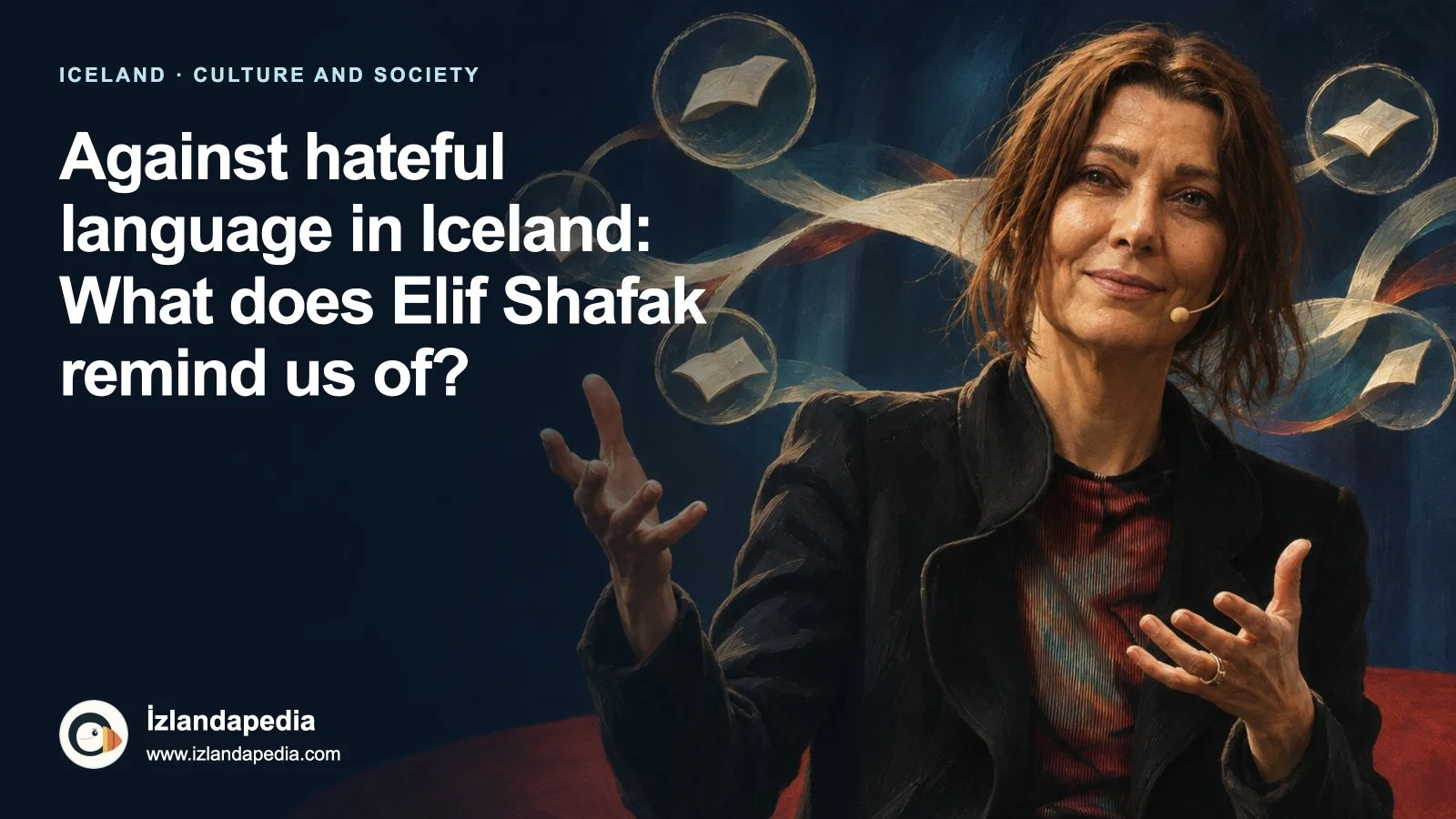
That is why we return to Elif Shafak’s talk. When we turn a person into both a representative and a defendant for a whole community instead of listening to them, we do more than hurt them: we undermine the equality on which living together depends.
Why Elif Shafak—and what is she telling us?
Elif Shafak’s TEDGlobal talk “The politics of fiction”, delivered in July 2010, offers a starting point for thinking about reducing a person to a representative of an identity. The connection between that older talk and today’s debate in Iceland is İzlandapedia’s editorial analysis, not a new statement by Shafak about Iceland. TED · Elif Shafak · TEDGlobal 2010 ↗
Shafak recalls foreign pupils at her international school in Madrid being identified with their countries, and being questioned herself about events in Turkey. Her school memory shows how a child can be assigned the role of representative. Elif Şafak · The politics of fiction ↗
A child is not a state’s spokesperson; a woman does not speak for an entire culture; a Muslim does not represent everyone in the world who shares their faith. This is the idea that brings the story into the present: people’s lives are larger than the labels attached to them. Looking at each other only through nationality or religion prevents us from hearing a person’s own voice.
Why should people who habitually use hateful language listen?
Because the experience Shafak describes reminds us that real people stand behind the easily spoken word “they”. Connecting her talk with Iceland’s debate, we ask: are you discussing what the person you criticise actually says, or blaming everybody who shares their identity?
You do not need to humiliate your neighbour to oppose one person’s views. You do not need to fit Muslim women into a single stereotype to defend women’s freedom. If you defend equality while treating every member of a community as suspect, your own words undermine your stated principle.
Listening to Shafak does not require agreement with all her views. It means pausing our own certainty and allowing another person to speak. Hateful language looks for the answer in a person’s identity; a genuine encounter asks them what they think.
The value of this talk for today’s debate is not that it exempts anyone from criticism. It helps us recognise where criticism becomes the collective humiliation of people. The events and documents below give that question a concrete context.
Watch · Elif Shafak, TEDGlobal 2010
The politics of fiction · July 2010 · Spoken in English. Subtitle availability depends on the TED player.
Watch on the official TED page ↗What do we know about the Reykjavík controversy?
Muhammad Taqi Usmani’s October 2026 mosque visit in Reykjavík prompted controversy. Mannlíf’s 27 October report cited Morgunblaðið’s reporting on his past writings supporting death for apostasy and corporal punishments. These are reports about earlier views, not proof that he repeated those statements in Reykjavík. Mannlíf · 27.10.2026 ↗
In Vísir on 28 October, Karim Askari of Stofnun múslíma á Íslandi said the visit arose during private travel, without a formal institutional invitation. He described general religious advice and disavowed the controversial views. This is the institution’s account. We have not independently transcribed and verified the entire local speech. Vísir · 28.10.2026 ↗
Advocating death for leaving a religion or subjecting people to corporal punishment cannot be dismissed as cultural difference. Such ideas attack the right to life and freedom of conscience and deserve explicit criticism. No title grants exemption from scrutiny. However, claiming that an earlier position was repeated in Reykjavík still requires separate evidence. Getting the facts right does not soften criticism; it gives criticism a solid foundation.
Nor does the institution’s explanation automatically close the matter. It is reasonable to ask how speakers are selected, whether earlier views were considered and what the institution’s position is on ideas incompatible with freedom. Those questions belong with the decision-makers. They cannot be distributed as personal responsibility to Muslims living in the same city who had no part in the decision.
Criticising ideas is not condemning people
It is possible to criticise an interpretation of religion sharply on grounds of women’s equality, freedom or science. It is also possible to regard a belief as mistaken. Silencing that discussion is not a necessary way of protecting believers. Defending equal human dignity and defending the freedom to question ideas can reinforce one another.
Consider three hypothetical examples. These are not quotations from real conversations. Explaining why a teaching restricts women’s lives is criticism of an idea. Asking an event organiser to explain their choice of speaker is a demand for institutional accountability. Telling an uninvolved neighbour they cannot be trusted because of their religion is exclusion based on identity.
This article does not issue legal rulings on individual statements. Whether speech constitutes an offence depends on its content, context and the applicable law. Our editorial standard is more basic: make the claim specific, identify who is responsible for the conduct and do not extend the criticism to uninvolved people. Not every hurtful remark falls into the same legal category; that does not make exclusionary language socially harmless.
The same freedom, for everyone
If we defend freedom of religion, we should defend freedom not to believe and to change religion just as clearly. Women’s equality, the safety of LGBT+ people and immigrants’ human dignity should not be presented as competing interests. Opposing discrimination against a group does not prevent criticism of oppressive ideas expressed within it.
These groups are not separate boxes either. An immigrant can also be a woman, gay or someone who has left a religion. Defining communities around one belief and one position makes their different lives invisible. Selective support for human rights leaves behind some of the very people those rights should protect.
Racism and the degradation of people because of religion must not be normalised as expressions of social concern. Circulating one person’s words as though they reveal every Muslim’s intentions shifts criticism from ideas to people and places uninvolved individuals under suspicion. Opposing this exclusion is as necessary as opposing advocacy of violence. Criticising violations whoever commits them is different from making excuses for them. Listening to someone does not endorse their oppressive ideas.
What does ECRI’s 2023 report document?
The Council of Europe’s anti-racism body ECRI published its Iceland report on 21 September 2023. It highlighted anti-immigrant hate speech and the association of Muslims with extremists. Its general cut-off was 30 March 2023. We are not presenting it as a new 2026 survey of society. ECRI · 21.09.2023 ↗
The report matters because it helps prevent concerns about exclusion being dismissed as merely personal discomfort. But we cannot stretch its scope to reach the same conclusion about every debate today. An older finding does not automatically settle a new incident. The words, people and context of that incident still need separate examination.
Making a country’s problems visible is not accusing everyone in that country. Describing a specific problem is a condition for discussing solutions. Generalisation can obscure both those affected and those working to improve matters. Criticism addressed to the right people is not only fairer; it can also be more useful.
ECRI’s follow-up, published on 5 March 2026, assessed just two priority recommendations. Consistent, accessible collection of racist and anti-LGBTI hate-speech and hate-crime data was partly implemented; awareness of anti-discrimination legislation and remedies was considered implemented. This was not a new assessment of the whole country. ECRI · 05.03.2026 ↗
Care with data is part of our responsibility to people. More recorded incidents do not, by themselves, prove that more incidents occurred. We need to know whether reporting opportunities, definitions or recording practices changed. Conversely, few records do not necessarily mean people experienced few problems. The relationship between recorded numbers and lived experience needs investigation.
Journalism’s task is therefore not to choose the most dramatic number. It is to explain what is being counted, the period covered and the questions the figure cannot answer. Identity debates require the same care: incomplete information should not become the foundation for a definitive judgement about a community.
Lives outside our own circles
Shafak also discusses the limits of surrounding ourselves with similar people and meddah storytellers reaching listeners of different faiths. Elif Şafak · The politics of fiction ↗ Here, the storyteller illustrates the possibility of encounter, not a verdict about tolerance throughout Ottoman society.
The connection we draw with today’s social media debates is our own analysis. Seeing an identity repeatedly through conflict reporting does not mean seeing the whole of its everyday life. The loudest speaker on a screen may not be our neighbour’s chosen spokesperson. This article does not claim to measure a particular algorithm’s effects; it asks whom the examples we encounter actually represent.
Everyday encounters matter for that reason. Working together, taking an interest in children’s schooling or discussing a book can allow us to hear a person’s ideas and choices alongside their identity. People should not first have to prove agreement with us on every controversy. Getting to know someone is not a search for perfect similarity.
Equality should not require perfection
Expecting someone continually to prove they are a good immigrant, a successful worker or an exemplary family member in order to be accepted is another problem. Human dignity should not depend on economic contribution or a life story that pleases everybody. An individual’s mistake can be criticised; it cannot be entered on the record of an entire group.
Nor should expecting a minority member to speak only about victimhood be our sole way of listening. People have humour, ordinary worries, contradictions and changing views. Even knowing a person only through the prejudice directed at them can push other parts of their life out of sight. An equal relationship lets people speak about their own concerns, not only defend themselves.
The resulting task for journalism is concrete: identify the speaker, seek the institution’s response, separate claims from evidence and keep uninvolved people outside the accusation. We do not claim new interviews for this article; it draws on the linked documents and published accounts. Our analysis is also distinguished from what those sources say.
What could change in the next conversation?
To discover what someone thinks, we cannot simply look at people presumed to speak on their behalf; we need to listen to the person themselves. That is İzlandapedia’s editorial approach in this article. Listening means directing difficult questions to the right person, not abandoning them.
In the next discussion, we can first ask ourselves: am I evaluating this person’s own words, or demanding an account from a group I assume they belong to? That brief pause will not resolve every disagreement. But it lets a person enter the conversation without first taking responsibility for someone else’s wrongdoing.
The question remains: will we genuinely ask what the person before us thinks, or assume their identity has already supplied the answer?
Sources and reading note
Source publication dates are distinguished from event dates. This article draws on accessible documents and published accounts, not new interviews.