
World · Climate
Why are we being told to prepare for emergencies? The risks, including nuclear war
Preparedness appeals across Europe and Iceland address natural disasters, war, cyberattacks and failures of essential services. Nuclear danger is part of security assessments. But advice to prepare for three days is not an announcement of imminent nuclear war or a planned global blackout.
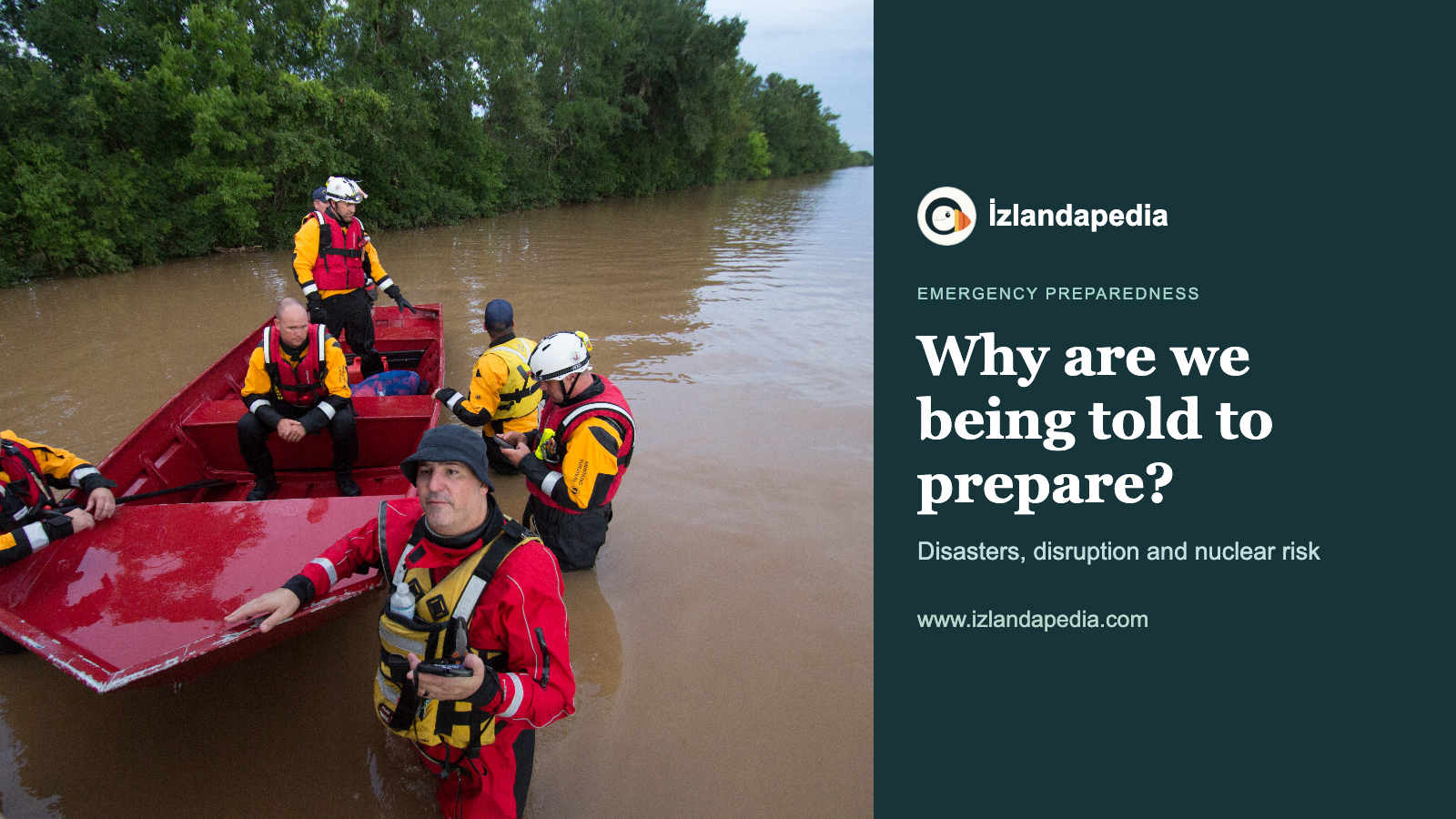
Archive photograph: Rosenberg area, Texas, June 2016. Flood-response search-and-rescue teams. Texas Military Department / Timothy Pruitt · Wikimedia Commons / DVIDS · Public domain.

Electricity, water, phones and card payments underpin daily life. Emergency guidance asks what households would do if several services stopped together. In a major disruption, assistance cannot necessarily reach everyone immediately.
The European Commission’s March 2025 preparedness strategy addresses geopolitical tensions, cyber threats and natural hazards. Guidelines presented on 3 November 2026 continue that work. This is about both a changing security environment and society’s ability to withstand disruption.
What risks are covered?
Natural disasters and extreme weather: Earthquakes, floods, wildfires, storms and volcanic events can damage roads, energy networks and communities. Local damage may disrupt transport and supplies elsewhere.
Electricity, water and communications failures: Accidents or disasters can affect several services. A power failure may also disrupt communications, payments and some water services, depending on infrastructure and backups.
Cyberattacks and sabotage: Attacks on digital systems or physical infrastructure can interrupt energy, transport and public services. That does not make every technical fault an attack; its cause must be investigated.
War and international tensions: Conflict can strain energy, transport and supply chains even in countries that are not directly attacked. The EU strategy explicitly includes armed conflict and security threats.
Pandemics and supply disruption: Health crises can hinder production, deliveries and essential services. Canada’s official preparedness guidance also considers public health, technological and infrastructure hazards alongside natural disasters.
Nuclear and radiological events: Nuclear weapon use, a power plant accident and another release of radioactive material are different events. Their potentially severe consequences make them relevant to emergency planning.
This list is not a ranking of probabilities. The relative importance of each risk depends on location and circumstances.
Is there a risk of nuclear war?
Yes. Nuclear weapon use remains a serious concern in international security assessments. In its assessment of 8 June 2026, the Stockholm International Peace Research Institute, SIPRI, warned of increasing reliance on nuclear weapons and rising risks of miscalculation and escalation.
It identifies weapons development, weakened arms control and geopolitical tensions as risk factors. This is a security assessment, not a prediction of war on a particular day. These sources do not justify a reliable numerical probability or a claim that war is certain to happen soon.
A safety incident at a nuclear facility also does not mean a nuclear weapon has been used. Accident risks and warfare must be discussed separately.
Why is Iceland asking households to prepare?
On 5 November, Iceland’s Ministry of Justice presented information about Almannavarnir’s household preparedness booklet, Verum viðbúin. Its purpose is to help households plan for serious events and interruptions to essential services.
Iceland’s three-day supplies advice is part of civil protection preparedness. It does not by itself establish that an attack or nationwide outage is imminent. Being prepared is different from knowing when an event will occur.
Why three days?
The Commission describes the first 72 hours as a period when households should be able to meet essential needs while public assistance is mobilised. That helps emergency services prioritise people who most need support.
It is neither a guarantee nor a deadline for restoring services. Some disruptions end sooner; others require longer support. The purpose is to avoid relying entirely on last-minute solutions for water, food, regular necessities and reliable information.
Real risks do not establish one hidden scenario
Dismissing these appeals, or treating them all as proof of a secret plan, goes beyond the evidence. Officially stated concerns include disasters, infrastructure vulnerability, pandemics and security threats. Their existence does not prove a global catastrophe is scheduled.
The US flight disruption, an alert-system test and Stephen King’s alien joke do not change that conclusion. No verified evidence connects them to such a plan. The substantive story is how societies prepare for different, genuine risks.
Sources
- SIPRI · 08.06.2026
- European Commission — Preparedness Strategy · 26.03.2025
- Dómsmálaráðuneytið · 05.11.2026
- Public Safety Canada
- FAA · 15.11.2026
- US Department of Transportation · 14.11.2026
- Stephen King · 13.11.2026
- La Repubblica · 14.11.2026
- European Commission · 03.11.2026
- FCC · 16.09.2026
- FEMA · 14.10.2026
- CBS · 07.06.2026