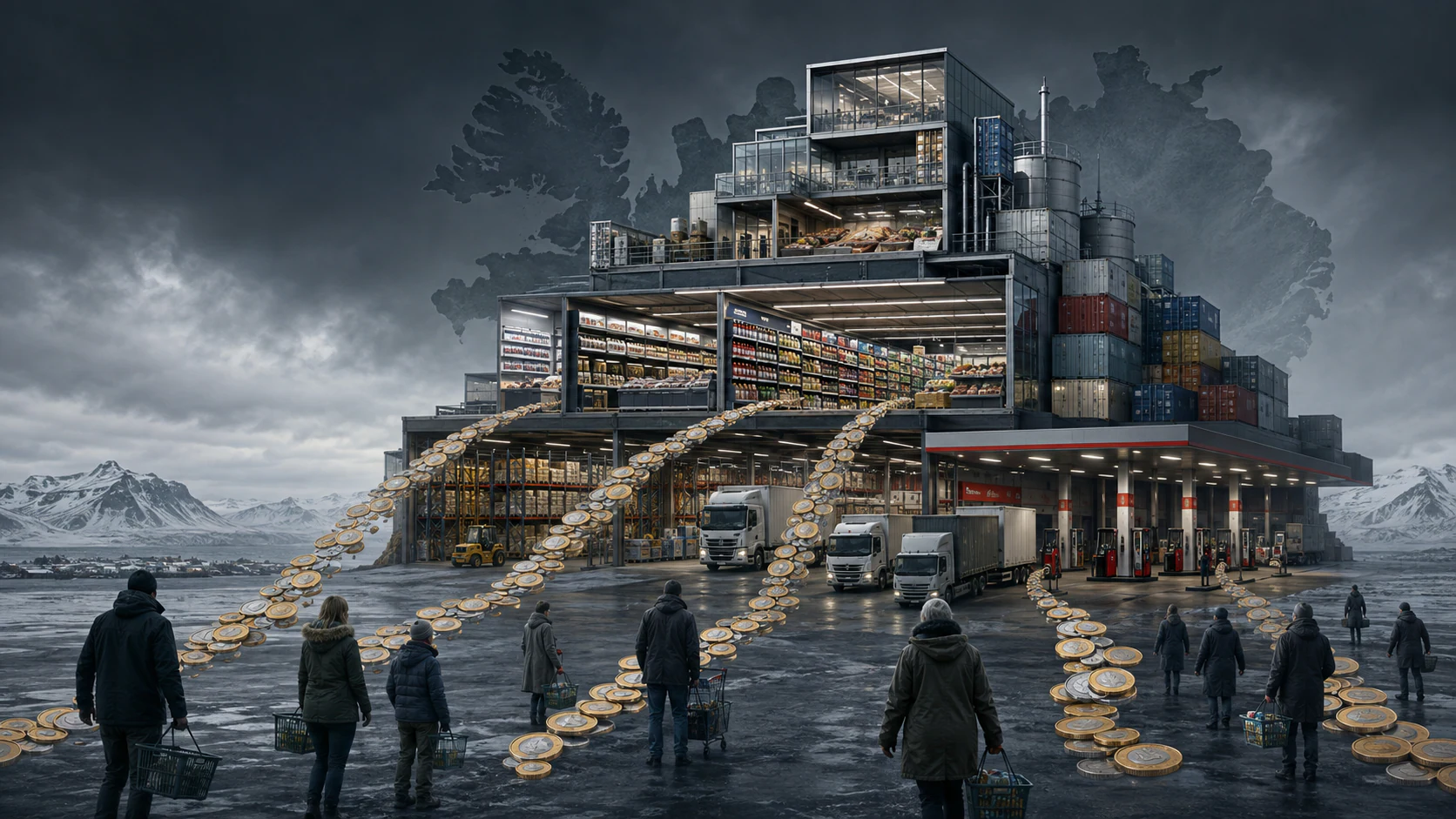
Right next to Keflavík Airport, in an area that was once a NATO base, there are no soldiers today; instead, thousands of AI chips run day and night. In the small north-western town of Blönduós, population around 800, an unassuming building next to a horse farm processes AI workloads from all over the world.
With a population of about 400,000, Iceland has become one of the unexpected players in the global race for AI infrastructure.
The numbers show the shift
The shift is clearest in foreign trade data. According to an analysis published on 9 September by Landsbankinn, the country’s largest bank, Iceland imported ISK 101 billion worth of office machines and computers in the first six months of 2026. The bank says the “vast majority” were computers for data centres. Over the same period the goods trade deficit reached ISK 177 billion – meaning this equipment alone accounts for more than half of the deficit.
Most of the computer imports go to data centres.
Source: Landsbankinn
Official statistics tell the same story. According to Statistics Iceland (Hagstofa Íslands), investment in data-centre-related industries hit a record in the second quarter of 2026; the previous record was set in the same quarter last year. This happened in a quarter when the economy contracted by 1.1% year on year.
Economists point to another detail: despite the large trade deficit, the króna strengthened by 4.8% from the start of the year to early September, with the euro falling from ISK 147.5 to ISK 140.4. Landsbankinn’s explanation is simple: the computers are bought by foreign companies and financed abroad, so the imports do not create a matching outflow of foreign currency.
Billion-dollar deals
Investor interest is also visible in large deals. The sale of atNorth, an Icelandic-born data centre company, was announced in February at an enterprise value of USD 4 billion and completed on 2 September. Canada’s CPP Investments took about 51% of the company, the US data centre giant Equinix about 34% and Partners Group about 10%, with the remainder held by management. atNorth operates eight data centres in five Nordic countries.
In Keflavík, the British AI company Nscale has leased 15 megawatts of capacity at Verne’s campus. Under the deal, about 4,600 Nvidia GPUs are being installed during 2026. The project’s first 7.5-megawatt phase was completed in April, in three months, and equipped with Nvidia Blackwell Ultra systems.
In Blönduós, Borealis signed an agreement on 23 June with the state-owned power company Landsvirkjun for 12 megawatts of firm power on top of its existing contracts. The site is being equipped for Nvidia’s latest liquid-cooled systems.
Why Iceland?
Industry representatives point to four reasons for Iceland’s appeal.
Clean energy: Almost all of the country’s electricity comes from hydropower and geothermal plants – a strong card for tech companies trying to cut their carbon footprint. According to Verne CEO Dominic Ward, “availability of clean, renewable power has become as important as raw performance.”
Natural cooling: Servers produce enormous heat and must be cooled. According to atNorth CEO Eyjólfur Magnús Kristinsson, cooling computer equipment alone accounts for 40% of total electricity costs at most data centres. Iceland’s cool, stable climate cuts that cost considerably.
Subsea cables: The island is connected to Europe and North America by fibre-optic cables. The IRIS cable, in service since 2023, links Þorlákshöfn directly to Galway in Ireland, so data reaches Dublin, Europe’s cloud capital, in about 10 milliseconds.
Predictable prices: Large customers buy electricity on long-term contracts, which lets companies plan years ahead.
Still, Iceland is not ideal for every job. For applications that need instant responses, hubs such as Frankfurt or Amsterdam remain better placed. But for work such as training AI models, which takes days or even weeks, a few milliseconds make no difference.
From Bitcoin to AI
The picture was very different a few years ago. According to a 2018 KPMG report cited by Iceland Review, around 90% of the energy used by Icelandic data centres then went to Bitcoin mining. In December 2021, Landsvirkjun stopped accepting power requests from new cryptocurrency-mining customers.
The industry changed course too. According to Borealis chief of staff Bergþóra Halldórsdóttir, speaking to the Reykjavík Grapevine, one customer in 2024 removed tens of millions of dollars’ worth of Bitcoin hardware and installed AI machines instead. “This is very valuable equipment, and there is an increased need to provide 24/7 services,” she said.
The biggest obstacle: electricity
Iceland’s energy is plentiful but not unlimited. The country’s grid is not connected to Europe, so it cannot import power. And for decades, most of its output has gone to three aluminium smelters.
In 2023, Landsvirkjun openly acknowledged that the electricity system was “running at full capacity” and that a foreseeable shortfall existed. The company argues that heavy permitting processes for new power plants are costing Iceland its historic advantage in renewable energy.
This autumn showed again how sensitive the system is. On 30 September, Landsvirkjun announced that one of the six units at Fljótsdalsstöð, the country’s largest power station, would be out of service for six to eight weeks because of a transformer fault. The other five units are being checked in turn from 6 October, for two to three days each. The company said large customers whose contracts allow it could face curtailment.
New capacity is on the way. Iceland’s first wind farm, Vaðölduver, started production on 15 September with 14 of its 28 turbines and is expected to reach 120 megawatts by the end of 2027.
According to Landsvirkjun, data centres now use about 70 megawatts, or roughly 3.5% of the country’s total electricity consumption. Its CEO Hörður Arnarson says “a strong data centre sector is important for Iceland’s competitiveness”, adding that this will matter even more as AI advances.
“What does Iceland get out of this?”
Not everyone in the country is so optimistic. Björg Eva Erlendsdóttir of the environmental organisation Landvernd points to a lack of transparency: “We don’t know what the data centres are used for. We can’t just welcome all data centres to Iceland.”
Professor Kristinn R. Þórisson, an AI researcher at Reykjavík University, says the data processed on these servers brings Iceland no direct benefit: “Iceland is a small data nation. The data stored here is data for English, data for Spanish, data for Chinese – it doesn’t serve the Icelandic community.”
In a 4 September column, Iceland Review’s editor-in-chief York Underwood put the debate in historical context. Decades ago, he argues, Iceland sold the energy it could not export to aluminium smelters; now it is doing the same with data centres. While neighbouring Norway taxes the profits from natural resources and returns them to the public, Iceland has yet to take a clear position.
Iceland once again stands at a familiar crossroads: who will it sell its plentiful but limited green energy to, at what price, and in return for what?
Methodology: This story is based on official data from Landsbankinn, Statistics Iceland and Landsvirkjun, and on company announcements. Quotes come from the Reykjavík Grapevine (July 2025) and from Verne and Landsvirkjun statements. “More than half of the deficit” is İzlandapedia’s calculation from Landsbankinn’s two figures.
Sources
- Landsbankinn, 9.9.2026 — Krónan styrkist þrátt fyrir halla á viðskiptum við útlönd
- Hagstofa Íslands, 31.8.2026 — National accounts, 2nd quarter 2026
- atNorth, 2.9.2026 — CPP Investments and Equinix complete atNorth acquisition
- Data Centre Magazine, 20.11.2025 — Verne and Nscale launch 15MW AI data centre in Iceland
- DatacenterDynamics, 24.4.2026 — Verne and Nscale complete first phase in Iceland
- Landsvirkjun, 23.6.2026 — Borealis and Landsvirkjun sign a 12 MW power purchasing agreement
- Landsvirkjun, 7.10.2023 — Energy system at full capacity
- Landsvirkjun — Vaðölduver
- Iceland Review, 1.10.2026 — Fljótsdalsstöð power failure and curtailments
- Iceland Review, 16.9.2026 — Iceland’s first wind farm Vaðölduver starts generating
- Iceland Review, 13.6.2023 — Bitcoin mining a growing waste of energy in Iceland
- Iceland Review, 4.9.2026 — York Underwood: Selling Iceland by the megawatt
- Reykjavík Grapevine, 24.7.2025 — Micah Garen: Artificial Iceland
- Bloomberg, 7.12.2021 — Iceland reduces power to heavy users, denies bitcoin miners
- Converge Digest, 15.11.2022 — IRIS subsea cable completed
Spotted a mistake? info@izlandapedia.com · Instagram @izlandapedia