
ICELAND · CONSUMERS · DIGITAL SECURITY
ISK 683 million lost: How bank-transfer scams work in Iceland
A new Central Bank of Iceland report shows rising losses from transfer fraud. In a common method, the person paying is deceived into sending the money. Approving a transaction does not prove that the story behind it is genuine.
In this report
What does the new report show?
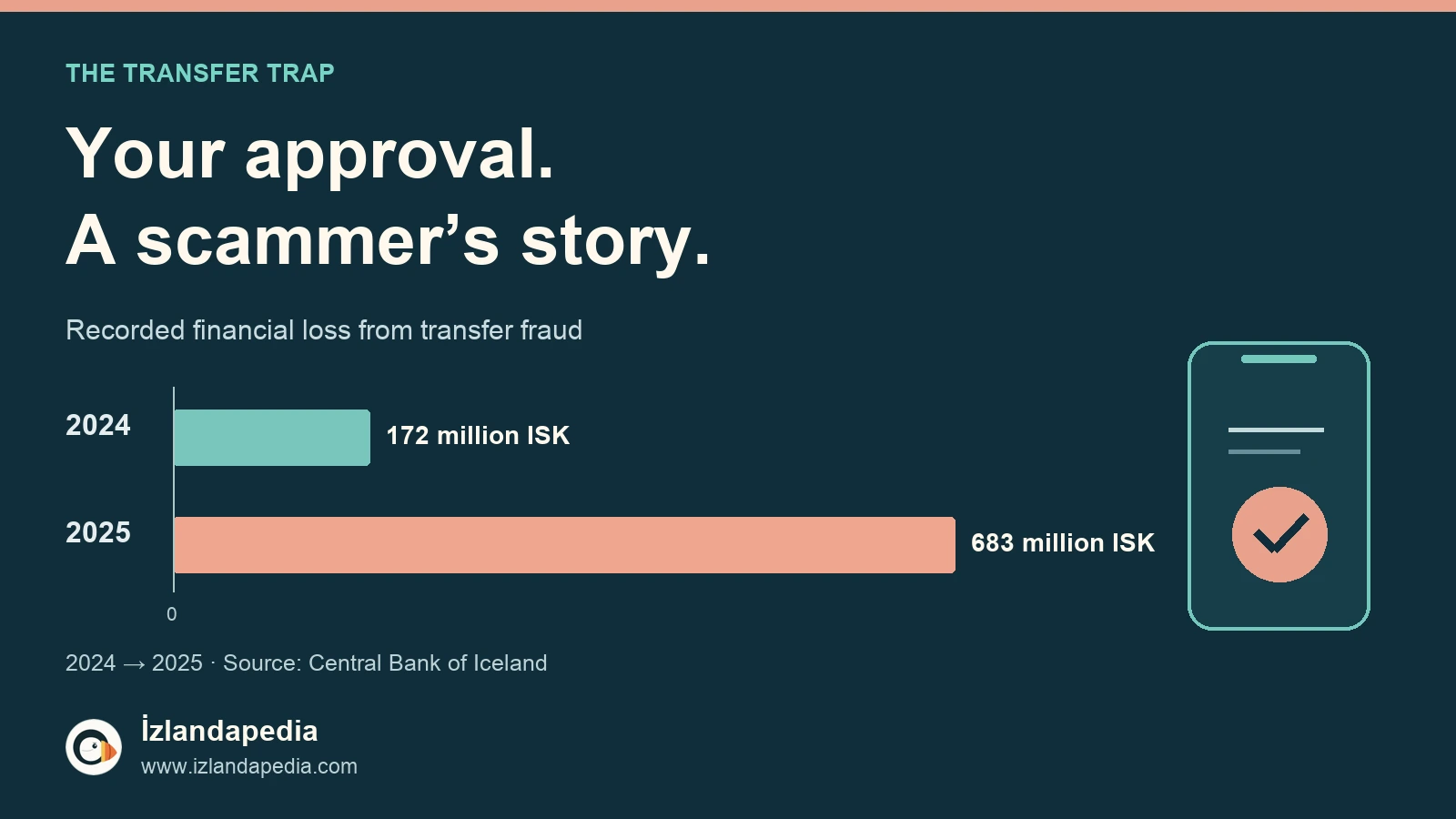
The Central Bank of Iceland’s payment-fraud report, published on 11 November, puts recorded losses from transfer fraud at about ISK 683 million in 2025, up from about ISK 172 million in 2024. Using these rounded amounts, the later total is roughly four times as large. These are historical figures published in 2026, not a total for losses during 2026. [1]
Recorded cases rose from 695 to 1,358 over the same period, an increase of about 95%. Growth in cases and growth in losses are different measures. One person may be involved in more than one transaction: 1,358 cases does not necessarily mean 1,358 individual victims. [1]
Three measures that mean different things
| Measure | 2024 | 2025 |
|---|---|---|
| Recorded transfer-fraud cases | 695 | 1,358 |
| Value of fraudulent transfers | ISK 534 million | ISK 845 million |
| Recorded financial loss | ISK 172 million | ISK 683 million |
The trap: persuading you to pay the wrong account
A prominent method in transfer fraud is deceiving the payer into making the transfer. A scammer does not always need to break into a bank’s systems; getting someone to believe a story may be enough. In card fraud, it is more common for stolen card details to be used without the cardholder making the payment. [1]
Consider an illustrative example: an employee receives an email saying a supplier has changed its bank account and an invoice must urgently be paid to the new account. The employee genuinely makes the payment, but the account does not belong to the supplier. This is an explanatory scenario, not a reported incident or a quotation from a real message. Landsbankinn’s guidance also warns about false management and payment requests aimed at staff. [2]
The useful question is therefore more than ‘Am I making this payment myself?’ It is also ‘Who sent the request, and whose account is this?’ Checking an account-change request through an independently known contact channel, rather than the number supplied in the message, could interrupt this example of a scam.
Why electronic identification cannot check the whole story
Electronic identification and strong authentication provide important protection. But your approval of a transaction does not, by itself, establish that the explanation you were given is true. Confirming who enters the password and confirming who should receive the money are different checks.
Do not accept unexpected login or transaction approvals. Reach your bank by opening its app yourself or typing its official address, rather than following a link in a message. Landsbankinn also advises against sharing login details or giving unknown people remote access to a device. [2]
If you think money has been taken, act promptly
1. Contact your bank or payment provider immediately through an official channel. Ask whether the transfer can be stopped or a recovery attempt started. Prompt reporting may improve the chance of recovery; it does not guarantee a refund. [1][3]
2. Keep the messages, recipient account details, transaction receipt and times. They give you a concrete record when explaining what happened. Do not try to fix the situation by sending another payment or opening new links supplied by the scammer.
3. Report it to police. The official Ísland.is service accepts reports of online financial fraud and attempted fraud. You do not need to wait until a financial loss is confirmed before reporting an attempt. [4]
4. Tell the bank if you also gave someone account or device access. Follow its instructions to secure access. Landsbankinn’s emergency access-blocking feature is for its own customers; procedures can differ at other banks. [3]
Why ISK 683 million and ISK 845 million are different
ISK 845 million is the recorded value of fraudulent transfers in 2025; ISK 683 million is the recorded financial loss. Losses and recoveries may be recorded in different periods. Subtracting the two cannot tell us exactly how much money from that year’s fraud was recovered. [1]
Similarly, the report’s allocation of losses does not determine legal liability in an individual case or whether a bank must reimburse someone. It does not justify the conclusion that approving a payment means losing every right. Reporting to the bank and police remains important. [1]
What the figures cannot tell us
The report uses payment providers’ submissions to the Central Bank for 2023–2025. It cannot be assumed to capture every unreported fraud, and figures can be revised. İzlandapedia calculated the approximate fourfold level and 95% increase from the report’s rounded figures. [1]
This article provides general information, not personal financial or legal advice. For an individual case, follow guidance from your bank and the relevant authorities.
Sources and method
- Central Bank of Iceland — Annual report on payment fraud, 2026 edition (11 November 2026), pp. 4–6, 8, 10–14 ↗
- Landsbankinn — Advice on preventing online fraud (30 October 2023; page checked 12 November 2026) ↗
- Landsbankinn — Banking security and responding to fraud (checked 12 November 2026) ↗
- Ísland.is / Police — Reporting cybercrime and financial fraud (checked 12 November 2026) ↗
Research: Özgür AKIN / İzlandapedia. The report’s statistics, the bank’s prevention guidance and the police reporting service are separate sources. The illustrative scenario is not an account from an actual victim. Sources checked: 12 November 2026.