
When a glacier melts, more than ice disappears. Family memories, a country’s landscape and the world inherited by future generations change with it. In his 2020 TED talk “On time and water”, Icelandic writer Andri Snær Magnason brings an apparently distant climate problem into the family.
Watch: On time and water
TED talk from 2020 · English. Available subtitles can be selected in the player. Watch on TED ↗
How distant is the future, really?
The year 2100 can look remote on a chart. Yet a child born in 2026 will turn 74 that year. Magnason’s perspective makes future generations less abstract: the consequences of decisions made today will become the everyday lives of our children and grandchildren.
This is not simply a story about the distant future
Magnason’s question goes beyond how many years glaciers might survive. It asks how people can care about changes extending beyond their own lifetimes. Imagine a grandmother and her grandchild sharing a table: their relationship joins a long stretch of past and future within a single family. Through that connection, a report full of dates becomes a personal question: how are we shaping the world of people we love?
A family example does not replace scientific measurement. It helps explain why measurement matters. This article therefore places two distinct perspectives alongside each other: Magnason’s cultural approach and researchers’ observations on the ground, from aircraft and from space. The TED talk dates from 2020; the periods covered by the studies below are identified separately.
Source [1] ↗ Source [8] ↗Okjökull: A glacier can disappear before all its ice melts
Okjökull in western Iceland lost its glacier status in 2014. That did not mean every piece of ice vanished overnight. It was no longer thick enough to flow under its own weight. Magnason wrote the text for the memorial installed on 18 August 2019, connecting loss with responsibility towards those who come after us.
Source [2] ↗Why does a glacier shrink—and does every break-up prove climate change?
To understand a glacier, we need to consider how much snow it gains as well as how much ice it loses. Accumulated snow gradually compacts into ice. Melting and the breaking away of ice remove mass. If losses exceed gains over a sustained period, the glacier shrinks. Scientists call the difference between gains and losses its mass balance.
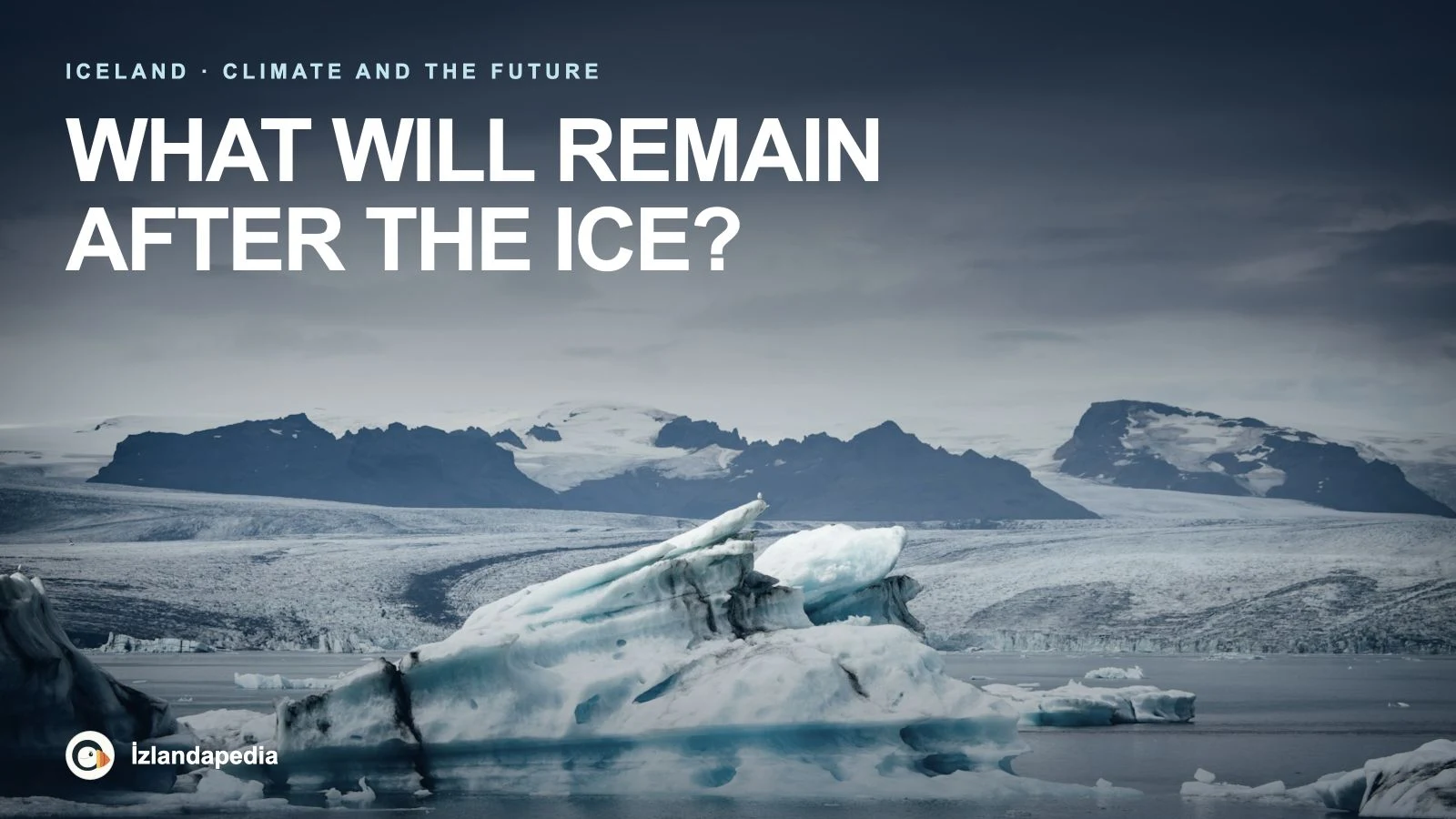
A cold day or a snowy winter does not, by itself, overturn a long-term trend. Equally, a single piece of breaking ice cannot measure the scale of climate change. That requires observations over time. The photograph from Jökulsárlón on this article’s cover is a real view of the landscape, not a measurement or a before-and-after comparison.
Source [7] ↗How can scientists measure the loss?
Vatnajökull National Park explains that researchers sample winter snow in spring and track melting with stakes and wires placed in glacier ice. Satellite images and surface maps from different years allow comparisons. Radar measurements help reveal the underlying ground and the thickness of the ice.
Three concepts matter here. Area loss means a smaller footprint on a map. Thinning means a lower ice surface. Mass loss describes the amount of ice lost, expressed in tonnes. The 18 per cent area reduction and the thinning figures measured in metres therefore describe different changes. They should not be used interchangeably.
Source [7] ↗What measurements tell us about Iceland
The national glacier inventory found that Iceland’s glacier area shrank by about 18 per cent, or more than 2,200 square kilometres, between around 1890 and 2019. Approximately 750 square kilometres of that loss occurred in 2000–2019. These figures describe changes measured up to 2019, not the total loss as of 2026.
Source [3] ↗A white landscape is not necessarily an unchanged one
Research reported by the University of Iceland estimated average thinning between 1890 and 2019 at 45 metres for Vatnajökull, 66 metres for Langjökull and 56 metres for Hofsjökull. These are averages, not identical losses at every point. A glacier that still looks white in a family photograph may have lost substantial volume.
Source [4] ↗The global picture
The GlaMBIE study published in Nature in 2025 calculated average global glacier mass loss of 273 billion tonnes a year in 2000–2023. The annual loss rate increased by 36 per cent in 2012–2023 compared with the preceding twelve years. The study excludes the large Greenland and Antarctic ice sheets. The glaciers studied contributed about 18 millimetres to global mean sea-level rise over the full period; this is not the total rise from all causes.
Source [5] ↗More than a changing view
Glacier retreat can affect water supplies, seasonal river flows, river courses and infrastructure. In Iceland, Skeiðará changed course in 2009 and joined Gígjukvísl, leaving an approximately 880-metre bridge over a largely dry riverbed. Impacts vary: water availability matters in some regions, while floods and unstable slopes are major concerns in others.
Source [6] ↗What could change in the everyday lives of future generations?
For a child, this inheritance is more than an old glacier photograph in a schoolbook. It can include where roads run, when water arrives and which risks shape the design of a building. Glacier retreat may require planning decisions to be reconsidered. That does not mean the same danger exists beside every glacier: local conditions need separate assessment.
River flows also matter for Iceland’s hydropower. Greater melting can initially increase runoff, but the store of ice is finite. Long-term planning needs to consider different climate and melting scenarios rather than assuming present flows will remain unchanged. More meltwater now is not the same as a permanently larger water supply.
Source [6] ↗ Source [7] ↗Nature, culture and responsibility
Glaciers are also part of place names, journeys and family albums. Science measures the change; culture helps explain what it means to people. The future is not entirely predetermined. Cutting emissions and adapting to changing conditions involve public policy, institutions and society. Family memory helps us feel what is being lost. Science shows the scale. Responsibility begins with what we do next.
What responsibility does Iceland carry?
The question raised by this feature is not only whether individuals behave more carefully. What climate assumptions underpin roads, energy infrastructure and settlement planning? Will long-term glacier observations be sustained? Are children being taught about change only as a catastrophe, or also as understandable science and a subject for informed decisions? These are editorial questions prompted by the research, not an announcement of a new government policy.
Iceland cannot halt global warming alone. It can nevertheless take responsibility for its own choices. Maintaining scientific observations, contributing to emissions reductions and preparing infrastructure for change are different parts of that task. Adaptation does not replace efforts to limit further warming. Both are necessary.
Is there a definite date when every glacier will disappear?
There is no scientifically sound single deadline. Glacier futures depend on temperature, snowfall, size, elevation and local conditions. Model studies described by the national park indicate substantial retreat under different warming assumptions. These are scenarios, not changes already measured.
Distinguishing observations from projections does not minimise the problem; it makes the evidence clearer. The ice already lost is a measured reality. How much can remain is precisely why future decisions matter. Will Iceland leave children only the story of its glaciers—or also the story of what it did to protect them?
Source [7] ↗Sources
- TED: On time and water (2020)
- NASA: Okjökull remembered (2019)
- National glacier inventory: area changes, 1890–2019
- University of Iceland: glacier thinning (2021)
- Nature: global glacier mass, 2000–2023 (2025)
- Icelandic Meteorological Office: climate impacts (2018)
- Vatnajökull National Park: glaciological research
- Andri Snær Magnason: background to the TED talk (2020)