
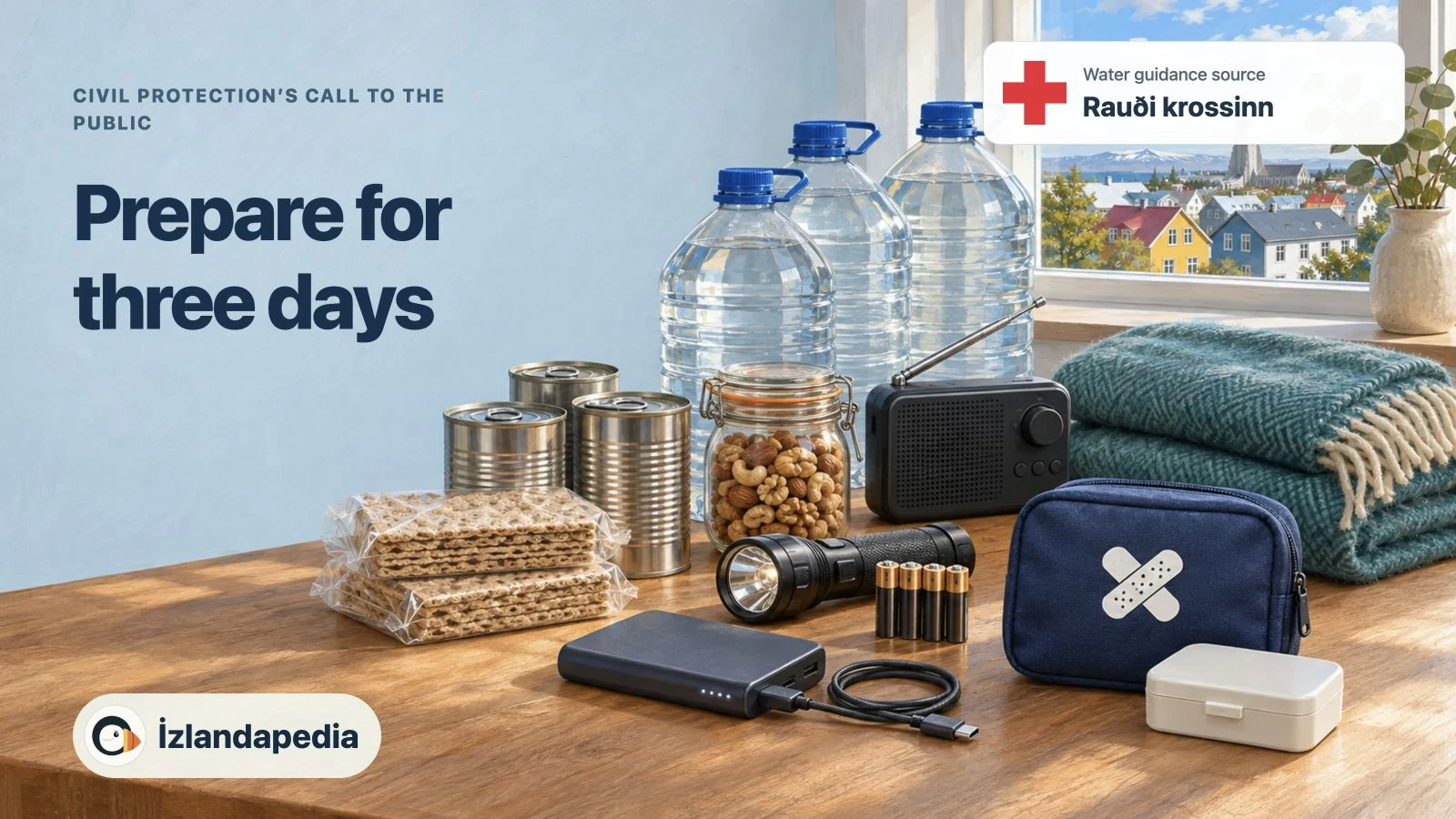
What is civil protection asking the public to do?
Iceland’s Department of Civil Protection and Emergency Management, Almannavarnir, published “Verum viðbúin” — “Be prepared” — on 3 November 2026. It asks households to arrange water, food, medicines and essential equipment so they can meet their basic needs for at least three days. Official announcement.
Why is this appeal being made?
The concern extends beyond earthquakes and volcanoes. The guide’s introduction points to experience of natural disasters and a pandemic, a changing security environment, and dependence on electricity, communications and imported necessities. Three considerations underpin the appeal:
- Iceland has experienced events that disrupt essential services. Eruptions, earthquakes, avalanches and severe weather can affect roads, water, electricity and other services. The Almannavarnir announcement specifically recalls these experiences in recent years.
- One failure can affect several parts of daily life. Power or communications failures can make shopping, paying by card, preparing food and getting information difficult. The booklet also includes technical failures and cyberattacks among possible causes of disruption. It says international tensions and armed conflicts in Europe and elsewhere may have effects in Iceland too.
- Emergency help should reach those who need it most. Households that can meet basic needs for a time reduce pressure on responders, allowing more resources to go to people who rely on daily assistance and those most severely affected.
Three days is a recommended minimum for preparation. It does not mean help will be withheld for three days or services will necessarily return within that period. The announcement does not claim a particular attack or disaster is imminent; it asks people to prepare for disruptions from a range of causes.
Japan also calls for supplies: At least three days, ideally a week
In its appeal dated 2 November 2026, Japan’s government urged households to keep at least three days of water and food, preferably a week. Major disasters can overwhelm public response and delay help. The appeal gives no date for a predicted disaster.
This is longstanding guidance: Japan’s Ministry of Agriculture, Forestry and Fisheries recommended the same duration in September 2016. The November appeal renews that preparedness advice.
Iceland and Japan are not alone: Preparedness appeals across Europe
The European Commission’s new guidelines announced on 3 November 2026 focus on meeting essential needs during the first 72 hours of a crisis. This non-binding guidance for authorities builds on the EU preparedness strategy adopted in March 2025. The Danish, Norwegian and Swedish announcements below date from 2024; they are not new alerts issued today.
| Country / institution | Announcement or presentation date | Recommended preparedness |
|---|---|---|
| Iceland · Almannavarnir | 3 November 2026 — new booklet announced | At least three days |
| Japan’s government | 2 November 2026 — renewed preparedness appeal | At least three days; preferably a week |
| European Commission | 3 November 2026 — new guidelines announced | Meeting essential needs for the first 72 hours |
| Norway · DSB | 29 May 2024 — updated advice launched | One week, extending the previous three-day recommendation |
| Denmark · Beredskabsstyrelsen | 15 June 2024 — national recommendation announced | Three days |
| Sweden · MSB | 8 October 2024 — new booklet presented | At least one week |
In Sweden, presentation and distribution have different dates. The press release dated 14 November 2024 announced that household mailing would start on 18 November 2024. The table dates identify the relevant announcement or revised guidance, not the beginning of disaster preparedness in each country.
The shared aim is for households to meet basic needs for a period when essential services fail. Denmark’s announcement explains that this helps responders focus on those most in need. These appeals, issued at different times, are not by themselves evidence of a particular war or disaster approaching simultaneously.
What should you keep at home?
This checklist groups the official guide’s necessities into practical categories. Plan food for everyone in the household for at least three days, taking dietary needs into account.
Tick what you already have. Selections last while this page stays open.
How much water? At least 18 litres for two people
The new booklet recommends enough drinking and cooking water for everyone for at least three days. The Icelandic Red Cross preparedness page, to which the booklet directs readers for further information, specifies at least 3 litres per person per day. Our table uses that baseline: people × 3 litres × 3 days.
| People at home | Minimum water for three days |
|---|---|
| 1 | 9 litres |
| 2 | 18 litres |
| 3 | 27 litres |
| 4 | 36 litres |
| 5 | 45 litres |
| 6 | 54 litres |
This is not an allowance for unrestricted everyday water use. Plan separately for hygiene and toilet needs, and add water for pets. Store water in closed containers in a cool place, and check and renew supplies regularly.
Three priorities without power or internet
Getting information: A charged phone does not guarantee a working mobile network or internet connection. The booklet names RÚV’s Rás 2 as the emergency radio channel for official messages. That is why a radio belongs on the list.
Keeping warm: Warm clothes and blankets matter when heating fails. The guide recommends reducing heat loss, closing off unused rooms if necessary, and planning a safe place to stay if the outage lasts.
Preparing food: The official list also includes a camping stove or gas barbecue, but these are not an indoor cooking solution. CDC safety guidance warns that portable camp stoves, barbecues and generators can cause carbon monoxide poisoning indoors. Never use them inside a home or garage, or close to open doors or windows. If you cannot cook safely, plan food that can be eaten without cooking.
Beyond supplies: Who will do what?
Preparedness also means making a simple household plan, printing it and ensuring everyone understands it. The official guide recommends agreeing on arrangements in advance. Start with these four questions:
- Where will we meet if our phones stop working?
- Who will help children, older people or anyone who needs daily assistance?
- Which medicines, documents and essentials will we take if we must leave home?
- Who nearby lives alone or may need support?
The supplies do not all have to be in one box. They need to be easy to find. Check what you already own, fill gaps gradually, and review expiry dates and battery charge regularly.
If authorities order an evacuation, follow their instructions rather than staying because you have supplies. For emergencies, call 112.
Where can you get the booklet?
The booklet is to be sent electronically through Ísland.is. Verumvidbuin.is provides PDF editions in Icelandic, English and Polish. İzlandapedia also explains the guidance in Turkish; that article is an editorial summary, not an official translation.
Almannavarnir says printed copies will be distributed at selected locations from 4 to 8 November 2026, with Landsbjörg rescue teams during the Neyðarkall fundraising campaign. The announcement also mentions easy-read and sign-language editions; when checked, the guide’s sign-language section was still marked “coming soon”.
Sources and method
Based on the Almannavarnir announcement dated 3 November 2026 and the Verum viðbúin guide. The minimum of 3 litres of water per person per day comes from the Icelandic Red Cross; the household table multiplies it by three days. Food examples and the grouping of checklist items are İzlandapedia’s explanatory adaptation. Follow current official instructions during any incident.
Updated: — Japan’s appeal added with official sources.
Updated: — European preparedness advice and dated national announcements added.
Sources and documents
- Almannavarnir: booklet launch, 3 November 2026Checked: 3 November 2026
- Verum viðbúin: official preparedness guide and checklistChecked: 3 November 2026
- Official English booklet: preparations and necessities, pp. 10–18Checked: 3 November 2026
- Icelandic Red Cross: three-day preparedness and water quantitiesChecked: 3 November 2026
- CDC: carbon monoxide safety during a power outageChecked: 3 November 2026
- Japan’s disaster management agency: preparedness appeal, 2 November 2026Checked: 3 November 2026
- Japan’s agriculture ministry: household food supplies, September 2016Checked: 3 November 2026
- European Commission: new 72-hour preparedness guidelines, 3 November 2026Checked: 3 November 2026
- Norwegian government: DSB guidance launched on 29 May 2024 (Box 6.4)Checked: 3 November 2026
- Denmark: three-day preparedness announcement, 15 June 2024Checked: 3 November 2026
- City of Malmö: presentation of Sweden’s new booklet, 8 October 2024Checked: 3 November 2026
- MSB press release, 14 November 2024: household distribution starts on 18 NovemberChecked: 3 November 2026