Easy Icelandic summary
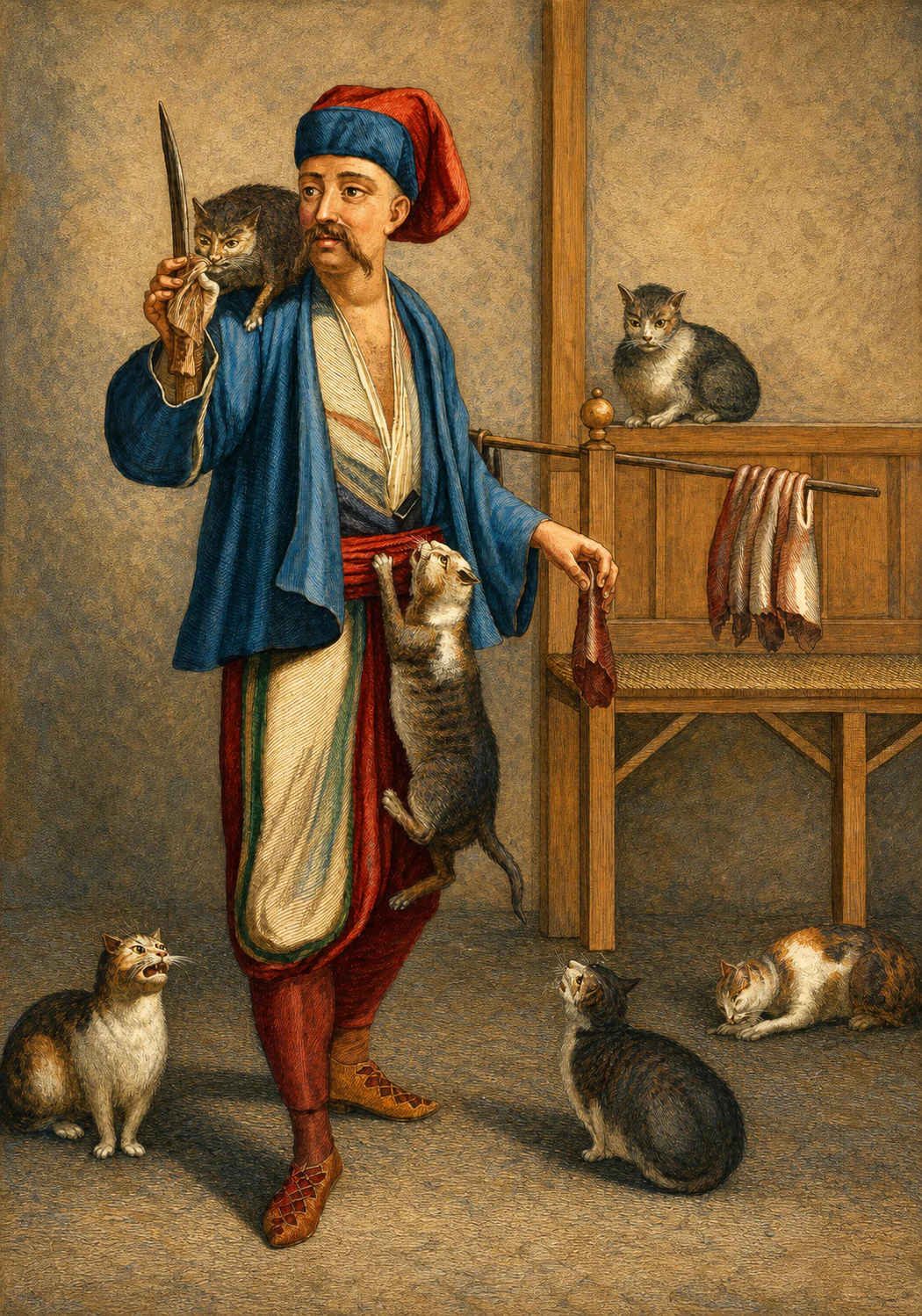
Mancacı var farandsali í Istanbúl. Hann seldi lifur og annan innmat handa köttum og hundum. Borgarbúar gátu keypt matinn eða greitt sölumanninum fyrir að fæða dýrin. Gömul prentmynd sýnir sambærilega venju, en hún sannar ekki alla sögu starfsins.
Learn with this story · Bu haberle öğren
Icelandic + English + Turkish
Listen to four short Icelandic sentences, compare both translations, then reuse the chunks.
Dört kısa İzlandaca cümleyi dinle, iki çeviriyi karşılaştır ve kelime gruplarını yeniden kullan.
Loading Salka recordings…
- Mancacı var farandsali sem seldi innmat handa götuköttum og götuhundum.A mancacı was an itinerant seller who sold offal for street cats and dogs.Mancacı, sokak kedileri ve köpekleri için sakatat satan seyyar bir satıcıydı.farandsali · itinerant seller · seyyar satıcıinnmatur · offal · sakatathanda dýrum · for animals · hayvanlar için
- Borgarbúar keyptu mat og gáfu dýrunum að borða.City residents bought food and fed the animals.Kent sakinleri yiyecek satın alıp hayvanları besledi.borgarbúar · city residents · kent sakinlerikeyptu mat · bought food · yiyecek satın aldıgáfu að borða · fed · yiyecek verdi
- Koparstungan frá 1714–1715 sýnir albanskan lifrarsala í Istanbúl.The engraving from 1714–1715 shows an Albanian liver seller in Istanbul.1714–1715 tarihli gravür, İstanbul’da Arnavut bir ciğer satıcısını gösteriyor.koparstungan · the engraving · gravürsýnir · shows · gösteriyorlifrarsali · liver seller · ciğer satıcısı
- Myndin er söguleg heimild, en hún segir ekki alla söguna.The image is a historical source, but it does not tell the whole story.Görsel tarihî bir kaynaktır, fakat hikâyenin tamamını anlatmaz.söguleg heimild · historical source · tarihî kaynaken · but · fakatalla söguna · the whole story · bütün hikâye
The museum catalogue does not use the word mancacı. The occupational link comes from comparing the image with scholarship and travel accounts.
Who was the mancacı?
According to a historical study published in 2022, manca could mean food or a meal, but in common usage it also referred to pieces of offal—such as liver, spleen and heart—prepared for cats and dogs. People who sold this food in the streets were known as mancacı or seyyar ciğerci, meaning itinerant liver sellers.
They did not necessarily operate from a permanent shop. They moved through the streets and sold their goods to residents who wanted to feed animals. A buyer might hand the food directly to the animals, or pay the seller to distribute it. The practice created a small urban chain linking seller, donor and street animal.
The same study reports that a charitable endowment associated with the Şeyh Evhad Mosque in the Koca Mustafa Paşa area set aside a daily quantity of liver for unowned cats. The example suggests that feeding animals was not always a spontaneous act; in some cases, continuity was planned and funded.
What does the engraving show?
The work in The Metropolitan Museum of Art was engraved by Gérard Jean-Baptiste Scotin I after a design by Jean-Baptiste Vanmour and published by Jacques le Hay. It is plate 60 from the series Recueil de cent estampes représentant différentes nations du Levant and is dated 1714–1715.
Its French title describes a “Dgi-Guerdgi Albanois” carrying sheep livers to the Bedesten to feed cats. The identification of the figure as Albanian matters: Ottoman Istanbul’s commercial and labouring population included people from many communities. The waiting cats also make clear that human shoppers were not the only intended beneficiaries of the vendor’s work.
One distinction is essential. The museum catalogue does not label the figure mancacı. The subject strongly resembles the occupation described in dictionaries, travel accounts and modern historical studies, but the print is best treated as visual evidence of the wider practice—not as a document proving a formal occupational title on its own.
How did the system work?
Travel accounts discussed in the academic literature describe street sellers carrying meat or offal on skewers, followed by cats and dogs. Residents purchased pieces and gave them to animals; some paid the seller to distribute the food on their behalf.
The accounts point to three features of urban life:
- Street animals were visible residents of the city. Their need for food was recognised in everyday public life.
- Care could be shared through small payments. The seller could turn an individual charitable act into a recurring service.
- Itinerant work was flexible but precarious. Without a fixed shop, earnings depended on season, neighbourhood and demand.
From mangia to manca: what was actually being sold?
The word manca is thought to be connected to the Italian mangia, referring to eating. In Ottoman Turkish and later everyday usage it could mean food or a meal. In this urban trade, however, it acquired a narrower sense: liver, lung, spleen, heart and other inexpensive offal intended as food for cats and dogs. The Turkish occupational suffix -cı or -ci turns the commodity into a job title. In the simplest possible explanation, a mancacı was “a person who sold manca.”
Sources also use seyyar ciğerci, meaning an itinerant liver seller, and the expressions kedi eti and köpek eti. The latter two can be badly misunderstood today. In these accounts they mean meat or feed for cats and dogs, not meat from cats and dogs. That difference must remain explicit whenever historical wording is translated for a modern audience.
The commodity was not luxury food. It was a way of using animal parts that had comparatively little value in the market for human consumption. Yet it supported a small service chain: a butcher or supplier moved low-value stock, the itinerant seller earned an income, a resident could buy a small quantity, and an unowned animal was fed. The occupation therefore sat at the intersection of the food economy, petty trade, charitable practice and human–animal coexistence.
Mornings, evenings and animals that knew the route
The traveller Wenceslas Wratislaw described cats waiting by walls at particular times of day. People bought tripe and lungs and passed the food to the animals, sometimes with a long stick to reach them. In his description, the cats are not random scenery. They appear to have learned where and when food would arrive.
Stephan Gerlach also wrote of people buying meat or offal for cats and dogs, linking the act to doing good “for the sake of God.” Jean de Thévenot described people carrying meat, calling the animals and distributing pieces. Salomon Schweigger reported seeing dozens of cats at the Şehzade Mehmed Mosque in the afternoon, where pieces of liver were given as alms. Domenico Hierosolimitano described roasted liver on wooden skewers near the Sultan Bayezid Mosque and said respectable people bought it for cats.
The pattern remained visible in eighteenth-century accounts. Baron de Tott, who arrived in Istanbul in 1755, wrote of liver sellers, cats gathering around them and a benefactor paying for the food. Guillaume-Antoine Olivier described long poles carrying liver, hearts and intestines, with wealthier residents buying the pieces for neighbourhood dogs. Taken together, these texts do not provide a census of mancacı sellers. They do show a recurring urban practice noticed by different visitors at different times.
The Bedesten was not only a human marketplace
The Bedesten stood at the heart of Istanbul’s commercial life. Valuable goods, skilled labour, credit and people of many origins converged there. The engraving places the liver seller and the cats inside that setting. The animals were not outside the economy: they lived beside it, followed flows of scraps and surplus, and helped shape the everyday space of the market.
The French title identifies the figure as Dgi-Guerdgi Albanois, and the museum catalogues him as an Albanian man. This should not become a simplistic ethnic explanation of the occupation. It is more useful as a reminder that Istanbul was a multilingual, multiethnic imperial capital. Albanian workers and sellers were part of that city, alongside many other communities. The figure is both an individual and a sign of the mobile labour on which the metropolis depended.
The scene also contains a hierarchy of movement. The man carries and controls the commodity; the cats cluster around him and follow his gestures. It is not a photograph of a typical minute across the whole city. It is a European print created for consumers interested in the clothing and “nations of the Levant.” The viewer therefore has to read both the scene and the market for which the scene itself was produced.
Who paid? Small coins, charitable acts and the vakıf
In the simplest transaction, a resident handed over a few coins, received offal and fed an animal. In another version, the resident paid the seller to carry out the feeding. The customer was then purchasing not a commodity for personal use but a service performed on their behalf. That allowed people to participate even if they lacked the time or means to care for the animals directly.
Metin Menekşe’s study gives a specific example connected to the Şeyh Evhad Mosque in Koca Mustafa Paşa. A charitable endowment was said to allocate a daily quantity of liver for unowned cats. A vakıf was an endowed institution or fund dedicated to a stated social purpose. The example matters because it shows care moving beyond a spontaneous gift into a recurring financial arrangement.
It does not prove that the entire city had a uniform animal-welfare system. We do not know how many such conditions were active, how consistently they were honoured or what proportion of animals benefited. Its significance is more precise: feeding unowned animals could be defined as a task deserving money, time and continuing responsibility.
A small occupation inside a vast urban economy
The mancacı did not necessarily have a sign, fixed rent or a guaranteed customer base. He needed to know where animals gathered, when donors were likely to give and where inexpensive offal could be obtained. Income may have changed with the season, slaughter days, religious festivals, weather and the movement of people around markets and mosques.
That uncertainty makes the occupation surprisingly recognisable today. It belonged to an informal economy in which a service appeared without an office or large company. The itinerant seller combined retail, transport and a care task. A resident’s charitable act simultaneously became another person’s livelihood. Commerce and compassion were therefore not always opposites; at times, each sustained the other.
The research notes that the work was often associated with Albanian labourers. This point needs the same careful treatment as the image. It may reveal something about migration, labour segmentation and particular sales networks, but it cannot prove that the work belonged exclusively to one community or that all Albanian itinerant sellers performed it.
Cats, dogs and birds in the same moral landscape
Cats dominate the engraving, but the travel accounts also mention dogs and birds. Wratislaw said that he himself bought meat for animals and food for birds. This broadens the story: care was not confined to the animal that later became a symbol of Istanbul, but reached a more varied urban fauna.
Coexistence was not always peaceful. Dogs could be valued because they consumed organic waste and watched over neighbourhoods, but could also inspire fear or be treated as a public-health problem. Cats were fed and admired, yet still lived with disease, hunger and injury. Receiving food therefore did not automatically mean receiving protection in the modern sense.
Recent scholarship on the late Ottoman period makes this tension particularly clear. Residents could care for neighbourhood dogs while authorities attempted to remove them. In 1910, thousands of dogs were deported from Istanbul to Sivriada in one of the most violent episodes in the city’s human–animal history. The mancacı and the exile are not two incompatible pasts. They show that care and violence can exist within the same society.
What travel books tell us — and what they cannot
The most important limitation is the source base. Menekşe acknowledges that the detailed descriptions of mancacı sellers come mainly from travel writing, not from an unbroken series of occupational registers, tax books or municipal regulations. Travellers noticed what seemed exotic, appealing or different from home. They could misunderstand words, exaggerate numbers or give a solely religious explanation to conduct that had several motives.
That does not make travel writing useless. When different writers at different times describe liver sellers, cats near mosques and residents buying animal food, a pattern emerges that deserves attention. The sound method is to compare the accounts, place them beside visual evidence and institutional examples, and state clearly where the evidence stops.
For that reason, this article uses phrases such as “the sources describe,” “the research suggests” and “a comparable urban practice.” It does not claim that mancacı was a single regulated guild operating uniformly across every Ottoman city and century. Such qualifications do not weaken the story. They make it more exact.
Why the story should not be romanticised
Mancacılık is often presented as simple proof of “Ottoman love for animals”. That interpretation has a real historical basis: several travellers wrote that animals were fed as charity or as a pious act. Yet many surviving descriptions were written by Western visitors, whose accounts could also present Ottoman life as exotic or as a moral contrast with Europe.
A single print cannot demonstrate that every animal in every Ottoman city was protected. Care, utility, fear, exclusion and conflict could coexist in human–animal relations. The importance of the mancacı lies not in proving a flawless past, but in showing how residents, itinerant labour and animals could form an everyday system of urban care before modern municipal services.
The question that survives the occupation
The mancacı was more than a picturesque street character carrying liver. The practice offered one historical answer to a continuing question: who is responsible for unowned animals living in a city? The answer was distributed. A resident paid, a vendor transported the food and, in some cases, a charitable endowment supported continuity.
Contemporary knowledge of veterinary medicine, balanced nutrition, sterilisation and public health is far more developed. Historical offal distribution should therefore not be treated as present-day feeding advice. What remains relevant is the social arrangement: street animals were not made invisible, and the cost of care could be shared through small contributions.
What is established, and what requires caution?
Established by the cited sources
- The Met engraving is dated 1714–1715, was made by Scotin after Vanmour and is in the public domain.
- Its title identifies an Albanian figure carrying sheep livers to the Bedesten to feed cats.
- Academic literature uses mancacı and seyyar ciğerci for sellers of offal intended for street animals.
- Travel accounts describe residents buying food from such sellers for cats and dogs.
Claims that require caution
- The museum record does not itself call the depicted figure a mancacı.
- Travel writing is an outsider’s record and cannot represent the entire Ottoman population.
- These sources do not prove that mancacılık was a formally organised guild operating under identical rules in every city and century.
Sources
- The Metropolitan Museum of Art — Dgi-Guerdgi Albanois…, plate 60, 1714–1715
- Metin Menekşe — “Osmanlı Medeniyetinde Hayvan Sevgisinin Mesleğe Dönüşümü: Mancacılık” (DergiPark PDF, Turkish)
- Süleyman Demirel University Repository — article record and abstract
- Frontiers in Sociology — human–animal relations and street dogs in the late Ottoman period
- Detroit Institute of Arts — collection record for the same print
This article was prepared by comparing the sources above on 26 August 2026. If new archival evidence or a correction becomes available, an update note should be added without silently erasing the previous wording.
Did you understand the story?
What could a resident do through a mancacı?