
Trillions of neutrinos are passing through your body as you read this sentence. You feel no vibration and see no flash. For most of these particles, Earth, walls and people barely interrupt the journey. CERN puts the approximate number passing through a person at 100 trillion every second. This invisible traffic is one way news from the universe reaches us. CERN’s explanation.
Scientists are learning to read that news. Francis Halzen’s contributions to the IceCube Neutrino Observatory and the discovery of high-energy neutrinos from space were recognised with the 2026 Nobel Prize in Physics, announced on 6 October. At its heart is an idea that turned deep Antarctic ice into an instrument for exploring the universe. The NSF’s Nobel announcement.
Why is such an elusive particle so valuable?
Neutrinos are elementary particles with no electric charge. They usually pass through matter without interacting, making them difficult to catch but valuable as cosmic messengers. Magnetic fields can bend the paths of electrically charged particles; they do not deflect neutrinos in the same way. Neutrinos therefore offer a valuable clue to the distant environments that produced them. IceCube’s introduction to neutrinos.
The nickname “ghost particle” captures how difficult they are to detect. Scientists build an observation large enough, and patient enough, for a particle that is exceptionally unlikely to leave a trace. Sometimes the beauty of a research question begins here: you can learn that something exists, even when you cannot see it, by measuring what it does.
Nor do all neutrinos share the same cosmic adventure. Nuclear reactions in the Sun, natural radioactive processes on Earth, particle collisions in the atmosphere and human-made reactors can produce them. The extremely energetic messengers IceCube seeks from distant space must be distinguished from the ordinary solar neutrinos constantly passing through us. Fermilab’s explanation of neutrino sources.
A telescope made from a cubic kilometre of ice
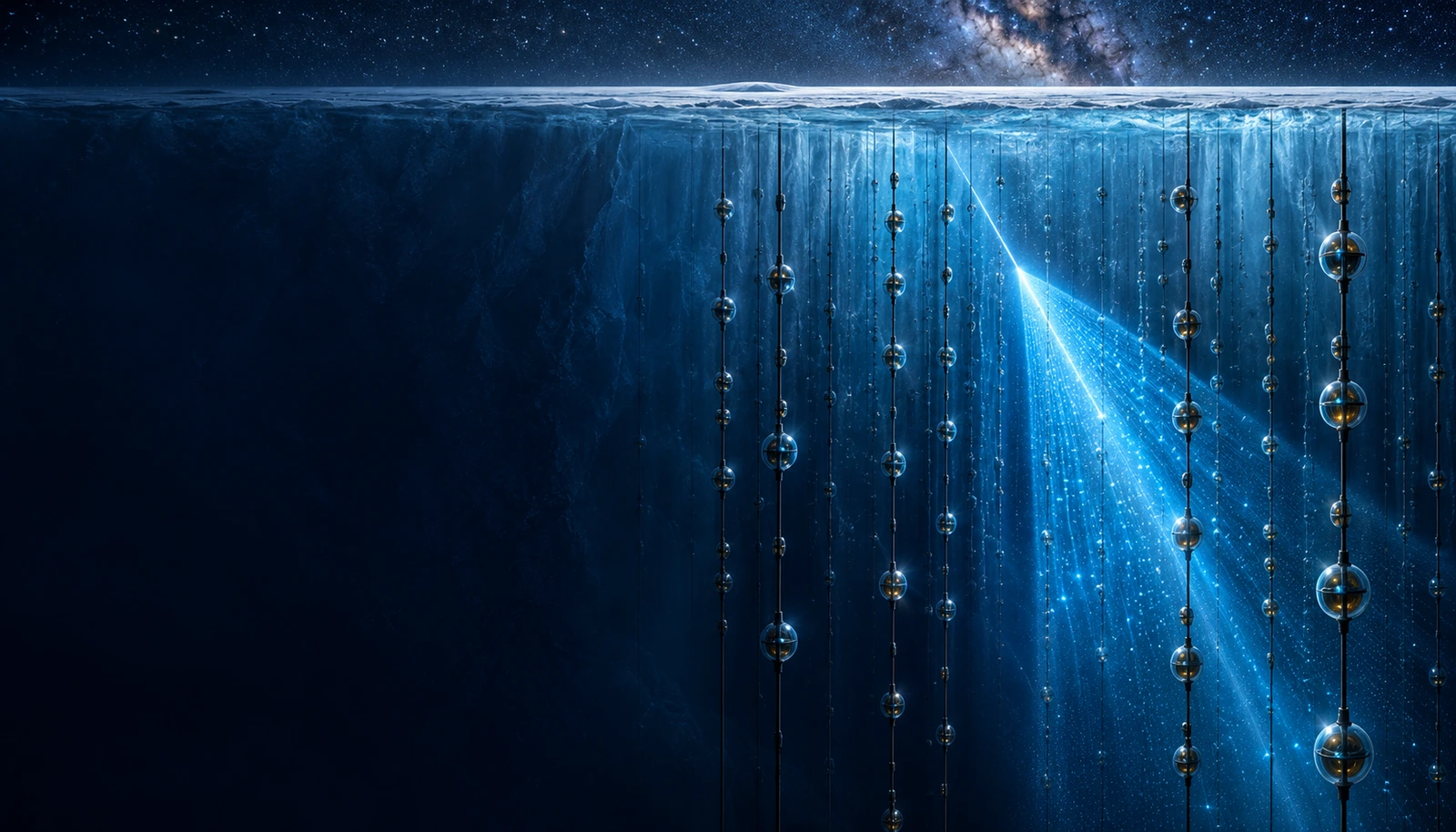
IceCube uses roughly a cubic kilometre of deep ice at the South Pole. Beneath the thick overlying layers, clear, compressed and stable ice provides a suitable medium for following the light produced by interactions. A larger volume increases the chance of recording a rare encounter. IceCube explains its choice of location.
IceCube follows neutrinos through the light traces their rare interactions produce. When a neutrino interacts with matter in the ice, charged secondary particles can emerge. Their Cherenkov light is recorded by sensitive detectors embedded in the ice. The timing and pattern of that light provide clues to the original neutrino’s energy and direction. IceCube explains the detection process.
The observatory’s original main in-ice array was built with 5,160 optical modules positioned along cables. The number makes the scale tangible: instead of looking through a single lens at the surface, researchers combine measurements from many detectors within the ice. This is why an “ice telescope” is such a useful image. Facts about IceCube’s main array.
Reading the universe another way
What has this instrument taught us? A study published by the IceCube Collaboration in 2013 presented evidence that high-energy events could not be explained by atmospheric processes alone, opening a path to exploring beyond the Solar System with neutrinos. The original 2013 study. Halzen’s 2026 prize focuses on opening this cosmic window, rather than the first discovery of the neutrino itself. The Academy’s announcement, republished by Fermilab.
In 2023, the team also announced evidence of high-energy neutrino emission from the Milky Way. Scientific analysis of the detected events builds another view of the galaxy, using neutrinos. Like reading a familiar city through a different map for the first time, it reveals another layer within a landscape we thought we knew. IceCube’s Milky Way study.
The search also reaches beneath the sea. After lengthy analysis, the Mediterranean KM3NeT team announced on 12 February 2025 an event recorded on 13 February 2023, consistent with a cosmic neutrino carrying about 220 PeV of energy. That is an energy estimate; it does not settle every question about the event’s origin. Sea and ice become different observing environments for the same great search. KM3NeT’s original announcement.
Three flavours, tiny masses, big questions
Another surprising property is the quantum change between the three known neutrino types. Called electron, muon and tau flavours, these describe how neutrinos appear in interactions. The probability of being detected as another flavour can change along the journey: this is “neutrino oscillation”. Changes in these probabilities with distance give researchers further clues to the particle’s properties. Fermilab explains flavours and masses.
Neutrino oscillations show that these particles have mass. Other experiments investigate how much mass they have. Germany’s KATRIN uses the energy distribution of radioactive decay products to constrain neutrino mass. Its 2025 result of 0.45 eV/c² is an upper limit, rather than a precisely determined mass. This seemingly small distinction in a science story defines what we actually know. KIT’s KATRIN announcement.
Alongside major prizes, the field advances through careful measurements. On 30 October, Fermilab announced that the SBND team had posted its first research results on arXiv and submitted them for peer review. The study focuses on improving models of how neutrinos interact with argon, laying the groundwork for interpreting future experiments more reliably. Fermilab’s 30 October report.
Messages from inside Earth
One branch of this research looks beneath our feet. “Geoneutrinos” produced by radioactive decays of uranium and thorium inside Earth help researchers investigate processes generating its internal heat. Borexino’s 2020 analysis in Italy explored that connection through measurements. For readers thinking of Iceland’s geothermal landscapes, it is a particularly intriguing link: particle physics meets the geophysics of Earth’s heat. Borexino’s original study.
You can love science without knowing every answer
What does learning this change in everyday life? First, it shows how knowledge is made: curiosity becomes a question, the question a measurable experiment, and the result an explanation that other people can test. The value of a striking claim comes from the observations supporting it. That habit of thinking has a place far beyond a physics laboratory.
The excitement lies in learning another way to question the universe. When you look up at the night sky in Reykjavík, invisible messengers are travelling alongside the stars you can see. Science is building its own senses to listen to them. Each new measurement lets us decipher a little more of the silence between a distant event and ourselves.
From a neutrino to information
- 1Neutrino
- 2A rare interaction
- 3Charged secondary particles
- 4Light pattern
- 5Optical sensors
What does the sensor actually measure?
The sensors record light emitted by charged particles produced in the interaction. Analysis of those records provides information about the neutrino’s direction and energy.
Sources and original documents
Sources are linked beside the relevant information. The documents and reports used are listed below.
- CERN — Halzen and the 2026 Nobel Prize in Physics, 6 October 2026home.cern
- NSF — Nobel announcement, 6 October 2026nsf.gov
- IceCube — Neutrinos and their interactionsicecube.wisc.edu
- Fermilab — Neutrino questions and the purpose of basic researchneutrinos.fnal.gov
- IceCube — Why the detector is at the South Poleicecube.wisc.edu
- IceCube Masterclass — Indirect detection and light patternsmasterclass.icecube.wisc.edu
- IceCube — The original main detector arrayicecube.wisc.edu
- IceCube Collaboration — Original 2013 research paperarxiv.org
- IceCube — High-energy neutrinos from the Milky Way, 29 June 2023icecube.wisc.edu
- KM3NeT — Event on 13 February 2023; announcement on 12 February 2025km3net.org
- Fermilab — Mass states, flavours and oscillationsneutrinos.fnal.gov
- KIT/KATRIN — An upper limit on mass, 11 April 2025kit.edu
- Fermilab — SBND’s first research results, 30 October 2026news.fnal.gov
- Fermilab — Republication of the Royal Swedish Academy of Sciences’ 2026 Nobel announcementnews.fnal.gov
- Borexino Collaboration — Geoneutrino analysis, 21 January 2020borex.lngs.infn.it