This is an opinion piece. For the facts of the day, read our news report.
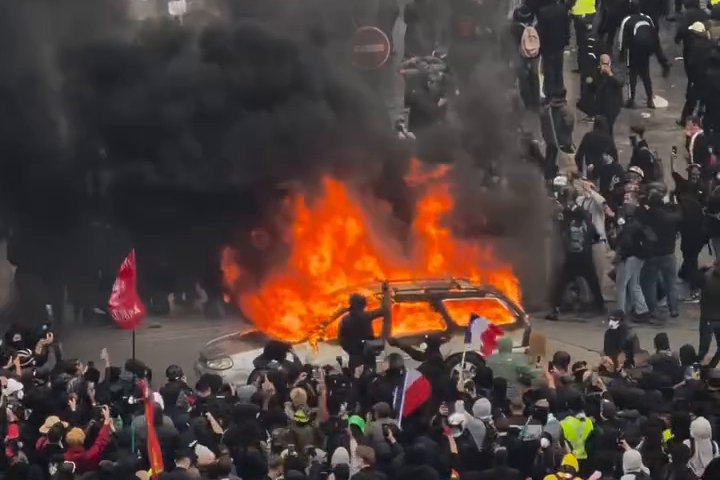
For more than 140 years, the town hall of Limoges stood at the centre of the city. Ceramic medallions on its façade honoured the region’s famous names, carved pediments celebrated its goldsmiths and enamel makers, and the fountain in front of it is made of porcelain. On the night of 17 October it was set on fire. The prefect said the building had been “largely lost”, and its bell tower, the symbol of the city, collapsed.
The house that belonged to everyone
The French once called a town hall the maison commune: the common house. It is where births are registered, marriages performed and votes counted. Whoever burns it is not striking at the state but at the neighbours. When the Hôtel de Ville in Paris burned in the last days of the Commune in 1871, the most precious thing lost to the flames was the city’s civil register: the birth and marriage records of ordinary Parisians. Burning the common house hurts ordinary people most of all.
The line Hugo drew
Few cultures romanticise the street like the French one. 1789, 1830, 1848, 1871, 1968: the barricade is part of the national imagination. Yet the same culture also drew the limit of that romance. In Les Misérables, Victor Hugo writes: «Il y a l’émeute, et il y a l’insurrection ; ce sont deux colères ; l’une a tort, l’autre a droit.» There is the riot and there is the insurrection; both are anger, one is wrong, the other is right. For Hugo, a riot springs from a material grievance, while an insurrection is always a moral act.
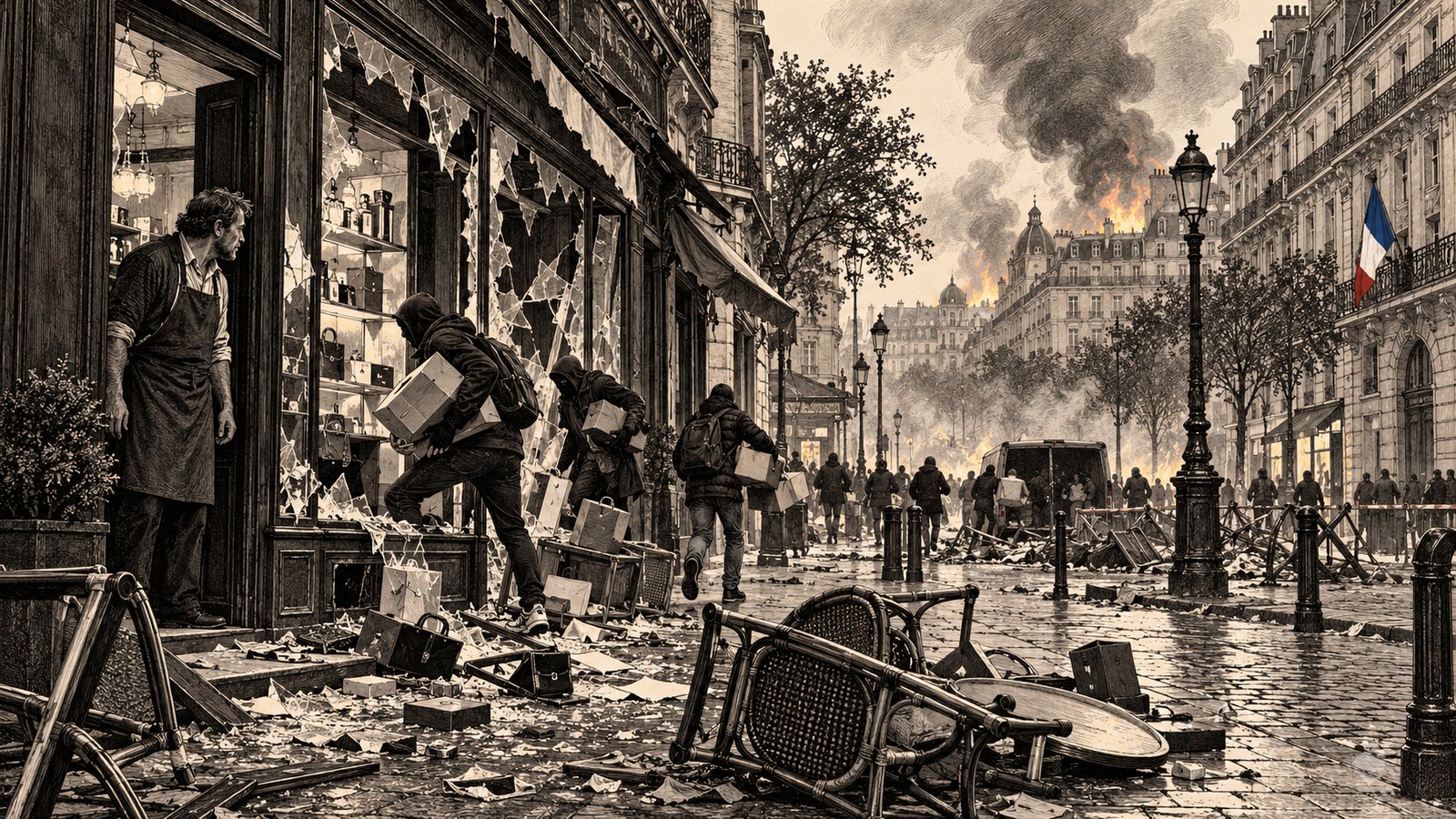
On 17 October, both kinds of anger marched down the same streets. The anger at missing teachers, crumbling school buildings and police violence against children was the righteous one. The hands that smashed the windows of Galeries Lafayette in Paris and emptied the Hermès store in Marseille belonged to the riot, and in their barest form, to theft.
A Hermès bag is not a manifesto
The targets named in the reports tell their own story. A crowd that says it is angry about the cost of living and falling purchasing power does not rebel by filling its pockets with the shiniest emblems of consumer society. That is not a critique of consumerism. It is a free shopping trip for its most loyal customers: an ordinary theft in revolutionary costume.
In 1967 the French thinker Guy Debord described modern life as the society of the spectacle, a world in which images take the place of experience. The call for 17 October circulated on TikTok for weeks. Anger now lives on screens as much as in the street, and for some, a smashed window is not a demand but content.
The crowd is no alibi
In 1895 Gustave Le Bon argued in The Crowd that a person who joins a crowd descends several rungs on the ladder of civilisation. That suits looters perfectly: the crowd did it, nobody is responsible. Modern social psychology has largely dismantled Le Bon. Researchers such as Stephen Reicher and Clifford Stott, who studied the 2011 riots in England, showed that crowds act on shared identities and goals, not on madness. Looting is not a moment of insanity but a choice. Someone chooses which window to break and which building to burn.
Who makes that choice matters too. Of the 191 people detained in Paris by 6 p.m., 90 per cent were adults. Not the 15- and 16-year-olds who started the movement, but adults who trampled on their anger. The government blames far-left groups; for now that remains a claim. Whoever they are, the people who thought of themselves as soldiers of the cause became its worst enemy.
Who loses
The next morning, France was not talking about the 15-year-old student in Lens who lost a hand, or the 16-year-old in Tours who lost the sight of one eye. It was talking about the burned town hall and the looted shops. The same day, Prime Minister Lecornu said he would push ahead with the “casseurs-payeurs” law, which makes those who cause damage pay for it. The debate moved from school buildings to the penal code. The looters handed everyone who wants to silence the students their strongest argument.
The bill lands on familiar desks: the shopkeepers whose stores were stripped, the employees whose workplaces closed, and the people of Limoges, who will rebuild their town hall with their own taxes.
A mirror in Reykjavík
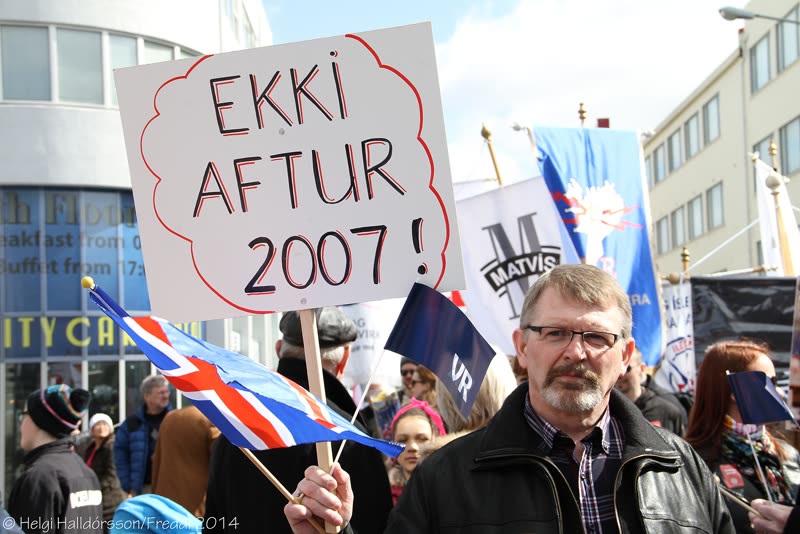
Iceland knows scenes like these, in a different version. After the 2008 banking collapse, protesters gathered for weeks on Austurvöllur, the square in front of parliament. In January 2009 thousands surrounded the building beating pots and pans, which is why the events are remembered as Búsáhaldabyltingin, the Pots and Pans Revolution. The anger ran high: parliament’s windows were broken, government buildings were pelted with paint and eggs, and police used tear gas for the first time since 1949.
Yet one of the defining moments of that winter came when a group of protesters lined up between the police and the people throwing stones, and stopped the stone-throwing. A police report later called it a “world event”. The anger was aimed at parliament and the government, not at the neighbourhood. At the end of January 2009 the government fell; the anger reached its target because it never lost its legitimacy. Comparing Iceland with France one-to-one would be unfair: the population, the history and the problems differ. The lesson travels, though: righteous anger loses its righteousness the moment it starts burning the neighbour’s house.
Condemnation is not enough, but nothing works without it
Condemning the looters plainly is the precondition for defending the students. Every sentence that begins with “But the system…” makes the fire in Limoges a little more acceptable. Condemnation alone is not a policy, however. If school buildings keep crumbling, police violence against children goes unanswered and the cost of living keeps rising, the next riot is only a matter of time.
What France needs now is to remember Hugo’s distinction, in the street and in government alike: listen to the righteous anger, and punish the unrighteous one.
Sources
- Victor Hugo — Les Misérables, tome 4, livre 10, chapitre II : «Le fond de la question» (Wikisource)
- Europe 1 — Mobilisation du 17 octobre (17.10.2026)
- France 3 Nouvelle-Aquitaine — La mairie de Limoges en feu
- Wikipédia — Hôtel de ville de Limoges
- Ville de Paris — L'histoire de l'Hôtel de Ville en sept dates marquantes
- Amnesty International France — Mouvement lycéen
- Wikipedia — 2009 Icelandic financial crisis protests
- Reykjavík Grapevine — “World Event” in 2009 when protesters defended disarmed police (26.10.2014)
Spotted a mistake? info@izlandapedia.com · Instagram @izlandapedia