
TRAVEL · NATURE · PHOTOGRAPHY
Chasing the northern lights: 5 of the best spots near Reykjavík and a photography guide
You do not always need a long tour to find a dark sky. Five options from the city coast to quiet lakes, with practical advice on where to stand and how to take your first photograph.

The first sign may not be a brilliant green curtain. It might be a pale arc you initially mistake for cloud. As your eyes adjust, its shape changes; a camera collects light over seconds that you do not see in a single glance. Looking for aurora means giving the sky some time.
Reykjavík and its surroundings offer several possibilities. These five places were selected from official tourism recommendations with access, photographic foregrounds and night conditions in mind. The best place is the one with suitable weather and access that night; this is not a visibility ranking or a forecast for tonight. [2][3]
Check the sky before choosing a place
Aurora viewing needs darkness and at least partly clear skies. On the Icelandic Met Office cloud map, green means cloud and white means clear sky, not where green aurora is occurring. Read the selected date, time, cloud layer and legend together. [1]
An activity score or Kp value alone cannot promise a sighting. Cloud, local weather and city light can change what is visible. Instead of relying on one fixed best hour, recheck the current forecast during darkness. An apparently clear patch of sky is no reason to use a closed or unsafe road. [1][5]
Why are the northern lights colourful?
Energetic particles from space excite atoms and molecules in the atmosphere. That energy is released as light. The colour depends on the gas, altitude and particle energy.
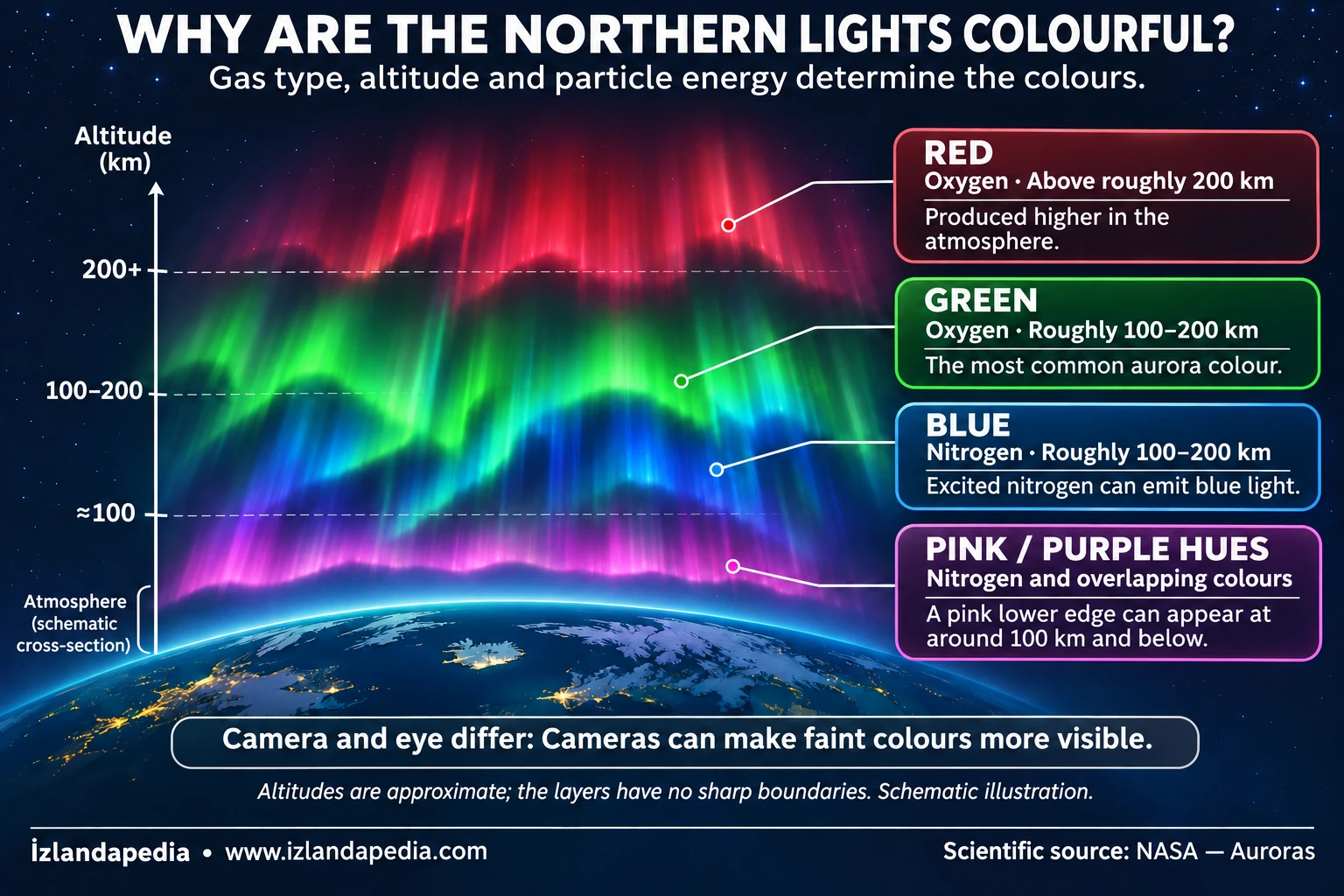
- Green
- Oxygen · Roughly 100–200 km
- Red
- Oxygen · Above roughly 200 km
- Blue
- Nitrogen · Roughly 100–200 km
- Pink lower edge
- Nitrogen · Around 100 km and below
Overlapping colours can also appear purple or pink. The altitude ranges for green and blue overlap; the colours do not form separate layers with sharp boundaries. Cameras can make colours that look faint to the eye more visible.
Which option suits your plan?
| Place | Access / setting | Key point |
|---|---|---|
| Grótta | City edge · a car-free plan may be possible | Stay on the mainland; crossing the tidal causeway is unnecessary. |
| Öskjuhlíð | Within Reykjavík · walking options | Outdoor park paths; museum/terrace access not included. |
| Rauðhólar | City outskirts · easier to plan by car | Marked paths; sensitive ground and possible ice. |
| Hvaleyrarvatn | Near Hafnarfjörður · plan vehicle access | Watch from shore; stay off lake ice. |
| Kleifarvatn | Reykjanes · only if roads and weather allow | Current road and weather checks essential. |
01 · City edge · a car-free plan may be possible
Grótta coast: A nearby sea horizon
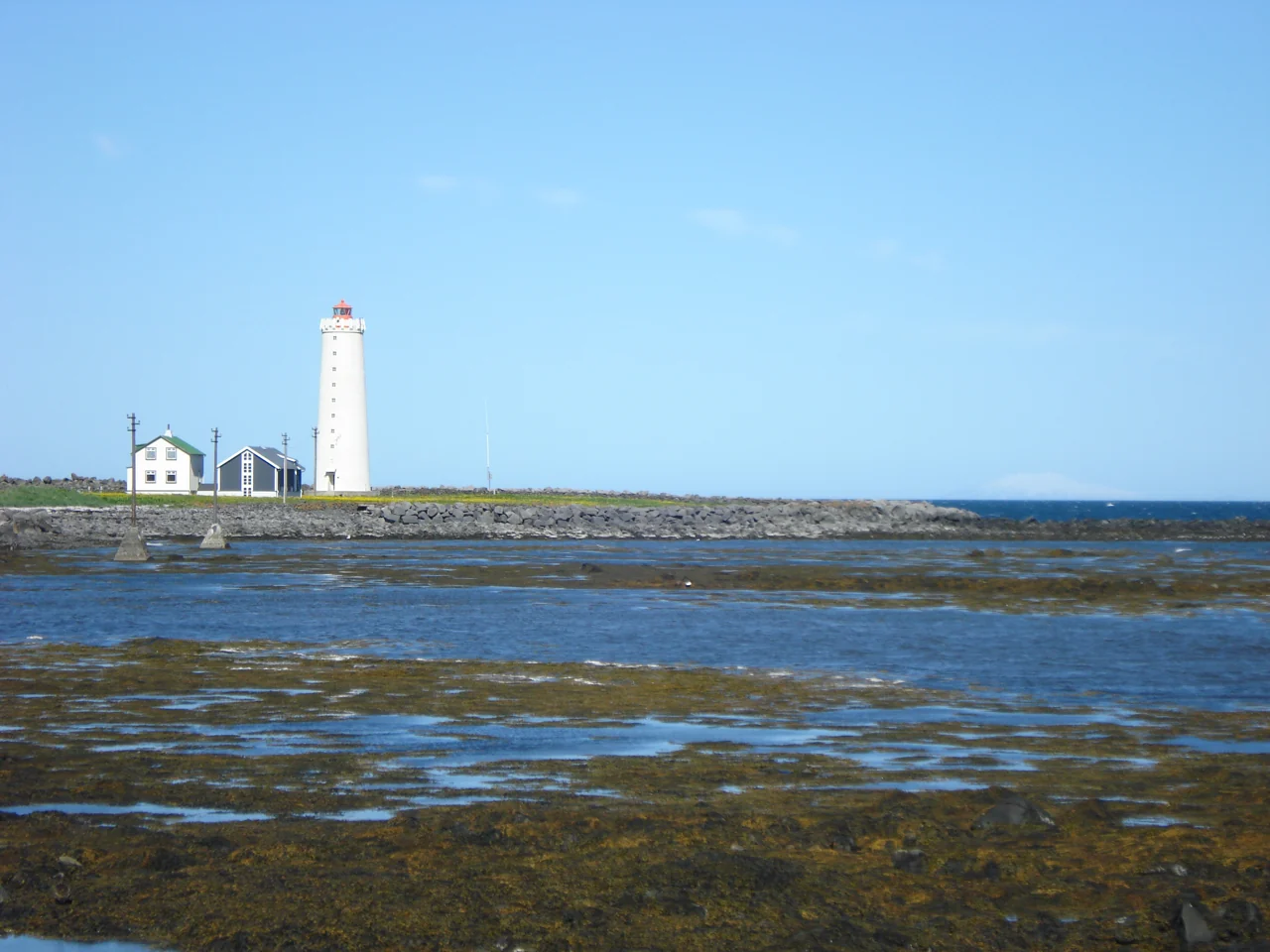
The exposed coast at the end of Seltjarnarnes offers a sea horizon and lighthouse silhouette. City glow does not disappear, but avoiding direct lamps can help. Plan your walk and any public transport using current Strætó information. [2]
This guide recommends watching from the mainland coast; you do not need to cross to the lighthouse island. The causeway is submerged at high tide. The municipality states that island access is closed from 1 May to 31 July for nesting birds. Any crossing requires the official tide tables and local signs. [4]
Photo idea: Keep the lighthouse small in the frame; do not approach water or slippery rocks for a better angle.
Find the area on a map ↗A location search, not a verified parking entrance, open road or safe walking route.
02 · Within Reykjavík · walking options
Öskjuhlíð: A short attempt within the city
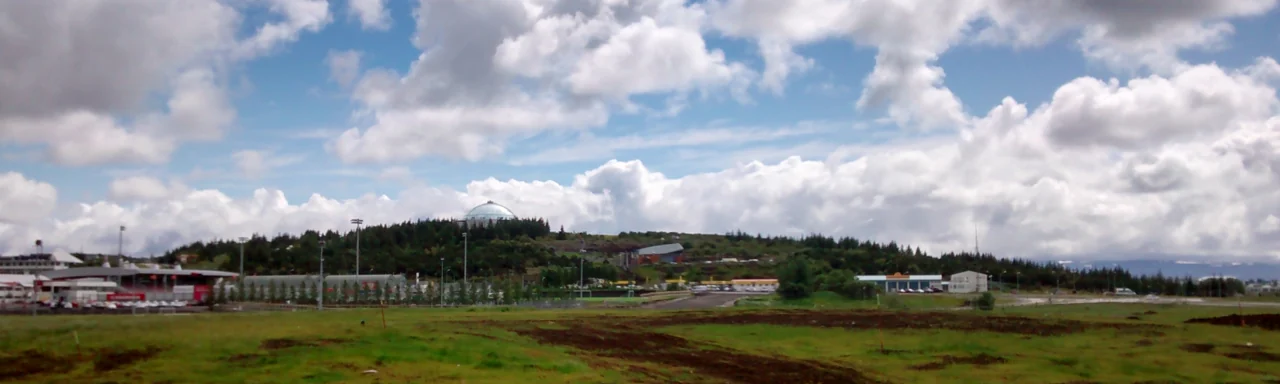
The hill around Perlan is a practical choice if you want to stay in Reykjavík. Open areas between trees can shield some direct lights, although city glow remains. Learning the paths in daylight is better than searching for an unfamiliar trail at night. [3]
The suggestion concerns outdoor park paths. It does not assume Perlan’s museum, paid experiences or viewing terrace are open at night. Turn back if a dark or icy path becomes difficult; this is not a night-time summit itinerary.
Photo idea: Frame the sky with tree silhouettes; point higher if city lights overwhelm the foreground.
Find the area on a map ↗A location search, not a verified parking entrance, open road or safe walking route.
03 · City outskirts · easier to plan by car
Rauðhólar: Red formations in the foreground
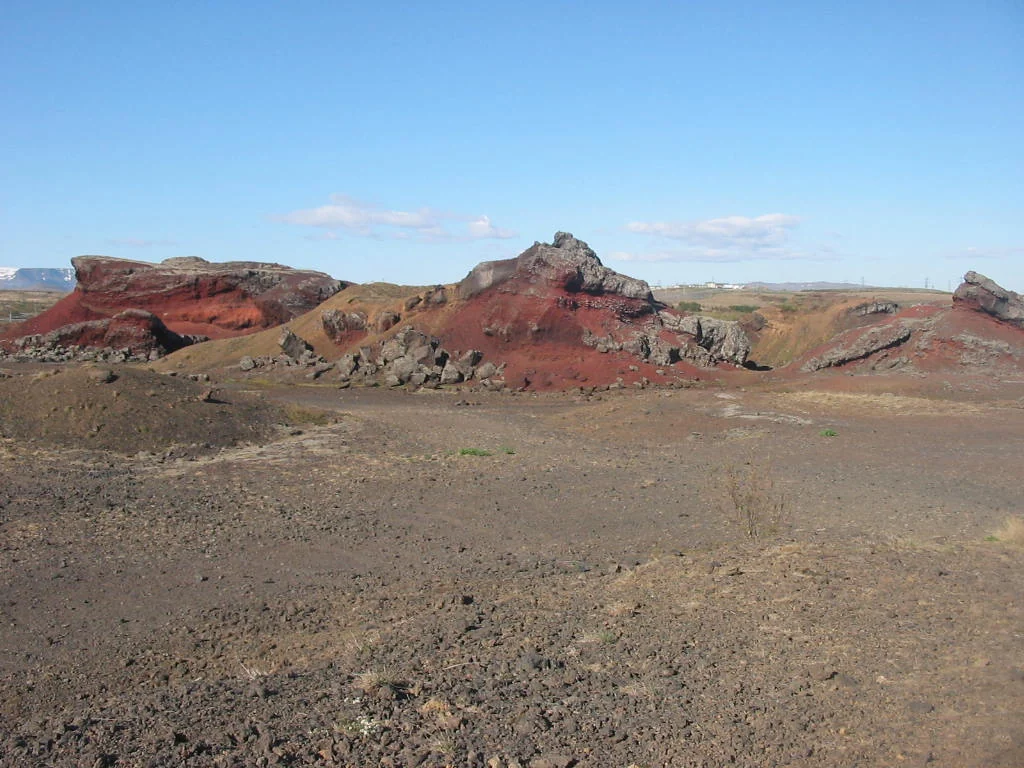
Near Heiðmörk, Rauðhólar’s reddish volcanic formations can give a sky photograph a distinctive foreground. Moving away from the centre may reduce direct streetlight, but darkness alone cannot compensate for cloud or absent aurora. [2]
Use marked paths and permitted areas rather than climbing the hills in darkness. Do not create new tracks on sensitive ground. Check winter approach conditions and permitted parking in advance; the map link is not a verified car-park entrance.
Photo idea: Use a nearby ridge outline without shining a white torch into other photographers’ frames.
Find the area on a map ↗A location search, not a verified parking entrance, open road or safe walking route.
04 · Near Hafnarfjörður · plan vehicle access
Hvaleyrarvatn: Reflections when the water is calm
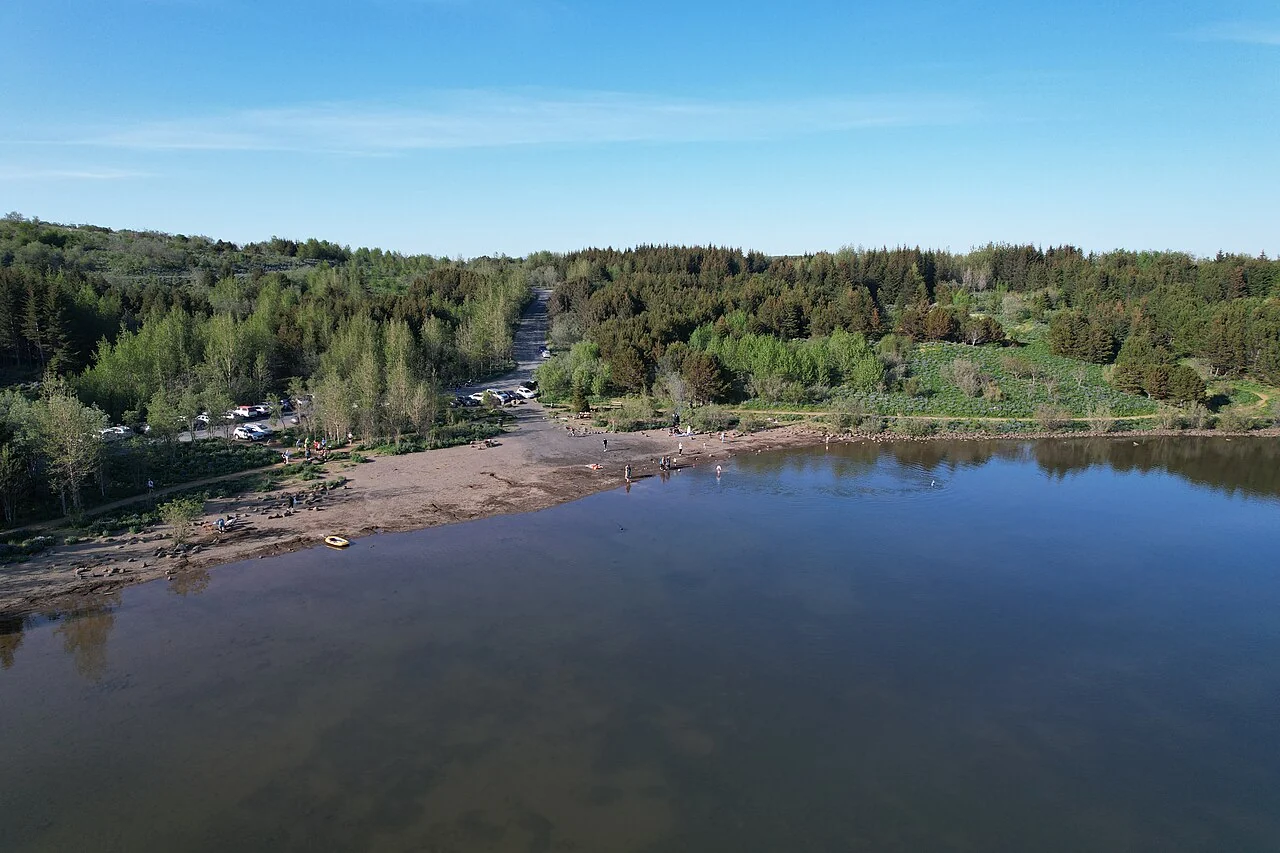
Hvaleyrarvatn offers a lake and wooded setting near Hafnarfjörður. Calm, open water may reflect the lights; do not expect a mirror every evening. The municipality describes paths of different lengths and places to rest in the surrounding area. [3][8]
Stay on the shore at night and do not walk on lake ice. A daytime photograph does not establish safe winter ground conditions. Trees may block some directions; do not move towards an unsafe edge or unfamiliar ground in search of a wider view.
Photo idea: Try reflections only from safe ground; in wind, emphasise the sky rather than the water.
Find the area on a map ↗A location search, not a verified parking entrance, open road or safe walking route.
05 · Reykjanes · only if roads and weather allow
Kleifarvatn: Darker skies, more preparation
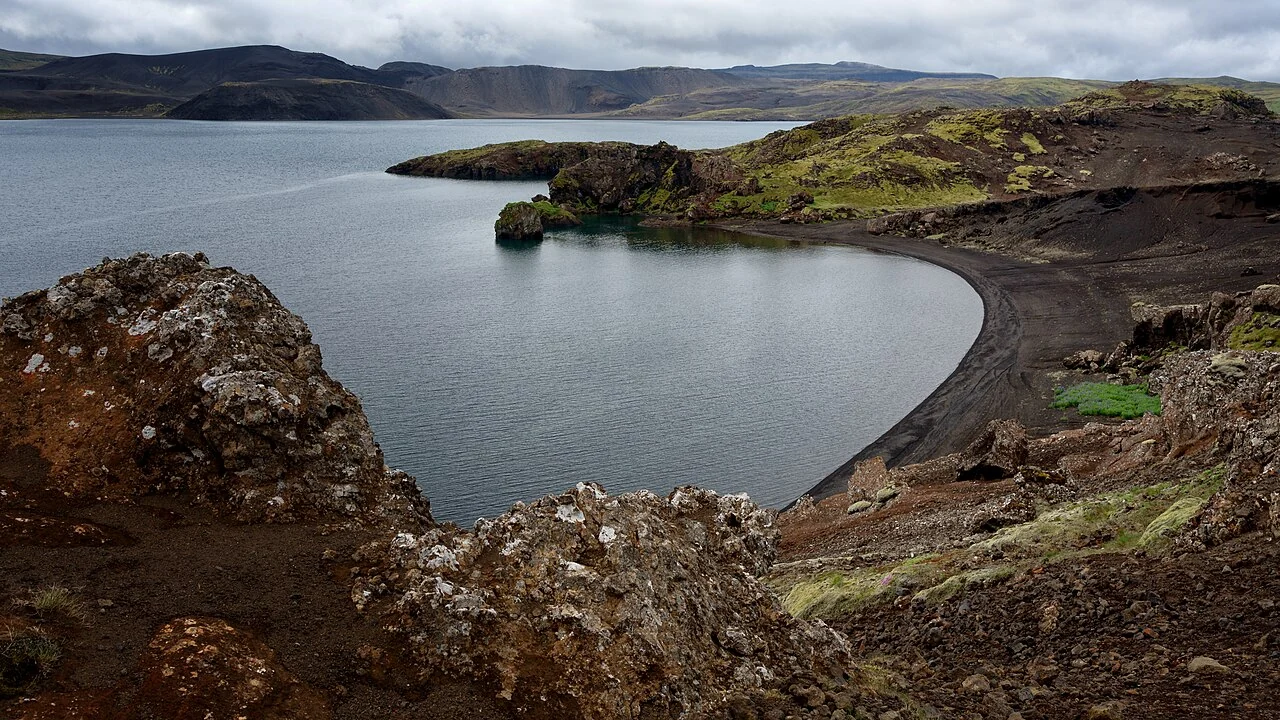
Kleifarvatn offers a broad sky between volcanic slopes farther from the city. Its dark landscape can appeal to photographers, but it should not be treated as the easiest or an all-weather option. [2][7]
Check umferdin.is and SafeTravel especially carefully for this journey. Choose a city option if roads are closed, icy conditions are unsuitable or strong winds are forecast. Stop only in permitted parking, not on the road shoulder, and keep away from water and cliff edges. [5][9]
Photo idea: Include the shoreline from a distance; do not descend a steep slope for a composition.
Find the area on a map ↗A location search, not a verified parking entrance, open road or safe walking route.
A simple starting point for a camera
Set a tripod on firm ground. With a wide-angle lens in manual mode, f/1.8–f/2.8, ISO 1600 and about four seconds can be a useful first test. This is our practical starting example, not one correct recipe for every scene. If your lens begins at f/3.5, experiment with the equipment you have. [6]
Magnify a star to check focus and switch to manual focus where appropriate. Do not trust the infinity mark blindly. Try one or two seconds for a bright, fast-moving curtain, and six to ten seconds for a faint, slower arc. Raise ISO if the frame is too dark and lower it if too bright; inspect each result. [6]
Long exposures collect more light but can smear fast movement. A photograph may look more colourful than the view with your eyes. Choose white balance and RAW capture to suit your equipment, without presenting the result as an exact naked-eye view. Carry a spare battery, a dry cloth and gloves you can operate the camera in.
If you only have a phone
If your phone supports a night mode, stabilise it first using a small tripod or a secure dry support. Turn off flash, avoid excessive digital zoom and keep it still until the capture finishes. Supported iPhones choose a night exposure automatically; controls vary by model. [10]
The longest exposure is not always best. Try a shorter capture if the lights move quickly. Dim the screen and avoid a continuously lit white torch so you do not disturb other people’s night vision or photographs. After a few pictures, put the phone down and enjoy the sky too.
Five checks before leaving
Quick answers
Should I drive to all five in one night?
No. These are alternatives, not a driving circuit. Waiting at one suitable place can be more useful than repeatedly moving.
Is it pointless when Kp is low?
One score is not enough to decide. Read the official forecast alongside cloud and weather; no score guarantees a sighting.
Are entry and parking free?
This is not a ticket or parking-tariff directory. Check current access, parking and local rules with the relevant operator and on site.
Sources and photo sources
Checked on 10 November 2026. This is a location and photography guide, not a current-night visibility forecast. Selection is editorial; best does not describe a measured success rate independent of conditions. Daytime and archive images introduce the locations, not current snow, ice, roads or sky. Photos were resized for the web; no AI aurora was added.
Marco Migliardi / Associazione Astronomica Cortina / IAU OAE · 2021 · IAU OAE · IAU OAE · CC BY 4.0. Resized.
- Veðurstofa Íslands · Aurora and cloud forecast
- Visit Reykjavík · Top spots for the northern lights
- Visit Reykjavík · Northern lights near Reykjavík
- Seltjarnarnesbær · Grótta tides and seasonal closure
- SafeTravel · Northern Lights Safety
- Nikon · Photographing the Northern Lights
- Visit Reykjanes · Kleifarvatn
- Hafnarfjörður · Hvaleyrarvatn outdoor area
- Vegagerðin · Current road conditions
- Apple · Use Night mode on your iPhone