
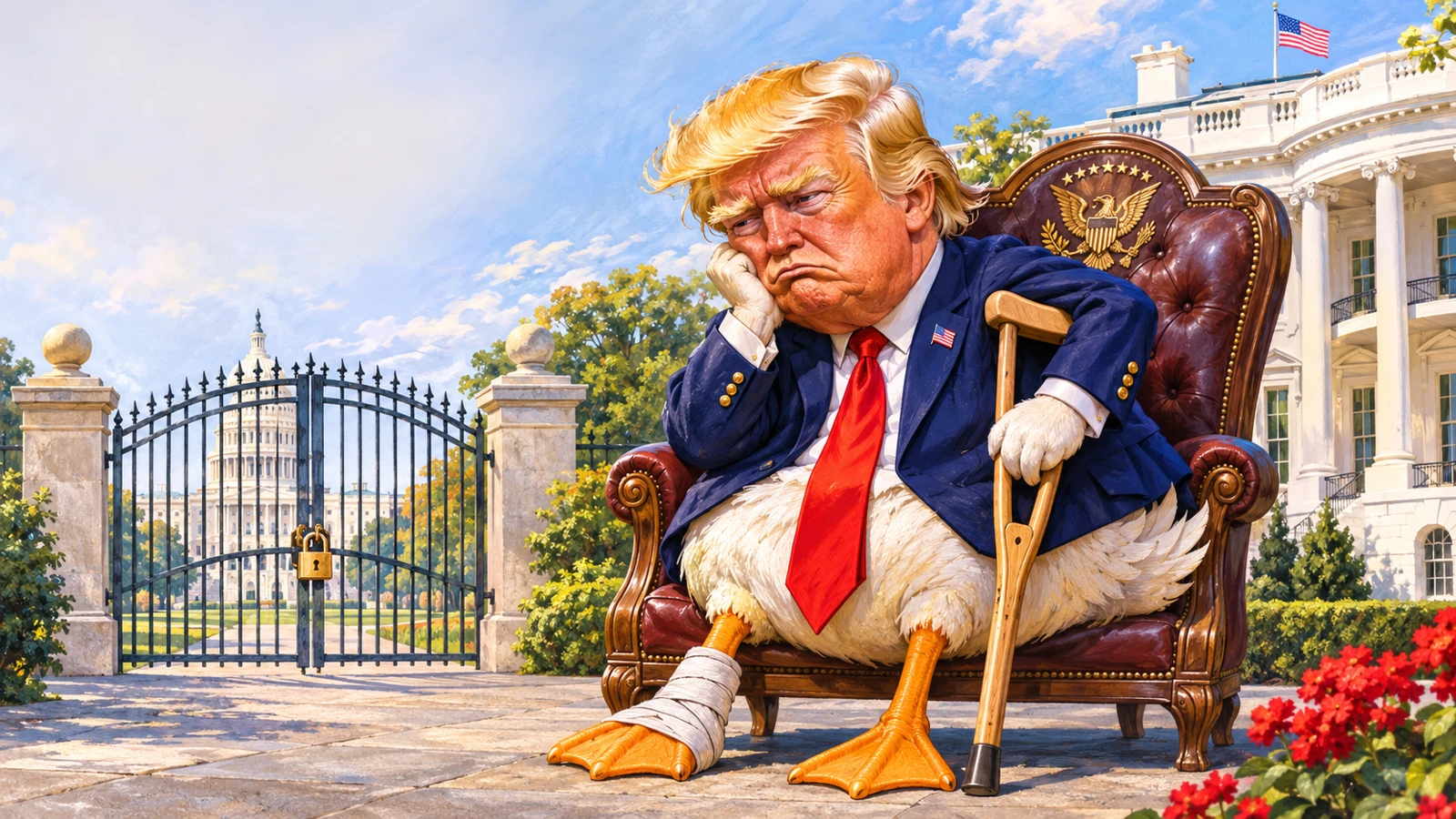
Who lost, and what changed?
According to AP’s 4 November results report, Democrats won control of both the House and Senate. Republicans lost Congress; Trump did not lose the presidency. AP results ↗
Congress has two chambers that work together to make federal laws. Losing the president’s party majority in both means the White House will need more negotiation with its opponents to advance its agenda.
A news organisation’s race call is different from official state certification. Unverified final seat totals are not included.
What does “lame duck” actually mean?
In its narrower political use, a “lame duck” is an officeholder waiting to leave after a successor has been elected. More broadly, political commentary uses the expression for a leader who remains in office but has less influence over what happens next.
Our headline asks about that broader meaning. It is not a legal status or a cancellation of presidential powers. Losing Congress does not automatically make Trump unable to govern.
Imagine Trump wants a new law and the congressional majority says: “Not on these terms.” He is still president, but must negotiate, change the proposal or seek another lawful route. That is a loss of political room to manoeuvre.
Where can Congress put obstacles in his way?
Legislation: A new federal law must pass both chambers. An opposition majority can amend a proposal or prevent it from advancing. The legislative process ↗
Spending: Appropriations put priorities up for negotiation. A president’s preference alone does not fund a programme that needs congressional approval.
Appointments: Federal judges and senior nominees requiring Senate consent must win that approval. The Senate can reject them. Nominations ↗
Oversight: Congressional committees can examine executive action, seek documents and hold public hearings, subject to procedural and legal limits. Oversight powers ↗
What powers does Trump keep?
He remains head of the executive branch and can act within constitutional and statutory authority. He can veto legislation. Overriding that veto requires a two-thirds vote in each chamber. Voting rules ↗
Executive orders cannot simply replace Congress on every issue; they remain subject to legal limits and judicial review. Equally, an opposition majority cannot assume that all its bills will become law over presidential objections. Negotiation may define the next phase: that is analysis, not a guaranteed forecast.
When does the change take effect? Could he be removed?
The new congressional term begins on 3 January 2027. Meetings of the outgoing Congress after the election are known as “lame-duck sessions.” That procedural label is distinct from commentary about a president’s political strength. Transition sessions · Terms of office
A midterm defeat does not remove a president. Impeachment by the House and conviction by the Senate are separate stages. Conviction requires two-thirds of senators present. A change of majority alone does not produce removal.
Why should Iceland watch?
For Iceland, the question is how the new balance in Washington will influence foreign policy and spending decisions. Concrete proposals involving security, the North Atlantic or trade will need to be assessed on their own terms.
The election result itself does not announce a new tariff, security decision or change to an agreement affecting Iceland. Trump remains in the White House. Whether he can get his way in Congress as readily is a different question.
Sources and method
Based on AP’s 4 November 2026 results report and official congressional explanations of powers and procedures. “Lame duck” is an analytical framing, not a legal status. Results were rechecked before publication. Official certification is separate from news organisations’ race calls.
Sources and documents
- AP: election results, 4 NovemberChecked: 4 November 2026
- House: how legislation becomes lawChecked: 4 November 2026
- Senate: confirmation of nominationsChecked: 4 November 2026
- Senate: voting and special majoritiesChecked: 4 November 2026
- Senate: lame-duck sessionsChecked: 4 November 2026
- When congressional terms beginChecked: 4 November 2026
- Congressional oversight of the executiveChecked: 4 November 2026