
Million-dollar trades by Erdoğan’s former minister
An investigation affecting hundreds of thousands of investors in Turkey has reached one of President Recep Tayyip Erdoğan’s former ministers. Share sales made just before the crisis by Fatma Betül Sayan Kaya, a former family minister and former deputy chair of the ruling AKP, raise questions about who managed to get out in time and what the regulators did.

An investigation is under way in Turkey involving hundreds of thousands of people who entrusted their savings to investment funds. Some funds have been placed in liquidation; investors are waiting for the remaining assets to be sold and their money to be paid back. Turkey’s capital markets regulator, the Capital Markets Board (SPK), puts the officially disclosed scope at 131 funds and 455,758 individual investors. [1] [2]
One of the most prominent names in the case is Fatma Betül Sayan Kaya. She served as minister of family and social policies during Recep Tayyip Erdoğan’s presidency and as a deputy chair of the AKP, the party he leads. Following proceedings that began on the night of 5 November, she was remanded in custody; her husband, İlyas Kaya, was released under judicial supervision. [7] [8] [17] [30]
Kaya came to public attention in this case when substantial share sales by her and her husband just before the crisis were disclosed, while the fate of smaller investors’ savings was being debated. The central question is this: while some people could not access their money, how were these transactions completed, and what information was available to those making them? [28] [29]
For comparison, all conversions use the Central Bank of Turkey’s 6 November 2026 indicative dollar selling rate: $1 = TRY 50.0724. These are not the dollar values on the transaction dates. [6]
Who is Fatma Betül Sayan Kaya, and what is her connection to Erdoğan?
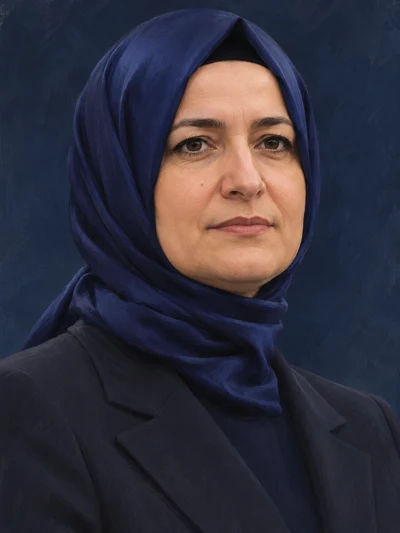
Fatma Betül Sayan Kaya
Erdoğan’s former Minister of Family and Social Policies · Former AKP deputy chair
Fatma Betül Sayan Kaya is a Turkish politician who has held office in government and in the leadership of the ruling party. During Erdoğan’s presidency, she served as minister of family and social policies from 24 May 2016 to 10 July 2018. She was a member of parliament for Istanbul; her political career also includes serving as an adviser to Erdoğan and as an AKP deputy chair. [7] [37]
AKP stands for the Justice and Development Party. Led by Erdoğan, it is the central party in Turkey’s government. Kaya’s position as deputy chair meant she was one of the party leader’s deputies, with a place in its senior leadership. Following the allegations about her fund-related transactions, her departure from party posts was announced on 27 September 2026. [30] [38]
The financial transactions under examination took place in 2026, not during her ministerial term in 2016–2018. Their political significance lies in her having exercised public authority and, until more recently, held a senior position in the ruling party.
From the promise of a ‘pious generation’ to a billion-dollar fund scandal
On 1 February 2012, while serving as prime minister, Recep Tayyip Erdoğan told an expanded meeting of AKP provincial chairs: ‘Our aim is to raise a pious generation.’ Reported by Habertürk that same day, the remark became a symbol of the government’s rhetoric about shaping society through religious and moral values. [39]
More than 14 years later, the detention of a politician who served as both a minister and a deputy chair of the same party in a fund investigation also puts the government’s longstanding claims to moral authority under scrutiny.
Editorial assessment: Appeals to piety cannot replace public accountability. A government’s integrity is tested by disclosure of its officials’ wealth, independent oversight and protection of citizens’ savings. A government that asks voters to trust its moral standing must also provide a transparent account of its own senior figures’ investments and financial transactions on this scale.
How did investors’ savings enter this system?
An investment fund pools people’s savings and invests them in shares and other assets. If the shares it holds rise in value, the savings shown on an investor’s screen grow. But turning that valuation into cash requires other investors willing to buy the shares at that price.
This case examines the concentration of some funds’ holdings in particular companies, unusual price rises, and the ability of certain people to exit before prices fell. Rising share prices can make funds look profitable and attract new investors. If many people then ask for their money back, selling the holdings at the same prices may become difficult. A gap can open between the wealth displayed on a screen and the cash that can actually be paid out. [4] [9]
On 17 September, SPK placed 131 funds managed by seven portfolio management companies in liquidation. Liquidation means selling the remaining assets and distributing payments to those entitled to them. The investigation is examining whether prices were manipulated, whether information that was not public was used, and who benefited from which transactions. [2] [29]
Kaya: the money and the timing
The money movements in Kaya’s case concern shares in Özata Denizcilik, a company listed in Turkey. Kaya said she bought shares in April, sold some in August and the rest in September, then briefly invested the gains in a Tera investment fund. These transactions are being examined within the wider fund investigation. [29] [30]
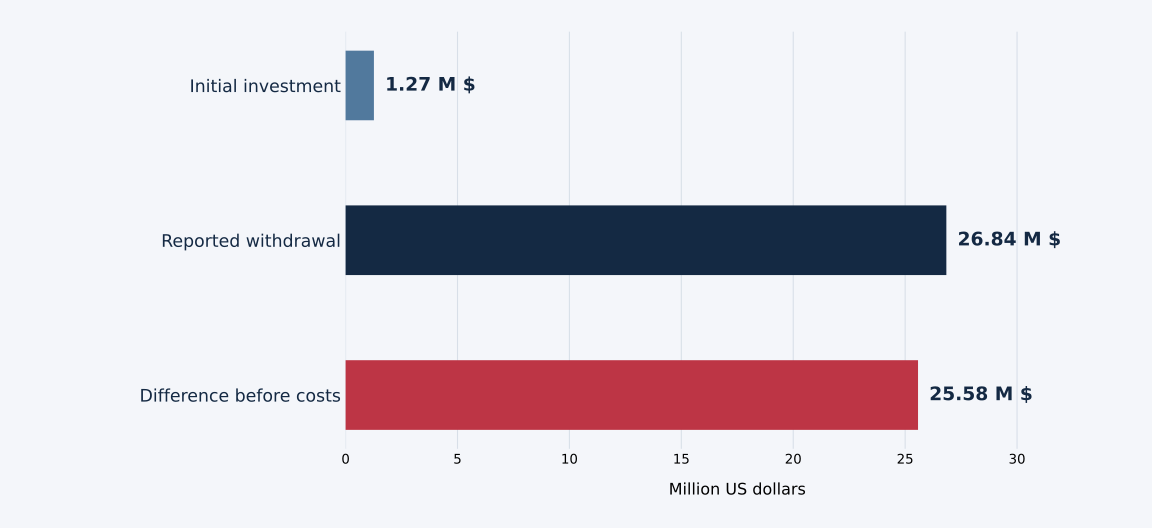
The chart below shows the investment and withdrawal amounts disclosed by opposition politician Zeynel Emre. Prosecutors are examining the timing of the transactions and the allegation of access to information that was not public. [28] [29]
Reported transactions: $1.27 million invested, $26.84 million withdrawn
For comparison, all conversions use the Central Bank of Turkey’s 6 November 2026 indicative dollar selling rate: $1 = TRY 50.0724. These are not the dollar values on the transaction dates. [6]
Using the amounts in that statement, the sum withdrawn was about 21.2 times the initial investment, an increase before costs of approximately 2,021%. The difference is calculated by subtracting the initial investment from the sale or withdrawal amount. The $25.58 million figure is the reported difference for Kaya’s personal transactions, not the loss across the entire fund case. [28]
Prosecutors are focusing on the transfer of shares to Tera Yatırım on 16 September, same-day payment and contacts with company executives. These findings underpin the allegation of access to information that was not public. The couple deny receiving privileged information or instructions. [29] [30]
The couple’s transactions and the money returned
According to the same statement, İlyas Kaya invested about $1.99 million and withdrew $16.50 million. Subtracting the initial investment gives a difference before costs of about $14.51 million. The couple’s combined figures therefore amount to an initial investment of $3.26 million, withdrawals of $43.34 million and a difference before costs of $40.08 million. [36]
About $37.15 million was reportedly transferred to the Turkish Savings Deposit Insurance Fund (TMSF) account on 5 October. Reports say approximately $3.26 million in principal and $2.94 million in deposit interest were excluded from the repayment calculation. The $37.15 million figure is the amount reportedly returned by the couple together, not by Fatma Betül Sayan Kaya alone. [31]
The outstanding question is whether purchase and sale records and the repayment calculation will be disclosed together in one reconciliation. Where did the principal come from? When was each position closed? What commissions and taxes applied, and why was the repayment calculated this way?
Four months or five? The transaction timeline
Emre gave 8 April 2026 as the purchase date; prosecutors identified 16 September 2026 as the transfer date. Those dates are 161 days apart: five months and eight days. We therefore do not present ‘four months’ as the precise duration. Public sources do not provide a transaction-by-transaction breakdown of the proceeds from the partial sales in August and September. [28] [29] [30]
- 8 April 2026: The purchase date stated by Emre; Kaya also said she bought shares in April. [28] [30]
- August–September: According to the couple’s statements, the shares were sold in stages. [30]
- 16 September: Prosecutors say the shares were transferred to Tera Yatırım and paid for that same day. [29]
- 17 September: The decision to liquidate the funds was taken. [29]
- 26–27 September: Emre disclosed the amounts; Kaya resigned from her party posts the following day. [28] [30]
- 5 October: The couple reportedly returned the equivalent of about $37.15 million to TMSF. [31]
- 5–6 November: Kaya was remanded in custody; her husband was released under judicial supervision. [8] [17]
How much money is involved across the fund case?
The SPK states that the scope covers 131 funds at seven companies and 455,758 distinct investors. This investor count does not establish that everyone lost all their money. [1]
| Amount | What does it measure? |
|---|---|
| $19.81 billion | Approximate assets of the funds concerned on 16 September, according to Mahfi Eğilmez’s account of Reuters’ calculation. This is an asset stock, not total transactions or losses. [34] |
| $8.01 billion | Large withdrawals to 440 people/companies from Tera and Pusula between 1 and 16 September, according to the examination reported by Aydınlık. These may include principal; original bank records were not reviewed here. [35] |
| $3.75 billion | Gains calculated for 141 people and 73 companies across three fund groups, according to the justice minister’s 9 October statement. [3] |
| $599 million | Cash, property and shares recovered under voluntary repayments, according to the minister’s 3 November statement. Not all of this is cash. [5] |
These sources do not provide a final account of all investors’ losses. The amounts cover different periods, assets and transactions. Adding them would not yield a total amount defrauded. Alleged improper gains need to be reconciled transaction by transaction with fund assets and repayments.
The state’s responsibility and people’s savings
At the heart of the fund crisis are citizens who entrusted their savings to investment products. The state is responsible for setting and enforcing the rules that protect that money. Whether access to information and political connections helps explain the gap between those who exited early and those unable to access their money is therefore a matter of public interest.
The case also reaches companies under public control. Pelin Ünker’s DW investigation, published on 27 October, examined investments in Tera by state-controlled Türkiye Sigorta and Türkiye Hayat Emeklilik, alongside allegations concerning executives. The report called for disclosure of how much these institutions had transferred. Their total fund assets cannot be presented as money lost in this case. [42]
Vice President Cevdet Yılmaz said on 7 October that Treasury resources would not be used to cover private investors’ losses arising from the crisis. That is the government’s stated position. The approximately $3.75 billion in gains reported across three fund groups is not described as money taken entirely from the Treasury. [41]
Editorial assessment: If people’s savings have been plundered, political accountability cannot end with investigations into those who received the money. It must also establish which public powers were used within this system, which warnings went unanswered and who failed to carry out their oversight duties.
Protest also reached the streets
One documented example of public protest was the demonstration in Istanbul’s Kadıköy İskele Square on 6 October 2026. At a press statement organised by the Istanbul Labour, Peace and Democracy Forces, participants called for an independent examination of fund transactions and disclosure of those who withdrew money before liquidation and their political connections. [40]
The organisers described what had happened as ‘organised robbery’ and called for the government’s political responsibility to be investigated. That wording is the protesters’ assessment. Their demand is clear: promises about citizens’ money are not enough; the transactions and those responsible must be made visible. [40]
Why is this more than a story about one person’s investments?
The case raises three public-interest questions at once: why were people’s savings exposed to this level of risk, did proximity to political and financial circles give some people an information advantage, and what did the regulators do if the risks were known?
The reported difference between the investment and withdrawals in Kaya’s personal transactions is about $25.58 million; the combined figure calculated for the couple is $40.08 million. These figures come from the amounts disclosed by opposition representative Zeynel Emre. The prosecutors’ document reported by the press examines the transfer one day before the liquidation decision and payment on the same day. The couple deny trading on privileged information. [28] [29] [30] [36]
The public needs to know more than who has been detained: where the money came from, who received what, what remains, and how much investors will be paid. Fund assets, gains, withdrawals and repayments are therefore presented separately above, rather than added together as if they measured the same thing.
The Hajj post dates from June 2025

The Hajj post described in the reporting dates from June 2025; the financial transactions under examination took place in 2026. These dates must be distinguished. [32]
Other political and institutional strands of the investigation
Which political figures are involved—and how?
The public record includes detained politicians, people reporting that their money is trapped, and figures denying allegations. Their positions need to be distinguished.
Ertan Aydın
A former AK Party MP and former adviser to Erdoğan. He was detained again following an objection to a judicial-supervision decision and placed in pretrial detention on 25 October. [10]
Mustafa Aksu
A former deputy minister of agriculture and forestry. He initially said he could not access an investment equivalent to approximately $2 million; he was subsequently placed in pretrial detention in October. His statement of loss and the later legal action are separate stages. [11] [22]
Nihat Zeybekci
The former economy minister and AK Party official said four companies in which he is a partner had money trapped in the TP2 fund. He appears here as someone reporting a loss, not in the category of detained figures. After comments about state negligence were reported, he issued a clarification locating any failure in responsible institutions and officials rather than the state itself. [12] [21]
Ömer Bolat
The trade minister’s investment relationship was discussed by journalists Murat Ağırel and İsmail Saymaz. Bolat rejected the allegations, saying his investment was a lawful lease certificate, or sukuk, and that he had not closed the account before the crisis. These sources do not report a pretrial-detention order against him in the fund inquiry. [13]
The inquiry reaches financial officials
Erkan Kilimci, a former central-bank deputy governor who later held a management role at Tera, was among those placed in pretrial detention on 25 September. Taha Çakmak, former chief executive of Türkiye Sigorta and Türkiye Hayat Emeklilik, was detained pending trial on 24 October. His case concerns allegations of personal benefits connected to directing institutional resources into funds. [14] [15]
Former Borsa İstanbul chief executive Ergun was reported to have been placed in pretrial detention on 3 November over alleged organisation membership and bribery. Former SPK chairman İbrahim Ömer Gönül and İlyas Kaya were instead subjected to reporting requirements and travel bans in the latest proceedings; they were not remanded in custody. [16] [17]
Tera executives Emre Tezmen, Erdin Özel and Emir Münir Sarpyener are also among those placed in pretrial detention. [27] Company roles, former public offices and personal transactions require separate examination: what connection is alleged between an institution’s investment decisions and an executive’s private gains?
If risks were discussed months earlier, what followed?
SPK’s 18 September account says issues relating to the preparation of fund regulations were discussed at the Financial Stability Committee chaired by Mehmet Şimşek on 2 December 2025, and recommendations on measures were adopted. The revised guide was announced on 28 August 2026. [18]
This record does not by itself establish that officials knew every alleged criminal connection at that time. It does make the intervention timeline unavoidable: which risk was identified, who was notified, and what action followed?
What do the government and opposition say?
President Erdoğan said those responsible would answer before the law, while maintaining that the problem did not pose a risk to the financial system as a whole. More recent government statements say the inquiry also examines bureaucratic connections and that recovered assets will be used for investor payments. [19] [5]
Speaking for CHP, Müslim Sarı argues that political and institutional connections have not been sufficiently exposed. He also alleges that operations against municipalities divert attention from the scandal; that is the opposition’s political assessment. [20]
Payments to an investor depend on the relevant fund, records and liquidation rules. SPK’s 27 October explanation sets out interim-payment conditions for specified funds; it is not a blanket guarantee that every investor will receive all their original capital back. [26]
The accounts investors are waiting to see
Detention announcements need to be accompanied by a clear financial account:
- How much original capital actually entered the funds?
- Who withdrew how much, when, and with what information?
- How much recovered property has been turned into cash, and how much has reached investors?
- What criteria governed investments by publicly connected institutions?
- Who received oversight reports, and what decisions followed?
Hundreds of thousands of people want to see the trail of their money: who gained, who lost, and who will be held accountable?
Sources and documents
Sources checked on 6 November 2026. This report reflects statements and reporting dated below. Publication names retain their original form.
- SPK · 23.09.2026 ↗
- TRT Haber · Liquidation of 131 funds ↗
- Euronews · 09.10.2026 ↗
- Medyascope · 01.10.2026 ↗
- Türkiye Gazetesi · 03.11.2026 ↗
- TCMB · 06.11.2026 ↗
- Ekonomim · 05.11.2026 ↗
- AA · 05–06.11.2026 ↗
- Bursa Hayat · 06.11.2026 ↗
- AA · 25.10.2026 ↗
- Memurlar.net · 13.10.2026 ↗
- Sözcü · 30.09.2026 ↗
- Cumhuriyet · 08.10.2026 ↗
- DW · 25.09.2026 ↗
- Aydınlık · 24.10.2026 ↗
- CNBC-e · 03.11.2026 ↗
- Haberler.com · 06.11.2026 ↗
- SPK · 18.09.2026 ↗
- Yeni Ankara · 24.09.2026 ↗
- CHP · 02.11.2026 ↗
- Medyascope · 30.09.2026 ↗
- Memurlar.net · 09.10.2026 ↗
- Aytunç Erkin / Nefes · 27.10.2026 ↗
- Medyascope · 04.11.2026 ↗
- Associated Press · 06.11.2026 ↗
- SPK · 27.10.2026 ↗
- Cumhuriyet · 28.10.2026 ↗
- Medyascope · 26.09.2026 ↗
- Bloomberg HT · 05–06.11.2026 ↗
- DW · 08.10.2026 ↗
- DW · 06.11.2026 ↗
- Sözcü · 29.09.2026 ↗
- İzlandapedia · conceptual illustration · 10 November 2026
- Mahfi Eğilmez · 13.10.2026 ↗
- Aydınlık · 04.11.2026 ↗
- Cumhuriyet · 26.09.2026 ↗
- Fatma Betül Sayan Kaya · — ↗
- Euronews · 27.09.2026 ↗
- Habertürk · 01.02.2012 ↗
- Gazete Pencere · 06.10.2026 ↗
- AA · 07.10.2026 ↗
- DW · 27.10.2026 ↗