
World · Climate
UN climate appeal in Antalya: Global emissions must fall by around 6% a year
UN Secretary-General António Guterres called for rapid cuts in greenhouse gas emissions at the COP31 climate summit in Antalya. The aim is to limit how far global warming exceeds 1.5°C and how long that overshoot lasts.
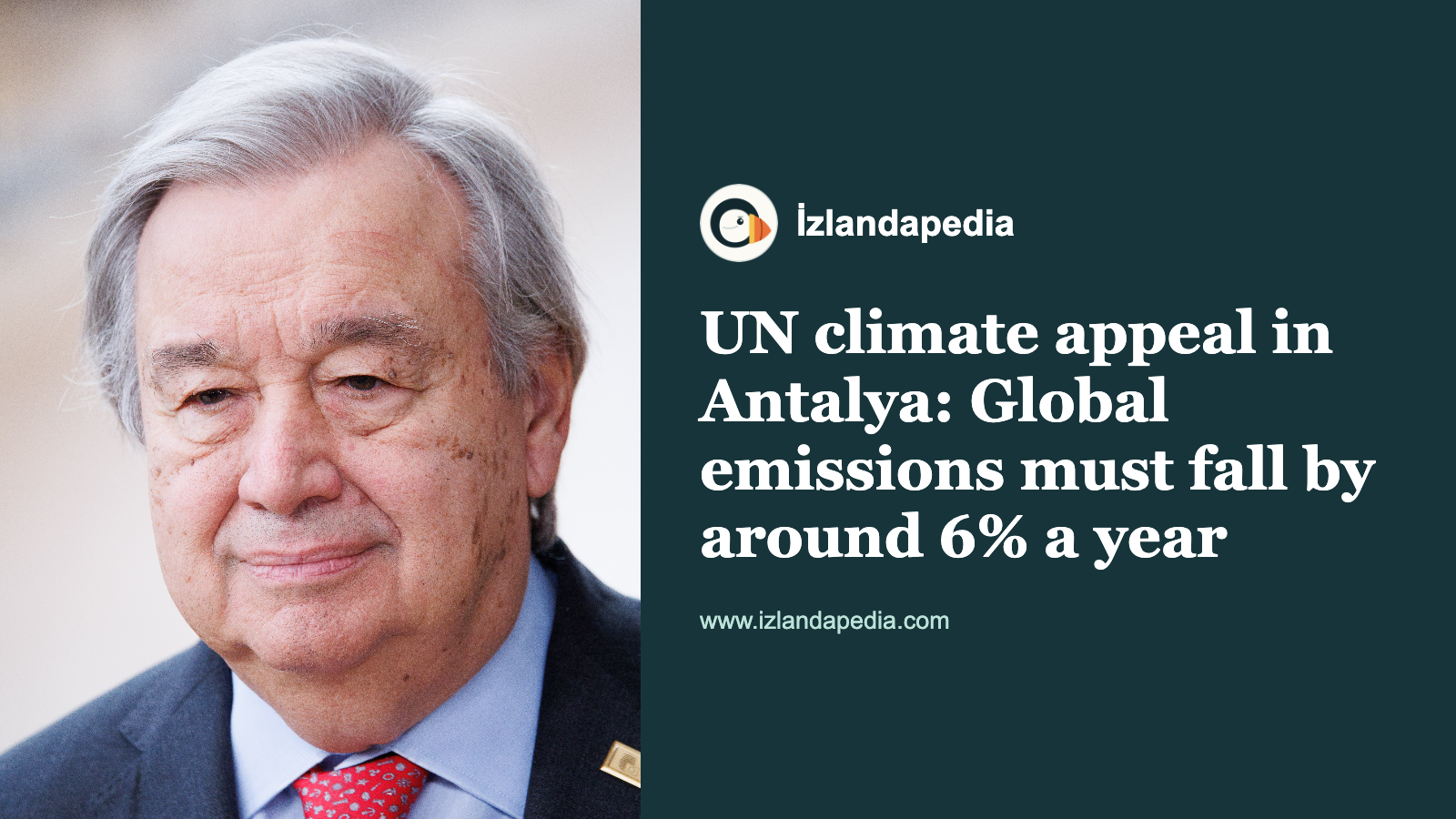
Archive photograph: Brussels, 23 March 2023. Not a photograph of the Antalya summit. European Commission / Christophe Licoppe · Wikimedia Commons · CC BY 4.0. Cropped; headline and logo added.

At his press conference on 13 November, Guterres said global emissions needed to fall by around 6% annually in the coming years. He urged a faster transition away from fossil fuels and towards renewable energy. The statement reported by Anadolu Agency is an appeal by the Secretary-General, rather than a new summit decision adopted by countries.
What does 6% mean?
Greenhouse gas emissions are releases of carbon dioxide and other gases into the atmosphere. Their accumulation warms the planet. The percentage refers to reducing total global emissions, rather than a household’s electricity use or a new identical quota for every country.
A simple calculation shows how annual reductions add up. If emissions start at 100 units and fall by 6% from the previous year’s level each year, they reach about 73.4 units after five years. This is an illustration of the percentage, not a forecast or a timetable agreed by governments.
Why does 1.5°C matter?
The figure describes long-term average global warming relative to pre-industrial levels, rather than tomorrow’s temperature in an individual city. The UN’s summit briefing stresses the need for faster action to limit both the size and duration of an overshoot.
Passing the threshold does not mean giving up on climate action. Every additional fraction of warming matters. The task remains to limit further warming and the damage associated with it.
An economic issue as well as an environmental one
According to the UN’s 13 November press briefing, Guterres also framed climate change as an economic challenge. Governments’ financial choices help determine whether they prepare for risks or end up paying for damage afterwards.
He also called for greater support to help developing countries adapt to climate change. Alongside the energy transition, the appeal concerns how to finance that transition and preparations for climate impacts.
Not a new agreement
COP31 is taking place in Antalya from 9 to 20 November. Guterres’s statement does not itself introduce a new tax, energy tariff or direct obligation for households in Türkiye or Iceland. Such measures would require separate decisions and national rules.