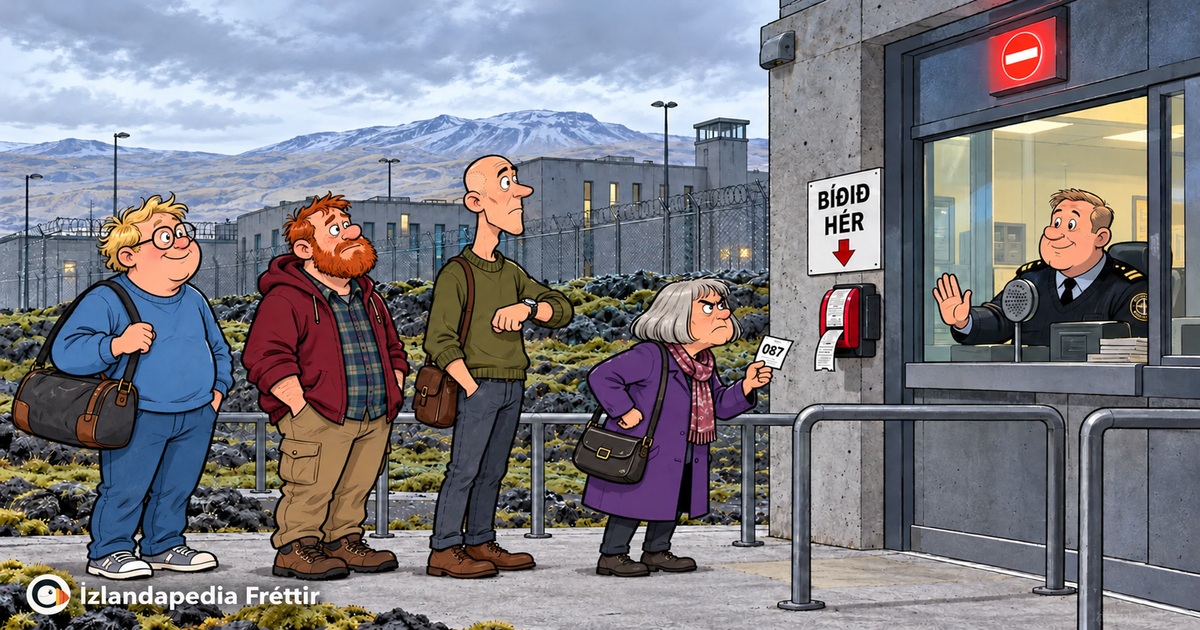
One box of wine, ISK 100,000
On 30 May 2024 a plain-clothes police officer ordered a three-litre box of Chardonnay from smarikid.is: ISK 6,898. The box was taken from a warehouse at Fellsmúli 24 in Reykjavík and handed to a Wolt courier. Two years later, on 8 April 2026, Reykjanes District Court convicted Smáríkið's manager Vilhjálmur Forberg Ólafsson over that single box: a fine of ISK 100,000, eight days in prison if unpaid, plus ISK 4.9 million in defence costs.
The penalty is small, the meaning is large. For the first time in a five-year dispute a court wrote that the arrangement was "beinlínis komið á til þess að komast fram hjá einkaleyfi ÁTVR", set up precisely to circumvent ÁTVR's monopoly. It added that it made no difference if members of parliament or ministers called the arrangement legal.
Smáríkið appealed and keeps selling. On 25 October it put Christmas beer on sale weeks ahead of ÁTVR; by its own account more than half of 20- to 34-year-olds in the capital area have registered as customers. That figure is the company's own, but there is no dispute that buying alcohol online has become ordinary in Iceland.
How the monopoly works
Iceland has had a state liquor store since 1922, a relic of prohibition. Beer itself was banned until 1 March 1989. Two acts form the backbone of today's rules:
- Alcohol Act no. 75/1998. Articles 3 and 4: a licence is required for import, wholesale and retail; without one it is a crime. Article 10: the retail licence belongs only to ÁTVR (Áfengis- og tóbaksverslun ríkisins), known to everyone as Vínbúðin. Article 27: the penalty is a fine or up to six years in prison.
- Act on trade in alcohol and tobacco no. 86/2011. Sets out ÁTVR's role and operating rules.
The monopoly has two exceptions, and both sit at the centre of the dispute. Since 2022 breweries and distilleries may sell their own products at the place of production (art. 6a). And Fríhöfnin at Keflavík Airport is the country's biggest liquor store: according to a 2020 reasoned opinion by the EFTA Surveillance Authority (ESA), about 14% of alcohol sold in Iceland was sold there, and the arrangement breached Article 16 of the EEA Agreement. The web shop owners now ask: if a private company can sell liquor at the airport, why not in Reykjanesbær?
The gap: "private import from a foreign shop"
When Iceland joined the European Economic Area (EEA) in 1995, ÁTVR's import monopoly was abolished and individuals were given the right to import alcohol from abroad for their own consumption. Article 3 of the act requires a licence for commercial import, not for private import. An Icelander can order wine from a German website, pay the duties and have it shipped; that has been legal for 30 years.
The web shops' structure rests on that one sentence. Santé's site is run by the French SanteWines SAS, while the Icelandic Sante ehf. imports the goods and holds them in a warehouse at Skeifan. Nýja vínbúðin sells through a British company. Smáríkið's site belongs to the Dutch Icelandic Trading Company b.v., its warehouse to the Icelandic Kjútís ehf. The customer buys "from a foreign seller"; the partner in Iceland delivers. To the sellers this is private import, only faster.
The prosecution's counter-argument fits in one sentence. Hildur Sunna Pálmadóttir, head of prosecutions at the capital-area police, put it this way in September 2025: the courts will answer "whether it is enough that the goods are bought from a company registered abroad, or whether the goods must be abroad when they are ordered". The Reykjanes court chose the second: neither of Smáríkið's companies exported anything from Iceland's customs territory between September 2023 and May 2024; most of the alcohol sold was produced in Iceland and never left it. Whatever it is called, the court said, that is domestic retail.
The government takes the same line. After the Federation of Trade and Services (SVÞ) complained to ESA in November 2025, ESA sent Iceland seven questions in March 2026. The Ministry of Finance's reply of 21 April 2026: a company that imports alcohol, stores it in Iceland and fulfils domestic orders is engaged in "domestic retail sale, not private importation"; the administration cannot approve an activity the law prohibits, that is for the legislature.
The players
| Shop | Launched | Structure | Status |
|---|---|---|---|
| Santé (sante.is) | May 2021 | SanteWines SAS (France) + Sante ehf.; warehouse and shop at Skeifan 8 | Owners Arnar Sigurðsson and Elías Blöndal Guðjónsson on trial since 2 September 2026 |
| Nýja vínbúðin | June 2021 | British company, delivery via Dropp | Pick-up point closed by police in December 2025 and January 2026 |
| Heimkaup | June 2022 | Home delivery through a foreign entity | Operating |
| Costco | 2023 | Online order, collection in store | Operating, no home delivery |
| Smáríkið | 2023 | ITC b.v. (Netherlands) + Kjútís ehf.; 7 pick-up points | Manager convicted 8 April 2026, appeal pending |
| Veigar (Hagkaup + Haga Wine) | 12 September 2024 | veigar.eu, collection at Skeifan, double electronic ID | Operating; the then finance minister called it "irresponsible" |
According to mbl.is, citing vinfinnur.is, there were 24 online alcohol shops in July 2026; all but Costco and Veigar deliver to the door.
Courts and prosecutors: five years of waiting, two cases
ÁTVR reported Santé to the police and the tax authority as early as July 2021, calling the arrangement "augljós málamyndagjörningur", an obvious sham. Then came a long silence. Justice minister Jón Gunnarsson told Alþingi in July 2022 that only two complaints had been filed between 2017 and 2022 and that investigating was the police's call.
In May 2024 the police carried out an inspection, as they do at bars, and bought wine from Smáríkið. The indictment came in summer 2025; prosecutors openly declared it a test case and said no further charges were coming. Nevertheless, on 19 June 2026 a second indictment was issued against Santé's owners: selling, on 14 August 2025, one bottle of Guelbenzu Vierlas 2020 for ISK 3,200 at the Skeifan shop and a twelve-pack of BolaX beer for ISK 5,810 through sante.is. A second count alleges money laundering, in the same amount as the sale itself: ISK 9,010.
Santé's owners pleaded not guilty at the first hearing on 2 September. The defence has three legs. First, a criminal provision must be clear: the Ministry of Justice's own 2024 draft states that "smásala" (retail) is not defined in the act and that "uncertainty about the legality of domestic web shops will persist". Second, the monopoly is already riddled with holes: dozens of breweries and a privately run airport store. Third, equal treatment: Elías Blöndal says he reported Heinemann, the airport store's operator, to the police for the same offence and that the complaint has gone nowhere.
What does Europe say?
Article 11 of the EEA Agreement protects the free movement of goods; Article 13 allows exceptions for public health; Article 16 permits state monopolies but forbids discrimination between domestic and imported goods. The Nordic monopolies (Systembolaget in Sweden, Alko in Finland, Vinmonopolet in Norway) live within that frame. Three rulings mark the boundaries:
- Rosengren (EU Court of Justice, 2007): Sweden's ban on individuals importing wine through an intermediary was held to breach free movement. That is where the right to private import took root.
- Visnapuu (EU Court of Justice, 2015): a seller shipping alcohol from Estonia to Finland may be required to hold a retail licence; public health can justify it. Finland's Supreme Court convicted the seller in 2018.
- Winefinder (Supreme Court of Sweden, 7 July 2023): a Danish site selling to Swedish customers and shipping with its own carrier was held lawful; the goods were in Denmark when ordered.
The last sentence is what sets the Icelandic case apart: in Winefinder the wine really crossed a border; in Smáríkið it never did. ÁTVR says the ruling is in line with the Swedish and Finnish precedents; the sellers point out that ESA's seven questions put Iceland's system itself under scrutiny. ESA's next step, closing the file or opening infringement proceedings, has not been announced.
Alþingi: two bills, a split coalition
Bill 1: abolish the monopoly (case 11). Hildur Sverrisdóttir of the Independence Party and 13 colleagues want to end ÁTVR's retail monopoly altogether and open sales to licensed private shops. The party has tabled the same bill five times since 2014; none ever reached a vote.
Bill 2: a licence for online sales (case 135). A 15-MP bill led by Pawel Bartoszek of Viðreisn and co-signed by Independence Party and Centre Party MPs leaves the monopoly in place but creates a "vefverslunarleyfi", an online sales licence. The text is almost identical to the draft the Ministry of Justice put out for consultation in September 2024. Its reasoning is striking: it is hard to find another example in Icelandic law where a consumer may buy a product from a foreign shop but not from a domestic one.
By Santé's MP-by-MP tally from July 2026, 35 of the 63 members support online sales, 18 are undecided and 10 are against. Support comes from every MP of the Independence Party, Viðreisn and the Centre Party. The other wing of the coalition is opposed: all ministers of the People's Party and health minister Alma Möller say no; from the Social Democrats only prime minister Kristrún Frostadóttir and Sigmundur Ernir Rúnarsson say yes. The numbers show a majority, but coalition discipline makes it hard to bring the bill to the floor.
The other side is not silent either. Kári Stefánsson, former head of deCODE, attacked Viðreisn in Morgunblaðið in July: unlawful online sales, he wrote, are "courtesy of the government, and the justice minister in particular". IOGT and parents' associations welcomed the Smáríkið ruling with the word "finally". Alcohol legislation has sat with finance minister Daði Már Kristófersson (Viðreisn) since 2025; in its reply to ESA the ministry passed the ball to Alþingi.
What the numbers say
Figures ÁTVR compiled for Morgunblaðið show Vínbúðin's January–September sales falling from 17.7 million litres in 2023 to 16.9 million in 2024, 15.9 million in 2025 and 14.7 million in 2026: a 17% drop in three years, 7.6% in the last year alone. How much of that is the web shops and how much changing drinking habits, nobody has measured. Santé says about 90,000 people buy alcohol online; Smáríkið speaks of "tens of thousands" of customers. There is no independent market measurement.
Seen from Türkiye
Türkiye lived the state monopoly story in reverse: Tekel was privatised in 2004 and retail is free, but a 2013 law (no. 6487) banned online alcohol sales outright. Iceland is the mirror image: retail belongs to the state, the internet is open to foreign sellers. What the two countries share is a law that fell behind technology and a fight that moved to the courts.
What happens next
- Landsréttur. The Smáríkið appeal is the test case; prosecutors have tied their decisions on other shops to it. No date yet.
- The Santé trial. Ongoing at Reykjavík District Court; the money-laundering count stands or falls with the main charge.
- Alþingi. Cases 11 and 135 are at committee stage; the coalition is split.
- ESA. Iceland's reply of 21 April is under review; infringement proceedings could end up at the EFTA Court.
- Christmas. ÁTVR's biggest selling months; the web shops started early this year.
Small glossary
- ÁTVR / Vínbúðin: the state alcohol and tobacco company and its retail chain.
- Einkaleyfi: exclusive right, monopoly.
- Smásala / heildsöla: retail / wholesale.
- EEA (EES): the European Economic Area (EU plus Iceland, Norway, Liechtenstein).
- ESA: the EFTA Surveillance Authority, which polices EEA rules in Iceland.
- Héraðsdómur / Landsréttur / Hæstiréttur: district court / court of appeal / Supreme Court.
Frequently asked questions
Is it a crime to buy alcohol online in Iceland?
No; the law penalises selling, not buying. Both cases so far are against sellers. Ordering from a site abroad for your own use and paying the duties has been legal since 1995.
Are the web shops legal or not?
There is one first-instance ruling and it says no; the appeal is pending. The government and ÁTVR say illegal, the sellers and 35 MPs say legal or should be made legal. The definitive answer will come from Landsréttur or from a new law.
Why prosecute over one bottle of wine?
Prosecutors pick a single sale to test the principle; the case stays simple and the outcome can be applied to every shop.
Why can breweries sell?
Article 6a, added in 2022, allows producers to sell at the place of production, to support small breweries. The web shops cite it as proof that the monopoly is already breached.
What changes if the law passes?
If the Viðreisn bill (case 135) passes, online sales become legal under a district commissioner's licence, with rules on age checks and delivery hours; ÁTVR's stores remain. If the Independence Party bill (case 11) passes, the monopoly ends and supermarkets can sell too.
Sources
- Vísir – Fyrirkomulagið beinlínis til að komast fram hjá lögum (dómur Héraðsdóms Reykjaness, 9.4.2026)
- Vísir – Áfrýja og segja dóminn ekki skýra viðvarandi óvissu (9.4.2026)
- Heimildin – Áfengisflétta Smáríkisins: Vínið keypt á Íslandi og aldrei flutt úr landi (17.4.2026)
- Heimildin – Ríkið telur áfengisdóm samhljóma sænskum og finnskum fordæmum (10.4.2026)
- mbl.is – Eigendur Santé ákærðir fyrir brot á áfengislögum (13.8.2026)
- mbl.is – Ætla að taka til varna: Einkaleyfi ÁTVR gatslitið (13.8.2026)
- mbl.is – Engar frekari ákærur á leiðinni (3.9.2025)
- mbl.is – 24 netverslanir með áfengi starfandi hér á landi (15.7.2026)
- mbl.is – Meirihluti þingmanna vill netverslun með áfengi (15.7.2026)
- mbl.is – Netverslun með áfengi í boði ráðherra (Kári Stefánsson, 18.7.2026)
- mbl.is – Samdráttur í sölu hjá Vínbúðunum (19.10.2026)
- mbl.is – Smáríkið „þjófstartar“ jólabjórvertíðinni (25.10.2026)
- mbl.is – Ætla að leita til dómstóla vegna aðgerða lögreglu (4.1.2026)
- mbl.is – Áfengissala netverslana aðeins kærð tvisvar (1.7.2022)
- Vísir – ÁTVR kærir Arnar til lögreglu og skattayfirvalda (16.7.2021)
- Vísir – Nýja vínbúðin fer í samkeppni við ÁTVR (2.7.2021)
- Vísir – Hagkaup hefur áfengissölu í dag (12.9.2024)
- Alþingi – 11. mál 158. þings: verslun með áfengi og tóbak o.fl. (smásala áfengis), þskj. 11
- Alþingi – 135. mál 158. þings: áfengislög (vefverslun með áfengi), þskj. 135
- Alþingi – Áfengislög nr. 75/1998 (lagasafn): 3., 4., 10. og 27. gr.
- ESA – Reasoned opinion, Fríhöfnin's retail sale of alcohol at Keflavík airport, Article 16 EEA (22.4.2020)
- Nordic Alcohol Policy Network – Icelandic government confirms online sales from domestic warehouses are not private importation (19.5.2026)
- Sveriges riksdag – Interpellation 2023/24:727 um Winefinder-dóm Hæstaréttar Svíþjóðar
- Wikimedia Commons – Vinbudin.JPG (kapak fotoğrafı / cover photo), Danninja, CC BY-SA 3.0
Spotted a mistake? info@izlandapedia.com · Instagram @izlandapedia