From opinion polls to the final result
This report first appeared before polling day and analysed the surveys and campaign. The headline, results and introduction were updated on 4 September 2026 when the official final total became available. The earlier analysis remains below as historical context.
The story in easy Icelandic
Nei fékk 52,8 prósent og já fékk 47,2 prósent. Ísland hefur því hafnað því að hefja aðildarviðræður við Evrópusambandið að nýju.
Learn with this story · Bu haberle öğren
Learn with this story
Listen to four short sentences, read their English and Turkish meanings, and practise expressions you can use again.
Loading recorded Icelandic audio…
- Þjóðaratkvæðagreiðslan fer fram tuttugasta og níunda ágúst, árið tvö þúsund tuttugu og sex.The referendum takes place on 29 August 2026.Referandum 29 Ağustos 2026'da yapılacak.þjóðaratkvæðagreiðslan · the referendum · referandumfer fram · takes place · yapılırtuttugasta og níunda ágúst · 29 August · 29 Ağustos
- Kosið er um hvort hefja eigi aðildarviðræður að nýju.The vote asks whether accession talks should restart.Oylama, katılım müzakerelerinin yeniden başlatılıp başlatılmamasını soruyor.kosið er um · the vote is about · oylamanın konusuhvort · whether · olup olmadığıað nýju · again · yeniden
- Ekki er kosið beint um inngöngu í ESB.The vote is not directly about joining the EU.Oylama doğrudan Avrupa Birliği'ne katılım hakkında değildir.ekki · not · değilbeint · directly · doğrudaninngöngu · joining / entry · katılım / giriş
- Ef samningur næst verður kosið aftur.If an agreement is reached, there will be another vote.Bir anlaşmaya varılırsa yeniden oylama yapılacak.ef · if · eğersamningur næst · an agreement is reached · anlaşmaya varılırverður kosið aftur · another vote follows · yeniden oylama yapılır
Archive: polls and analysis before the 29 August 2026 referendum — the final result is above
The sixty-second overview
No won with 52.8%, against 47.2% for Yes. Turnout was 82.6%.
- No: 118,040 votes.
- Yes: 105,339 votes.
- Counting is complete in every constituency.
- The vote concerned talks, not direct membership.
Who is ahead? The honest answer: we do not know yet
In Gallup’s Þjóðarpúls survey, conducted on 24–27 August, 51.6% of respondents expressing a preference opposed restarting talks and 48.4% supported it. Gallup reported a margin of error of ±2.4 percentage points and explicitly said the difference was not statistically significant.
That does not mean No was not ahead in this particular measurement. It means the gap was small enough for another survey, using a different sample, to show the reverse order. The latest percentage is a measurement, not a count of ballot papers.
Maskína’s 21–25 August survey showed precisely that reverse picture: 51.3% of the 898 people expressing a preference said Yes, and 48.7% said No. Among all 1,019 participants, 8.5% did not know and 3.4% did not want to answer.
The balance tips slightly in opposite directions depending on the survey. That signals uncertainty; it does not prove that one poll is wrong.
Why do the polls point in opposite directions?
| Poll | Fieldwork | Sample and method | Yes | No | How to interpret it |
|---|---|---|---|---|---|
| Gallup | 24–27 August | Sample of 4,583; online and telephone; 39.1% response rate | 48.4% | 51.6% | ±2.4 percentage points; difference not significant |
| Maskína | 21–25 August | 1,019 participants; 898 expressed a preference; online panel randomly sampled from the population register | 51.3% | 48.7% | A small gap is not a secure lead |
| Gallup earlier in August | 1–13 August | Gallup Þjóðarpúls | 51.5% | 48.5% | This difference was also not significant |
Different results do not automatically mean one company made a mistake. The gap is small, the fieldwork dates do not fully overlap, and the methods differ. Gallup combines online and telephone interviews; Maskína uses an online panel. Both weight their results to reflect the population.
Timing matters too. The final debates, news and campaigning may move people who are undecided or only leaning towards an option. Rounding can also change the last decimal place. Gallup’s detailed breakdown put definite Yes at 41%, probable Yes at 8%, probable No at 7% and definite No at 45%.
Three signals shared by both polls
1. The youngest group is not automatically pro-EU
In Gallup, 60% of 18–29-year-olds said No. In Maskína, No stood at 51.2% in the same age group. These measurements do not support the assumption that the youngest generation automatically wants closer EU ties. Whether this is a lasting generational pattern or a response to the final campaign stretch will only become clear later.
2. Reykjavík and the regions see the issue differently
Gallup measured Yes at 55% in the capital area but only 37% outside it. Maskína put Yes at 61% in Reykjavík, while No was clearly stronger in West Iceland and the Westfjords, North Iceland and East Iceland. Economic geography may matter: services, universities and international jobs feature prominently in the capital, while fishing, agriculture and resource management are more visible in many regional areas. This interprets the pattern; it does not describe every voter’s reasoning.
3. Higher educational attainment is associated with more Yes support
In Gallup, 57% of university graduates said Yes, compared with 43% of those with basic education. Maskína’s corresponding figures were 60.1% and 38.9%. This is one of the clearest shared patterns. It should not be read as a simple causal relationship: age, income, occupation, residence and party loyalty are all associated with education.
What exactly is on the ballot?
The official question is:„Á Ísland að hefja á ný aðildarviðræður við Evrópusambandið?“The options areYesandNo.
The most important word isaccession negotiations. Iceland applied for membership in 2009 and talks stopped in 2013. The 29 August vote is not about accepting an existing accession treaty, adopting the euro or transferring powers that day. Voters are saying whether they want the negotiating process to restart.
If new talks later produce an agreement, the government has promised to put that actual agreement to another referendum. Voters would then have the final say on membership itself.
The official announcement describes the referendum as advisory. Formal constitutional responsibility rests with Alþingi, but the prime minister and government said the outcome would be politically binding for the next steps.
What happens if Yes wins?
If Yes receives more votes, the expectation is that Alþingi’s Foreign Affairs Committee considers the issue, the European Union is notified and a negotiating team is appointed for Iceland. Individual chapters of possible membership would then have to be negotiated.
The foreign minister suggested the process could take around one and a half to two years. That is an estimate, not a guaranteed timetable. The EU’s position, domestic politics and difficult issues such as fisheries and agriculture could extend or change it.
Yes therefore means:put the terms on the table, then vote on them later.It does not mean Iceland becomes a member the next day or that the outcome of negotiations is predetermined.
What happens if No wins?
If No wins, the talks do not restart on the basis of this vote. The Foreign Affairs Committee would still consider the matter, and Alþingi would have to discuss whether Iceland’s earlier application should be formally withdrawn.
The current government said it would not reopen the accession issue during this parliamentary term if No won. Political debate may of course return later, but the result would close this particular route.
Iceland’s everyday cooperation with Europe continues: it remains in the EEA and Schengen, uses the króna and belongs to NATO. None of that automatically ends on polling day.
The campaign’s two competing stories
The Yes side’s arguments
“Let us see the terms before deciding on membership.”
- Talks would let Iceland discover what is actually on offer.
- More influence over European rules Iceland already adopts through the EEA.
- Economic and geographical security within a larger partnership.
- The euro option would be assessed only after an agreement.
The No side’s arguments
“The talks aim at membership, and the risk is real.”
- Sovereignty and legislative power could move further from voters.
- Fisheries, quotas, agriculture and resources should remain under Icelandic control.
- The króna provides independent monetary policy despite its fluctuations.
- NATO, the defence agreement with the United States and the EEA already provide security and market access.
In RÚV’s 27 August debate, Yes campaigners said sitting down to negotiate was not the same as agreeing to join. No campaigners emphasised that accession was the purpose of the talks and that fisheries, sovereignty and existing security arrangements should not become an experiment. These are campaign arguments. Specific exemptions or the economic outcome cannot be known before negotiations.
What changes immediately for people living in Iceland?
The short answer is:no permit system changes the morning after the vote.
- Residence and work permits continue under the same rules.
- The króna does not become the euro overnight.
- Taxes, interest rates and social rights do not automatically change because of the referendum.
- Voting is open to those who meet the rules for national elections. Most people without Icelandic citizenship therefore cannot vote in this referendum.
Long-term effects arise only if the entire sequence happens: a Yes victory, negotiations, an acceptable agreement and then a separate decision on membership.
The final 24 hours: an information-integrity warning
Persónuvernd, the Media Commission, the Electronic Communications Office, the National Electoral Commission, the National Commissioner of Police and CERT-IS jointly urged people to examine information’s origin before sharing it. Particular care is needed with misleading, decontextualised or deliberately manipulative material.
The same rule applies to polls. Taking one percentage out of context and declaring the result settled goes beyond what the data support. Ask: when was the poll conducted, how large was the sample, what was the margin of error, and how many people were undecided?
İzlandapedia’s assessment
The right headline is neither “No has won” nor “Yes has taken the lead”. The right headline is thatIceland goes to the polls with two almost evenly balanced sides.
Gallup puts No slightly ahead; Maskína put Yes slightly ahead. Both suggest most people have made up their minds, but neither provides a sound basis for declaring a winner. The distinction between measurement and result matters most when figures are this close.
The final word comes not from a poll but from counting the votes on the evening of 29 August.
Sources and method
- Gallup — ESB aðildarviðræður: Þjóðaratkvæðagreiðsla
- Gallup — detailed survey report, 24–27 August 2026
- Maskína — Mjótt á munum í afstöðu almennings
- Maskína — detailed survey report, 21–25 August 2026
- National Electoral Commission — official referendum notice
- Alþingi — referendum resolution and ballot question
- Alþingi — Prime Minister Kristrún Frostadóttir on the process
- RÚV — what happens after a Yes or No result?
- RÚV — final debate between the two sides
- Public authorities — information-integrity warning
Polls capture views on particular days; they are not forecasts with guaranteed outcomes. Data and links checked on 28 August 2026.
Election-night archive · 30 August 2026, 03:05 UTC — not the final result
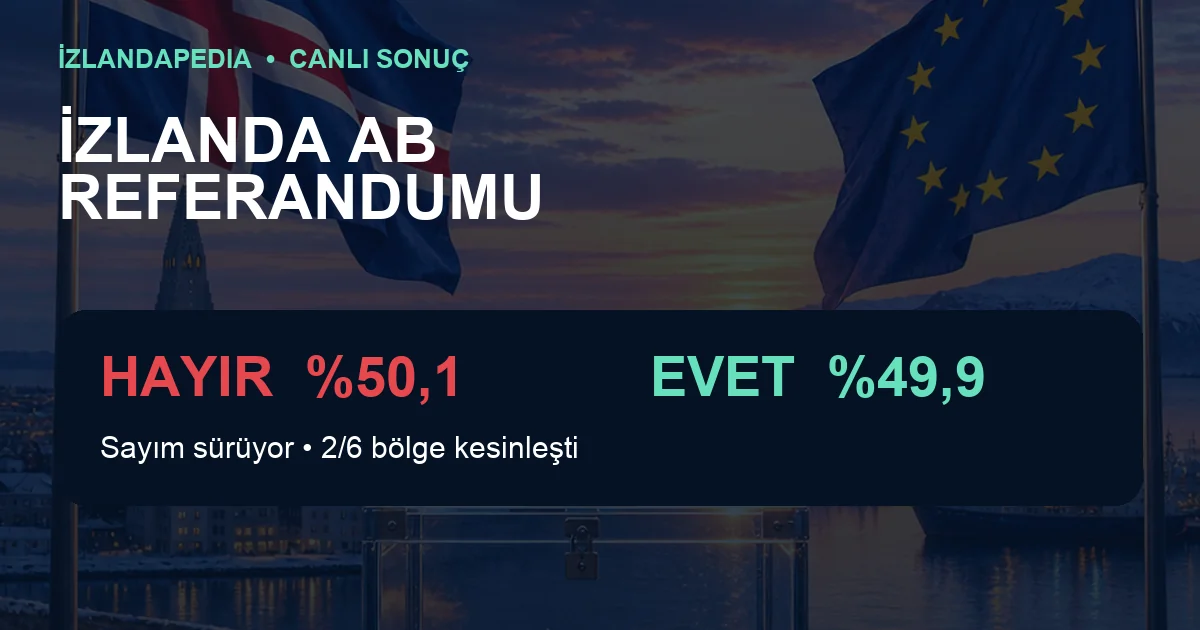
Election-night interim count
National total at 03:05: No 50.1% — 76,339 votes; Yes 49.9% — 75,904 votes. Final results had been declared in two of six constituencies.
RÚV’s election-night assessment said the four constituencies with uncounted votes leaned towards No; a very strong movement in the opposite direction would be needed to change the outcome. These were nevertheless not the official final national totals.
The vote concerned restarting accession negotiations, not joining the EU directly. The result was legally advisory; the government said it would implement the public’s decision. Yes led in Reykjavík’s two constituencies and No in the regional counts reported. EEA participation, Schengen, the króna and residence and work-permit arrangements did not change immediately.
Why was this not called a final result on election night?
At 03:05, mbl.is’s results table showed 153,197 counted votes. Reykjavík North and Reykjavík South were complete; counting continued in Southwest, South, Northeast and Northwest. The headline therefore described both the direction of the count and its provisional status instead of declaring a winner.
No’s national lead of 435 votes was small, but the existing distribution in the remaining constituencies favoured No. This was a strong election-night projection, not an official final result.
Did you understand the story?
What is being decided in the referendum on 29 August?